|
|
This topic comprises 6 pages: 1 2 3 4 5 6
|
|
Author
|
Topic: Anyone ever seen a XeTron Loop-Matic?
|
John Walsh
Film God

Posts: 2490
From: Connecticut, USA, Earth, Milky Way
Registered: Oct 1999
|
 posted 05-24-2000 10:46 PM


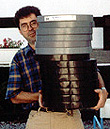
The article was really about the "Photokina" trade show in Cologne in 1976. The other figures (Fig. 1-9) show other equipment exhibited there- there are no more pictures relating to the "Loop-Matic."The description is as follows: <Note: Copied from the Journal of the Society of Motion Picture and Television Engineers- Vol. 85, No. 12 (Dec. 1976) pp. 895> "Long-Run Projection All 35mm theater projectors at Photokina show the demand for long-running program presentation and all accomodate spools of at least 2000-m (6500-ft) capacity. Some, like the Ernemann 12, can take 4000-m (13,000-ft) spools with both feed and take-up set below the main projector body, but in most cases spools larger than about 2700 m (8860 ft) are handled by separate freestanding units. The long-play "tower," with a pair of large reels having separate take-up drive and tension control, usually takes up to 4000-m (13,000-ft) spools; units of this type are offered by Ernemann, Hasso, Wassermann (Madrid) and Weston. The Weston 5035 assembly is double-sided and mounted on a turntable, so that one 2 1/2-h program can be assembled or rewound while the other is being projected. For even longer lengths the horizontal turntable system which avoids rewinding ("platter" or "cakestand") was shown in its freestanding form as the Christie Autowind, the Zeiss Ikon Ernowind, and the Philips Kinoton Disc. A four-plate version was shown by both Christie and Philips for feeding two projectors simultaneously where one projection box serves two auditoria in a twinned theater. A horizontal feed and take-up system for up to 6000 m (20,000 ft) but requiring rewinding between showing is available as part of the Bauer U6 projector (Fig. 9). All these long-run facilities have been in use for several years but a significantly new approach was provided by the Loopmatic system (Fig. 10) manufactured by Famco AG of Vaduz, Leichtenstein (represented in the U.S. by Carbon Inc. of Cedar Knolls, New Jersey). This accommodates up to 18,500 ft (5640 m) of 35mm film as an endless loop, so that uninterrupted presentation is possible for as long as is required. The principle is known as bi-filar winding, the looped film being wound as a double-layer spiral on one spool. When feeding off, one of the two strands passes to the projector while the other goes to a take-up reel, where it is similarly wound as a double layer with the strand coming from the projector (Fig. 11). When the first spool is empty, half-way through the loop length, the second spool becomes the feed and the first the take-up, the changeover from one to the other, the re-formation of the double path and the reversal of the direction of rotation all being completely automatic. Monkey elevators before and after the projector function during the brief period while moving arms transfer the take-up and allow continuous projection at all times. A prototype bi-filar system for a similar purpose was also being demonstrated at Photokina by the projector manufacturer Auvitel of Boulogne."
|
|
|
|
|
|
|
|
|
|
Tim Reed
Better Projection Pays

Posts: 5246
From: Northampton, PA
Registered: Sep 1999
|
posted 05-25-2000 12:30 PM

Steve: what I've gathered over the years of being a fan of this contraption, is each space in the hubs of the reels, is a rather large opening. There are two arms in the center of the frame, one is a roller, and the other is an arm with a protruding pin. Somehow, the roller arm drops (or rises, as the case may be) and the pin-arm follows, to shove the end of the film/loop into one of the hub openings. As the reel winds back on itself, it is held in place.At least, that's what I've deduced over the years. I'd purely LOVE to see one in operation. I remember reading an old BOXOFFICE article about a trade show demo. They said you could hear everyone holding their collective breath, as the reels came to a stop, the film transferred, and the reels reversed direction; all the while the projector cranked away. It was an amusing read. It would indeed be a hoot to see this occur. ------------------
Better Projection Pays!
|
|
John Walsh
Film God
Posts: 2490
From: Connecticut, USA, Earth, Milky Way
Registered: Oct 1999
|
posted 05-25-2000 03:01 PM
Nuemade bought Xetron, and moved to Newtown, CT. which is about 10 min. away from where I work. I would call them and ask if they had more pictures, or a copy of the Loop-Matic instruction manual, etc., but I am reluctant. I've called four times for an instruction manual for a rewind table they currently make, and while everyone there is "happy-happy-joy-joy" no manual is ever sent. A few key people left there and started Big-Sky, and now I think Nuemade/Xetron is in some kind of disarray. Too bad, because I think they make good stuff.They probably don't even have a copy of it anymore.
|
|
|
|
John Pytlak
Film God

Posts: 9987
From: Rochester, NY 14650-1922
Registered: Jan 2000
|
posted 05-26-2000 05:25 AM
Steve:
Unlikely to have a special film stock made, as Kodak color print film is coated in wide rolls, and slit to 38 35mm strips. So it's all the same thickness across the strips. But could you consider coating a narrow strip of material (e.g., 3M Scotchgard Film Protector, AKA "PhotoGard") along the edges after processing?Continuous loop platters are often problematic, especially when the temperature and humidity can't be controlled precisely. ------------------
John P. Pytlak, Senior Technical Specialist
Worldwide Technical Services, Entertainment Imaging
Eastman Kodak Company
Research Labs, Building 69, Room 7419
Rochester, New York, 14650-1922 USA
Tel: 716-477-5325 Fax: 716-722-7243
E-Mail: john.pytlak@kodak.com
|
|
|
|
John Pytlak
Film God
Posts: 9987
From: Rochester, NY 14650-1922
Registered: Jan 2000
|
posted 05-26-2000 11:48 AM
The Technicolor Super-8 cartridge projector (e.g., the one used by TransCom on airplanes in the 1970's) used a special film lubricant on the continuous loop to allow the film to slide with minimal friction and scratching. The lube was called "VYDAX", and was evidently tiny spherical beads of TEFLON applied to the film using a solvent. The VYDAX acted as tiny "ball bearings" to lubricate the print.IMHO, that cumbersome system seemed to be more reliable than some of the video systems now in use on planes, and could give much better image quality using a Super-8 feature-length print with dye track optical sound. BTW, does anyone recall the early days of "InFlight" motion pictures, where a single polyester 16mm print was strung through multiple projectors over the length of a Boeing 707 cabin? And you had to choose the correct audio channel that was in sync with the projector you were watching? ------------------
John P. Pytlak, Senior Technical Specialist
Worldwide Technical Services, Entertainment Imaging
Eastman Kodak Company
Research Labs, Building 69, Room 7419
Rochester, New York, 14650-1922 USA
Tel: 716-477-5325 Fax: 716-722-7243
E-Mail: john.pytlak@kodak.com
|
|
|
|
|
|
|
|
Steve Kraus
Film God

Posts: 4094
From: Chicago, IL, USA
Registered: May 2000
|
posted 05-26-2000 06:13 PM
For many years Chicago's Museum of Science and Industry's Sears Circus Exhibit (gone now) ran a film whose soundtrack (and some effects cues) ran as a 35mm fullcoat loop up and down several dozen rollers. But the picture? That was 16mm looped in one of those glorified 8-track gizmos that sits atop the projector. But the kicker was that the format was a triple height 16mm frame reduced from a vertically oriented 65mm negative (it was in American Cinematographer years back). The projector was a Century modified with special sprockets, pads, gate and trap. Triple frame 16mm has a frame height that is in the general ballpark of 4-perf 35mm so sprocket diameter isn't too oddball. Mark G. did repairs on this setup. As I recall there was a second such machine (later canibalized to keep Sears going) but it ran a conventional widescreen film (about farming) so they had a Perchan (sp?) prism to turn the image 90 degrees. In my opinion the image quality was poor and they would have been better off converting to normal 35mm albeit with a vertical Scope orientation (slightly masked at the sides). They could have run that over rollers just like the track. Only problem was the 65mm negative was AWOL and all they had were the 16mm reduction materials.
|
|
|
|
All times are Central (GMT -6:00)
|
This topic comprises 6 pages: 1 2 3 4 5 6
|
Powered by Infopop Corporation
UBB.classicTM
6.3.1.2
The Film-Tech Forums are designed for various members related to the cinema industry to express their opinions, viewpoints and testimonials on various products, services and events based upon speculation, personal knowledge and factual information through use, therefore all views represented here allow no liability upon the publishers of this web site and the owners of said views assume no liability for any ill will resulting from these postings. The posts made here are for educational as well as entertainment purposes and as such anyone viewing this portion of the website must accept these views as statements of the author of that opinion
and agrees to release the authors from any and all liability.
|

 Home
Home







 Printer-friendly view of this topic