|
|
This topic comprises 3 pages: 1 2 3
|
|
Author
|
Topic: Christies Rant
|
Jason Burroughs
Jedi Master Film Handler

Posts: 654
From: Allen, TX
Registered: Jun 99
|
 posted 06-16-2000 11:07 AM


Ethan, its strange you complain of flicker using Christie bulbs in the CFS lamphouses. When I was at the Hollywood USA previously to moving the the Tinseltown in Plano when it opened. We used Christies exclusivly at the Hollywood. We got better light, longer bulb life, and far less problems than with any other manufacturer, We once had ORC rammed down our throats and quickly decided than an old Christie bulb was better than a new ORC. When I moved to the Tinseltown we were using ORC bulbs and were experiencing bulb life problems particularly in the larger auditoriums, as well as low light output. I asked that we try a Christie bulb and we tried it in #13, the output was far better and had a much bluer (less infared ) light than the ORC, and it worked well, as well as far exceeding the lifespan of the equivilent ORC bulbs. If I remember right the Christie bulb we got was only 6000watts to replace a 7000 watt ORC (christie providing more light) of course properly adjusting the powersupply for rated bulb power. (By the way on #12 we had an average bulb life of about 56hours untill we got CFS to come out and look at it, after that we got about 600hrs but still not good.)On the Strong Highlight I's You should be able to get plent of light out of them, but they are difficult to align well, they were pretty notorious for that. Hoewever they still don't compare to the Christie SLC consoe for light output. I too have always prefered the Century projector, after working with Christie, Simplex and Cinemacanica, I found them the easiest to maintain, and operate. And the projected image was far steadier than any of them. My favorite is still the JJ.
| IP: Logged
|
|
|
|
|
|
|
|
|
|
|
|
|
|
Steve Guttag
We forgot the crackers Gromit!!!

Posts: 12814
From: Annapolis, MD
Registered: Dec 1999
|
posted 06-17-2000 08:32 AM
There are definately good and bad things with any platter, Christie included. Of the ones I have personally projected with, I would Xetron's at the bottom (circa 1990), including it's various payout modifications).
To give you an idea of the Xetron design, the payout feed-finger spindle runs in just one bearing (ball) and at an angle to top it off! You don't have to have a degree in engineering to know that just isn't good design practice. A ball bearing just isn't designed for that sort of loading. Naturally, the spindle is free to rock within the bearing (actually the inner race of the bearing is rocking) and it gets more sloppy with time.I have my least troubles with the SPECO LP-270. I have worked with Christie's AW-1, AW-2 and AW-3 (plus the AW-35 and AW-370 varients). There are a lot of strengths in it. The concept that each platter is independent on all modes is it's biggest sell point for me. LED/Cell drift it probably the biggest continual attention (and it appears that problem is soloved with the new LED modules and driver boards). Generally, when a Christie comes out of time, resetting the LED adjustment will put it back without having to mess with the motor speed controls, though I find most techs go for the motor speeds prior to checking the LEDs. I often find that the payout arm return spring is set too high from the factory causing the film to wrap a little since it can't pull the arm over. The early black rollers couldn't turn true to save their lives. I have always used the clutch spring (when I was the operator) on the payout cluster but change it's tension depending on platter distance to projector. I can certainly understand, however yanking them when they can't be given regular attention. The feed fingers have always been a sore spot for me, particularly with 70mm. The hour-glass design can and has allowed the film's image are to rub and get "angel scratches", depending on how long the film has been running, how much heat is absorbed, how much curl is in the film...etc. The old guide posts on the dust plate certainly would rub the middle of the picture. The bearings on the platter should have been rethought. The needle bearings are a great idea for where the platter rests, but the bronze bearings for the platter rotation suck. There is no method of lubricating them once assembled without removing the deck. Many times I have had the top bearing drop down and cause the platter to rock. They would have been better off using sealed ball bearings for platter rotation and kept the needle bearings under the deck. The little ballpoint pen spring in the take up arm mech. is a bit fragile and often gets deformed quickly depending on the quality of operators (if they let the t-u arm pull back to the vert. post they will die. The T-U roller custer stop pins often die a horrible death at the heavy hands of poorer operators too. Probably one of the biggest design flaws is the lack of fuse/circuit breaker in the system (and they got UL listing with this?). Sure, the current motor cards have fuses but I mean for the platter as a whole, and who hasn't gotten shocked when pulling a motor card with the power turned OFF? The lights should really have been fused from day-one. I have had several entire platter systems fail because the little 1822 lamps (that light the decks) short out and take the step down transformer out. More than once I have put double fuses on that line (one on each leg of the secondary that feeds the lights), particularly on the 5-deck platters since two screens are at stake (and because of Murphy, that is the most common place I have had this sort of difficulty). There, now I have picked on the beloved AW-3. ;-) As an operator I had no problems whatsoever running them (other than the feed finger issue listed above). Never lost a show with them, built up and broke down faster and smoother than any platter too. They don't have support ribs below the deck surface to create little wind storms (or catch your finger). Their current rollers turn true and don't chatter and would be welcomed in any booth I operated (that had platters that is). Then again, I would take Christie's, Strong SCDC (a jewel of a platter, fastest install and no maintenence), Kinoton (if you can afford it, probably the best platter) or the SPECO offerings. I generally find that once you reach a certain level of quality in a product (the thing HAS to be at least reliable, and not out and out damage film as a course of operation) that a good operator can make ANY of the products run well. Steve ------------------
"Old projectionists never die, they just changeover!"
| IP: Logged
|
|
|
|
Brad Miller
Administrator

Posts: 17775
From: Plano, TX (36.2 miles NW of Rockwall)
Registered: May 99
|
posted 06-17-2000 04:39 PM

Since we're ranting, allow me to come back against some of Steve' comments.First, yes I always turn the power button off before I go pulling cards, but I've never been shocked. I do agree, a fuse is a very good idea though. Now back to my favorite topic...the leds! Three to four weeks ago I timed every platter in the building personally. That being said, last week I had to retime two decks, as they were running more than 10RPM faster than I had set them. Yes, I always check the led first (very important to make sure the thing is going to run "sluggish" so it won't toss a print) and it was absolutely dead perfect on one platter, so the card had to be adjusted. On the second platter, the led was way off and readjusting that put the machine back into time. Generally though, I do find that the led drifts very bad. Beware of the clearance on that takeup arm "finger"! I have discovered it can catch on "the other finger" on the filter at it's edge and cause the feed arm to slam hard from -10% to it's limit, causing the takeup arm to perform complete stop/starts! Very, VERY bad for a long movie such as Gladiator. This is of course easily remedied, but beware as some machines are coming off the assembly line like this. We have also found the Christie center rings to be, well, a bit weak as of late. Dwayne broke one of these things in half pulling it from a print a few weeks back! (Joe, you got a pic of that?) But the biggest problem we're finding is upon breakdown the ring will "collapse" slightly and cinch scratch the trailers and first reel of the feature as it is being broken down!!! Our temporary solution has been to stick one of those soft plastic DTS cd cases in the opening and it works quite well. Supposedly Christie has made some sort of latch for this, but we haven't received it yet. I also don't like their new horizontal MUTs one single bit. If the traditional MUT has been discontinued completely, I will no longer push their platters. Otherwise, for the performance vs. dollars, the AW3 series cannot be beat! Before I finish, I might note that until I started to work with Joe's AW3s that none of these problems have ever been an issue before. I too think he has either gotten "special" platters or quality control has gone down the toilet. These things are requiring monthly calibration and his complaints are valid. Still though, I don't like the Xetron, Strong or late model SPECO platters and the Kinotons are too expensive.
| IP: Logged
|
|
Steve Guttag
We forgot the crackers Gromit!!!
Posts: 12814
From: Annapolis, MD
Registered: Dec 1999
|
posted 06-17-2000 05:50 PM
Joe,"I" have never lost a show due to having a transformer melt down while I was operating them since I have personally never had one melt down. But I do work for a service company now and in that relationship, I have had the transformer go as well as known of other transformers going while working for various exhibitors. Brad. What comeback? That you had an instance where it was indeed the motor card causing the speed drift instead of the LED/sensor? I merely said that one should check the LED settings first and that most techs reset the motors first. The rest of your comments seem to be adding to the list of complaints on the AW-3. There is no doubt that one could pick apart any platter or product and I could understand your position of desiring the AW-3 over the rest. I really like having independant platters. One of the nice things about the SCDC strong is that the payouts no longer reference off of the T-U and run independantly. There still is a common T-U assy. that can make life miserable if it goes cablooy. I will say that the Strong's SCDC never needs calibrating, it always works well. Steve ------------------
"Old projectionists never die, they just changeover!"
| IP: Logged
|
|
|
|
|
|
|
|
Brad Miller
Administrator
Posts: 17775
From: Plano, TX (36.2 miles NW of Rockwall)
Registered: May 99
|
posted 06-18-2000 05:05 AM
Scott,Yes the new Christie MUT is the funky one pictured below. I'm sure it can probably handle a 6000 foot reel, but try to load off of a 16,000 footer. I don't think it can be done. Besides, their new design FORCES you to splice ON the platter. That's just a plain stupid design in my book. It looks to me like a similar incident happened at Christie that Dolby went through with their CP45s. Dolby just turned their extra CP45 chassis into EX units and it looks like Christie took a bunch of overordered hand trucks and converted them into MUTs! 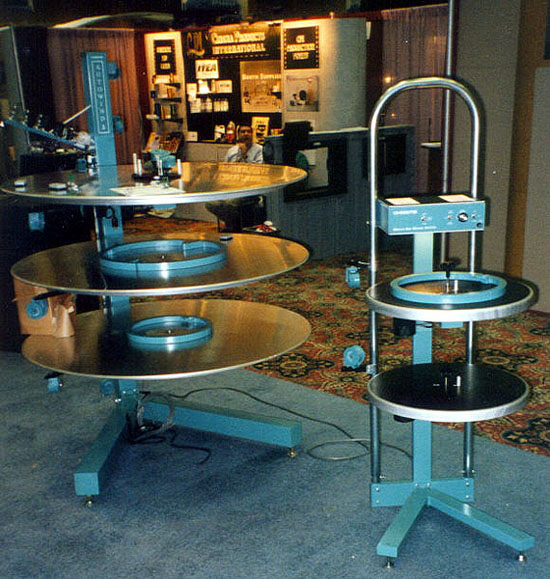 Steve, The Strong SCDC runs too damn fast and the center ring is too small of a diameter to begin with. They need a larger ring (Christie's diameter or slightly larger) and it needs to be able to run just as fast as required to pay out...and no more! This should be a user adjustable setting. I know of no way to prevent a Strong platter from spinning faster than a certain setting (however fast that little teeny ring requires). Also, (at least on the older units, I haven't tried this on the new ones) you must manually brake the platter during breakdown with your hand. What a joke! This requires constant attention and if not done carefully will damage the film. Of course most people don't bother to think about that, since they won't play it again. Lemme see, what else. How about that little takeup elevator? Can't that be manufactured to be an extra 6 inches (at least) taller? And why must it be right at the floor? The film has to come all the way back up to the top anyway. How about putting it halfway up the post to make threading easier? Why are certain selected rollers missing a keeper bracket/roller of some sort? Why are the rollers so small? Why must the design be so the operator must go over an extra roller when taking up onto the top deck? Christie's got the best roller design hands down (green rollers). Let's lose the bearings. I've had those platters a measly 8 feet away from the projector and the bearings on payout spin so freely that the weight of the film will cause it to drop all the way down to the point of dragging on the floor. Can the center feed be redesigned so the film can be "placed" in the track like a Christie? If for some reason the show must be stopped, the film must be cut or finagled to such an extent it will leave a mark on the film. Let's also lose the braces (like SPECO uses) underneath the platter. Over time, the deck will warp and if the tuck is not ON TOP OF one of the braces, the tail will fly right out. This isn't even getting into the head injuries when one must work on a lower deck during a show. Finally, my biggest beef with the Strongs is there is no provision to adjust the final roller's alignment in respect to the takeup platter's surface. I've seen far too many prints get those characteristic "platter scratches" from dragging over the edge of a Strong deck. I mean really, the film should not come into contact with the deck until perhaps the last inch or two before it stands completely upright and wraps around the film roll. Most of these come from the factory where there isn't but 1/8" clearance at best. There's just no excuse not to have some method of making those user adjustable. Sorry for the slams Pat, but I just hate the Strong platter design dearly. Correct what I pointed out above as well as making a vertical MUT and I'll be all for it. (And don't forget to add the two threaded holes like on a Christie to mount a film cleaner.  ) )
| IP: Logged
|
|
|
|
All times are Central (GMT -6:00)
|
This topic comprises 3 pages: 1 2 3
|
Powered by Infopop Corporation
UBB.classicTM
6.3.1.2
The Film-Tech Forums are designed for various members related to the cinema industry to express their opinions, viewpoints and testimonials on various products, services and events based upon speculation, personal knowledge and factual information through use, therefore all views represented here allow no liability upon the publishers of this web site and the owners of said views assume no liability for any ill will resulting from these postings. The posts made here are for educational as well as entertainment purposes and as such anyone viewing this portion of the website must accept these views as statements of the author of that opinion
and agrees to release the authors from any and all liability.
|

 Home
Home








 Printer-friendly view of this topic