Film-Tech Cinema Systems
Film-Tech Forum ARCHIVE


my profile | my password | search | faq & rules | forum home
  next oldest topic   next newest topic
» Film-Tech Forum ARCHIVE   » Operations   » Film Handlers' Forum   » Interlock setup (Page 2)

 
This topic comprises 2 pages: 1  2 
 
Author Topic: Interlock setup
Greg Pauley
Expert Film Handler

Posts: 173
From: Huntington, WV, USA
Registered: Jun 2000


 - posted 02-12-2001 12:34 PM      Profile for Greg Pauley   Author's Homepage   Email Greg Pauley   Send New Private Message       Edit/Delete Post 
I think interlocking is pretty safe because most people are scared of interlocking and triple check the film path before starting. It's the everyday threading you have to worry about!

Scott Norwood
Film God

Posts: 8146
From: Boston, MA. USA (1774.21 miles northeast of Dallas)
Registered: Jun 99


 - posted 02-12-2001 01:14 PM      Profile for Scott Norwood   Author's Homepage   Email Scott Norwood   Send New Private Message       Edit/Delete Post 
Brad and John -- so it's a bad idea to use a cleaner on each machine when interlocking multiple screens? Does this apply to PTR rollers as well or just the Kelmar/Christie media cleaner?

John Pytlak
Film God

Posts: 9987
From: Rochester, NY 14650-1922
Registered: Jan 2000


 - posted 02-12-2001 01:43 PM      Profile for John Pytlak   Author's Homepage   Email John Pytlak   Send New Private Message       Edit/Delete Post 
Scott:

I read Brad's concern as the slightly increased tension from the film running through the cleaner building up through multiple projectors. My opinion is that since each projector is pulling the film through using sprockets, the cleaner's tension only affects the projector immediately following it, and doesn't cascade through the system.

Either type of film cleaner should be satisfactory, although I would not run a media cleaner in the "dry" mode, since abrasive dirt can get caught in the media and scratch the film. (This is especially a risk around new construction, where abrasive cement and plaster dust are plentiful). In a really dirty situation, PTRs will "load up" and become less effective, but the risk of scratching is low as long as they turn freely.

------------------
John P. Pytlak, Senior Technical Specialist
Worldwide Technical Services, Entertainment Imaging
Eastman Kodak Company
Research Labs, Building 69, Room 7419
Rochester, New York, 14650-1922 USA
Tel: 716-477-5325 Cell: 716-781-4036 Fax: 716-722-7243
E-Mail: john.pytlak@kodak.com
Web site: http://www.kodak.com/go/motion

Brad Miller
Administrator

Posts: 17775
From: Plano, TX (36.2 miles NW of Rockwall)
Registered: May 99


 - posted 02-12-2001 02:32 PM      Profile for Brad Miller   Author's Homepage   Email Brad Miller       Edit/Delete Post 
Yes, you read my concern correctly. My rule in training has always been to run the film cleaner on the payout platter and regardless of how many other projectors the film will run through to NEVER run the cleaner on the rest. For example on a 2 screen interlock, I always make my staff move the cleaner each show to wherever the print is originating from. That way the tension is exactly like a normal non-interlocked run.

(Hey John, try that static test of yours on older film stocks with wet film. I think you'll see what I mean about airborne dirt not being a problem. Running FG is something I always do, so I frequently forget about other people speaking of something when they may have been running dry. Oops.)

Darryl Spicer
Film God

Posts: 3250
From: Lexington, KY, USA
Registered: Dec 2000


 - posted 02-12-2001 05:12 PM      Profile for Darryl Spicer     Send New Private Message       Edit/Delete Post 
Most projectors I've interlocked have been 5. We had a large group, around 750 people for a special showing of The Lion King. No problems and the film looked as good as it did prior to showing. The problem I have with interlocking is that you usualy have at least one maybe two people who can run it correctly. Our company has made it a policy that no interlocking of films is allowed without first contacting the booking department. If you can get in touch with them their answer is usualy no the film companies do not want us to do that. Something to do with the money not being properly credited.

John Walsh
Film God

Posts: 2490
From: Connecticut, USA, Earth, Milky Way
Registered: Oct 1999


 - posted 02-12-2001 06:59 PM      Profile for John Walsh   Email John Walsh   Send New Private Message       Edit/Delete Post 
I'm not a big fan of interlocking, but I recognize it is a necessity in today's "get what you can, while you can" method of operating theaters.

Properly done, I don't think it's much worse than what is already being done (with platters.)

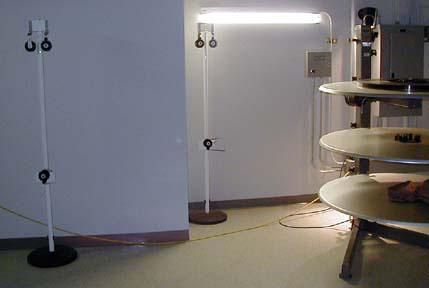
Any theater that wants to run interlock should have rollers permanently mounted to the walls, ceiling, etc. to lessen the possibility of scratching. I never did care for those free-standing roller poles. I tell people to either hold up the end of the film as it runs out of each projector, or splice on a trailer, to keep the end cleaner. Also to check their threading carefully!

As with anything, a good operator would not have any problems using those interlock roller poles. It's the people who don't know (or care) that you have to watch for.

Randy Stankey
Film God

Posts: 6539
From: Erie, Pennsylvania
Registered: Jun 99


 - posted 02-12-2001 07:56 PM      Profile for Randy Stankey   Email Randy Stankey   Send New Private Message       Edit/Delete Post 
I have never had any problem interlocking prints. When my "home" theatre first opened, we were booked to play two prints of Eraser but ended up getting only ONE print. We interlocked that one print for every show of every day for about two weeks! I don't think we had ANY problems with that print

We were all shitting little green apples for the first few days until we got the hang of it. After that it was a pretty routine operation.

Even then we double checked and triple checked those projectors before every show and we doubled up on the check-ups of those houses.

My number one piece of advice to any would-be interlocker is to do one or two TEST RUNS before you run your go-show.

George Roher
Master Film Handler

Posts: 266
From: Washington DC
Registered: Jul 99


 - posted 02-12-2001 08:05 PM      Profile for George Roher   Email George Roher   Send New Private Message       Edit/Delete Post 
Considering the amount of extra setup time it took me to get an interlock started using the poles (which I had never used before Saturday night), I would be very afraid of uncaring operators using them. It took a lot of tinkering before I was satisfied with the film path. The same night I had to thread an interlock in the older booth (with rollers permanently setup) and it took all of 3 minutes. I've never had any problems or damaged film from running interlock (the most I've ever done was 3 screens), but I really don't like the poles. They're weighted at the base but if someone bumped into one there could be a problem.


All times are Central (GMT -6:00)
This topic comprises 2 pages: 1  2 
 
   Close Topic    Move Topic    Delete Topic    next oldest topic   next newest topic
 - Printer-friendly view of this topic
Hop To:


Powered by Infopop Corporation
UBB.classicTM 6.3.1.2

The Film-Tech Forums are designed for various members related to the cinema industry to express their opinions, viewpoints and testimonials on various products, services and events based upon speculation, personal knowledge and factual information through use, therefore all views represented here allow no liability upon the publishers of this web site and the owners of said views assume no liability for any ill will resulting from these postings. The posts made here are for educational as well as entertainment purposes and as such anyone viewing this portion of the website must accept these views as statements of the author of that opinion and agrees to release the authors from any and all liability.

© 1999-2020 Film-Tech Cinema Systems, LLC. All rights reserved.