|
|
This topic comprises 2 pages: 1 2
|
|
Author
|
Topic: Philips/Norelco FP20
|
Bernard Tonks
Jedi Master Film Handler
Posts: 619
From: Cranleigh, Surrey, England
Registered: Apr 2001
|
 posted 06-28-2001 10:21 AM


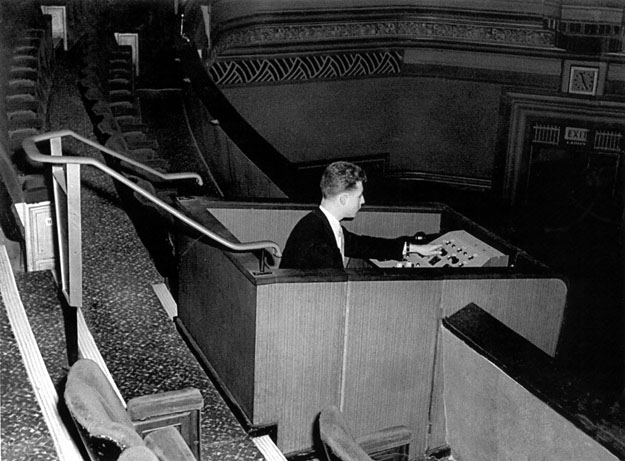
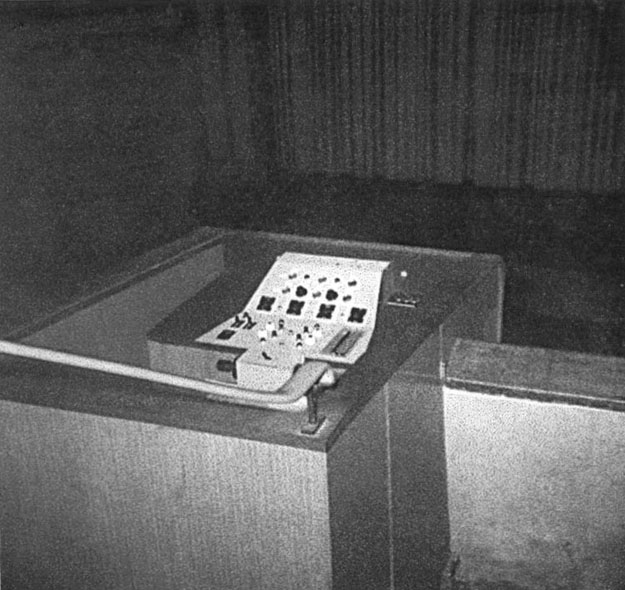
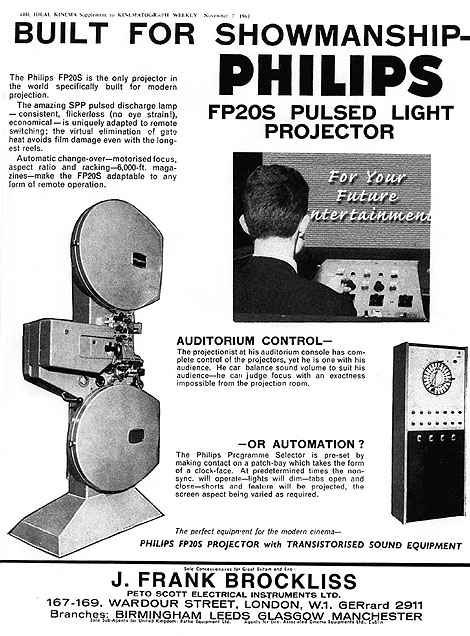
Further to James Robertson’s interesting Topic, Philips / Norelco FP 20 projectors. In 1960 Philips and Associated British Cinemas did an experimental installation at the ABC Queens Cinema Bayswater, London, with Philips FP.20.S pulsed lamp projection equipment with auditorium remote control. There would be one projectionist in the projection room for lacing up the projectors, rewinding, and standing by for any emergency. Presentation and projection was entirely from a console in the front of the circle by the other projectionist, with remote controls for houselights, 3 colour footlights, tabs & masking, projectors start / stop, lamp level adjustment, motorised framing & focus, and of course non-sync start with sound format change and fader control. With 6,000’ spools there was normally never more than two changeovers which were automatic from a single pulse on the motor cue dot, the changeover dot was activated by a micro switch on a cam timer.One of the hidden drawbacks with the system was that the projectionist could easily fall asleep, which I did on a re-issue of “Quo Vadis” on a Saturday 2nd house, just waking up in time to close the tabs for The End (no long cast lists in those days). Another unfortunate didn’t wake up at all, blank screen, everything had come to a grinding halt. The chief had to rouse him in view of a very amused audience, when a mop of black hair suddenly appeared to shoot skywards from the console like from a Tom & Jerry cartoon. Controls were not duplicated in the projection room at all, with the exception of projectors start & stop, and houselights only! This was not to be the future of cinema, with xenon lamps and single manning projection rooms introduced. There was only a 2nd remote control installation which was at the Classic Cinema Baker Street, London, but this was short lived like Bayswater. To quote from a manual, the SSP.800 gas discharge lamp consists of a quartz tube only 3-1/8” (80mm long), 72 impulses per second or three impulses per frame, there of course being no flicker shutter. The average life of lamp was 33 hours under full load. The average bulb life at Bayswater was between 60-70 hours, and many did upto 115 hours. The size of scope screen was 36’. If I am able to send the pictures, I am the person pictured in the console and on the Philips advert. 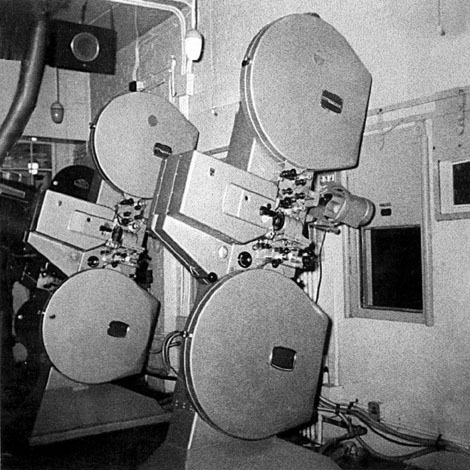
| IP: Logged
|
|
William Hooper
Phenomenal Film Handler
Posts: 1879
From: Mobile, AL USA
Registered: Jun 99
|
posted 06-29-2001 12:14 AM

Thanks for posting that.It's interesting to think of the fun involved with the architects when cutting out the front center section of the balcony. It is also interesting to think about the projectionist on the balcony rail, exposing the back of his head during kiddie matinees. Definitely a hard-hat job.
| IP: Logged
|
|
|
|
|
|
|
|
|
|
|
|
Bernard Tonks
Jedi Master Film Handler
Posts: 619
From: Cranleigh, Surrey, England
Registered: Apr 2001
|
posted 06-30-2001 11:02 AM
Gordan: You are so right about those Kalee Varamorph heavy light eaters. The light on 1.75 wide was acceptable, but 2.35 scope was too much loss. I could never understand why ABC didn’t install Bausch & Lomb anamorphics.In reply to Jim’s e-mail: The foot lamberts never seemed to be revealed, but my guess would have been about 12fl on 1.75 wide. New lamps did always fall into place with an almost imperceptable flicker, which I only witnessed a couple of times during my short tenure. I was only on loan to that cinema during the installation and trial runs, and for a short period when the equipment was commissioned. Nice experience, but I was only too glad to get back to my permanent base theatre, and be able to show pictures again from a projection room with Peerless carbon arcs, and the newly installed Philips FP 20 projectors. In the background of the first Bayswater picture you will notice No 1 Ross GC3 projector with a Peerless Magnarc, the pair of machines were moved to the spotlight portholes and used in this position for 3 months before changing to the Philips projectors. The article and photographs posted first appeared in The Projected Picture Trust Magazine. Preserving The Magic Of Cinema! Visit website www.pptrust.org
------------------
| IP: Logged
|
|
|
|
John Walsh
Film God
Posts: 2490
From: Connecticut, USA, Earth, Milky Way
Registered: Oct 1999
|
posted 07-01-2001 01:45 AM
When I looked at that console (at the Ziegfeld) it looked like just audio to me... but Larry and Gordon are right on with the projectors being Zeiss; I saw one of them (with many parts removed) sitting in the back booth hallway. I spoke to a guy there that said they thought the Ziess projectors were OK, but the reason they replaced then was they simply could not get parts in a reasonable time frame. Last time I was there, they had Xetron lamps, a platter and two Century JJ's.Thanks for those pictures, Bernard! they are really cool. It's neat to see different ways people tried to bring quality to a show. It seems showmanship has a long way to go - to get back to what was done 40 years ago. Did you ever see/read that SMPTE article about the wireless remote control? I think it was an experiment done by Rank in the early 1960's. A projectionist was given a wireless remote control for adjusting focus, framing, volume, etc. He cound walk right to the screen and set the focus. If I remember, they used Cinemecannica V8's.
| IP: Logged
|
|
Bernard Tonks
Jedi Master Film Handler
Posts: 619
From: Cranleigh, Surrey, England
Registered: Apr 2001
|
posted 07-01-2001 11:10 AM
Gordon: J. Frank Brockliss eventually became Pathe’ Equipment for many years, but are no longer trading. Kinoton equipment I believe is now supplied and installed by Bell Theatre Services. BTS also supply and service Century projectors.John: Glad you liked the old pictures, I think I gave Brad a rough time when I sent them but eventually they got through. I believe the experiment with radio remote control of the projectors was an invention by a projectionist at the Odeon Haymarket, London. I seem to remember Rank stopping the use of the remote control although it did work very efficiently. Ziegfeld: While in NYC last November, I was surprised to see so many theatres in the dark. Did some of these theatres also have cinema use but no longer viable ? Just interested as all London theatres are in full use.
------------------
| IP: Logged
|
|
|
|
|
|
All times are Central (GMT -6:00)
|
This topic comprises 2 pages: 1 2
|
Powered by Infopop Corporation
UBB.classicTM
6.3.1.2
The Film-Tech Forums are designed for various members related to the cinema industry to express their opinions, viewpoints and testimonials on various products, services and events based upon speculation, personal knowledge and factual information through use, therefore all views represented here allow no liability upon the publishers of this web site and the owners of said views assume no liability for any ill will resulting from these postings. The posts made here are for educational as well as entertainment purposes and as such anyone viewing this portion of the website must accept these views as statements of the author of that opinion
and agrees to release the authors from any and all liability.
|

 Home
Home







 Printer-friendly view of this topic