|
|
This topic comprises 3 pages: 1 2 3
|
|
Author
|
Topic: Variety Pans Quality of Films Shot on DV
|
|
|
Gerard S. Cohen
Jedi Master Film Handler
Posts: 975
From: Forest Hills, NY, USA
Registered: Sep 2001
|
 posted 07-27-2002 06:45 PM


Leo wrote:"One of the Akeley's many drawbacks was the magazine capacity of 100 feet, hence the fact that you never see any lengthy shots in that film." Actually, the Akeley ("Pancake") camera takes 200 foot rolls in internally mounted, darkroom loaded aluminum magazines with a loop left sticking out so that magazines can be changed in seconds. When inserted in the air-tight metal drum of the camera body, the film is extremely well protected. The Akeley, developed by Carl E. Akeley for filming wildlife on the run in Africa, was actually quite advanced for its time, being weatherproof, with two-speed gyro pan and tilt mechanisms built into
its ball-leveled tripod, making very smooth (but noisy) and rapid movements possible. Provision for changing the shutter (180' and 230'
shutters could be changed by the operator), backwind, single-frame or 8 frame cranking, provision for electric motor drive, twin normal lenses geared together for viewing and taking, five lenses to extreme
telephoto supplied in the metal camera case, internal film notcher
and spirit level, plus a swiveling viewfinder were some of the standard specs of this remarkable machine. All Akeley production was commandeered by the War Department in WWI (Akeley served as consultant without salary) and the cameras were used both in the air and on the ground in both World Wars. What movie camera did Hurley use on the Scott and Shackleton expeditions? Gerard
| IP: Logged
|
|
Frank Angel
Film God

Posts: 5305
From: Brooklyn NY USA
Registered: Dec 1999
|
posted 07-28-2002 12:05 AM

Brad said: "Perhaps we should put signs in the box office stating 'come see Full Frontal, shot with digital cameras.'" We are sure on the same page with this one Brad, I wrote in a review of CHELSEA WALLS for imdb.com:
------------------------------------------------
"Date: 26 April 2002
Summary: Pretentious, self-indulgent....how many times can you say BORING?! Typically what you expect to see from any Film School student's first project.
><it seems that the director evidently feels that all he has to do is aim a (video) camera and shoot without benefit of script, or even a vague notion of what happens from point A to point B, without adequate lighting or even a simple focus puller, and that will somehow the resultant murky, low contrast, dark (in many scenes, barely visible) and mostly out-of-focus images will rise to "Film Festival Winner" quality.
If this is what video-to-film is going to engender -- all those actors who think can be directors because they can cough up enough money to direct a vanity "movie," then please, in the spirit of truth in advertising, let it be clearly stated on the marquee before we plunk down our $9.50 -- "This film was made with a video camera for less money than most (film) productions spend on sandwiches for the crew -- enter at your own risk."
| IP: Logged
|
|
|
|
|
|
|
|
Bobby Henderson
"Ask me about Trajan."

Posts: 10973
From: Lawton, OK, USA
Registered: Apr 2001
|
posted 07-28-2002 11:54 AM
As far as "digital cinematography" goes, I suppose "Episode II" was using the very best technology available. And the videography did not measure up to 35mm film.With the cost of a major feature production being what it is, and having the target result being a high quality image, film is the only way to go. Doing "digital" is just hyping "digital" as a gimmick. And it is still videography, not cinematography. Videotaping production photography, no matter what kind of camera is used, is going to be inferior to the results attained by high quality 35mm film cameras. If the producers, directors and directors of photography really intend to give the viewer the highest quality image availble, they need to just sidestep the digital bandwagon and get down to something that really produces razor sharp results --like VistaVision and 70mm. Sure, it is analog, but it works. Super35 has its own problems, one of them being the intended "fashion" in the industry of showing gritty, color drained images. This kind of thing is totally unsuitable to use as a comparison of promoting the use of videography. It is just as unsuitable as the promoters of DLP selling their systems by only comparing their setups to "film done wrong" shows in low quality theaters. As I've said, they need to have the balls to compare their product against a film presentation where the projection and print handling is done expertly. When electronics companies can improve the resolution of HD video cameras to something at least 2 or 4 times the 1080 HD standard and improve the color handling then there might be a chance those cameras would be suitable to use on a major motion picture production. Right now the video cameras just need to stick to TV production and leave it at that.
| IP: Logged
|
|
Gerard S. Cohen
Jedi Master Film Handler
Posts: 975
From: Forest Hills, NY, USA
Registered: Sep 2001
|
posted 07-28-2002 12:56 PM
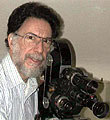
Scott:The camera im my photo is a Bell & Howell Model Q Eyemo, the so-called "Spider Eyemo" because the turret lenses stick out from the center on legs so as to avoid overlapping each other's field of view,
and to provide sufficient clearance for manipulating the focus and diaphragm controls. Although the 35mm Eymo was designed AFTER the success of the 16mm B & H Filmo Model 70, which had a compact turret, the larger 35mm lenses made the Spider (Q) design more practical. The Eyemo was also made in Models K,L,M,N,O, and P. Leo: The Akeley internal magazines may LOOK like they contain only 100 feet, being about the size of two 100 foot spools end-to-end (As they appear inside the Filmo, Eyemo and Bolex), but within the magazine the film is wound on wooden cores. As the feed roll diminishes, the takeup roll fills the space it occuppied, so the overall space remains the same. The ASC Handbook and Souto's Technique of the Motion Picture Camera mention only the 200' magazine. My Akeley is the original model and one of the earliest manufactured,
and all its magazines, plus the descriptions and graphics in the Operator's Handbook, refer to the same 200' magazine. Of course it is posible to load a magazine with less film, but I can't think of
a reason for doing so, especially since there is a footage counter and film notcher built into the camera. <<Dunno what cameras Ponting and Hurley used off-hand but Hurley's had a wooden body and magazine, so maybe it was an early model Bell & Howell or Debrie (both of which were used widely in Europe during the teens)>>
Could they have used the early wooden , very popular Pathe model with both square magazines mounted on top? Gerard
| IP: Logged
|
|
|
|
|
|
Evans A Criswell
Phenomenal Film Handler

Posts: 1579
From: Huntsville, AL, USA
Registered: Mar 2000
|
posted 07-28-2002 11:23 PM
quote:
A standard DV camera is all you need to exceed 70mm resolution. Just take your DV footage (720 x 480) and interpolate it up to 1440 x 960. Then interpolate that up to 2880 x 1920. Then keep interpolating up until you have 32,400 x 21,600. Unlimited resolution beating the hell outta IMAX! I don't see why anyone needs anything more advanced than video.
Joe, unfortunately, many non-technical people would believe that statement. I promise you that if you made this statement to random people, say, on the street or in a mall, that over half would believe it. That's the problem! Even some of my technical friends talk about how they can scale low-res video up to high resolutions like 1024x768 and 1280x1024 even though the source may only have 240 scan lines. They think they're adding information to it. I often have to explain that if they are scaling up to a non-integer multiple of what they had originally, they're actually losing a bit of the information.  ------------------
Evans A Criswell
Huntsville-Decatur Movie Theatre Information Site
| IP: Logged
|
|
|
|
|
|
|
|
John Pytlak
Film God

Posts: 9987
From: Rochester, NY 14650-1922
Registered: Jan 2000
|
posted 07-29-2002 10:31 AM
Don't forget that Mr. Cameron shot the underwater scenes of the actualy wreck in "Titanic" using the Techniscope 2-perf format, primarily to minimize camera reloading during the deep dives. The murkiness of the water and the floating debris hid the lack of sharpness and graininess of that format.For "Ghosts of the Abyss", Cameron likely chose the 24P HD format to avoid having to reload the 3D cameras during the deep dives, knowing the murkiness would hide any noise or lack of sharpness. ------------------
John P. Pytlak, Senior Technical Specialist
Worldwide Technical Services, Entertainment Imaging
Research Labs, Building 69, Room 7525A
Rochester, New York, 14650-1922 USA
Tel: +1 585 477 5325 Cell: +1 585 781 4036 Fax: +1 585 722 7243
e-mail: john.pytlak@kodak.com
Web site: http://www.kodak.com/go/motion
| IP: Logged
|
|
|
|
All times are Central (GMT -6:00)
|
This topic comprises 3 pages: 1 2 3
|
Powered by Infopop Corporation
UBB.classicTM
6.3.1.2
The Film-Tech Forums are designed for various members related to the cinema industry to express their opinions, viewpoints and testimonials on various products, services and events based upon speculation, personal knowledge and factual information through use, therefore all views represented here allow no liability upon the publishers of this web site and the owners of said views assume no liability for any ill will resulting from these postings. The posts made here are for educational as well as entertainment purposes and as such anyone viewing this portion of the website must accept these views as statements of the author of that opinion
and agrees to release the authors from any and all liability.
|

 Home
Home














 Printer-friendly view of this topic