|
|
This topic comprises 3 pages: 1 2 3
|
|
Author
|
Topic: exhaust requirements for followspots?
|
|
|
William Hooper
Phenomenal Film Handler
Posts: 1879
From: Mobile, AL USA
Registered: Jun 99
|
 posted 09-11-2002 12:38 AM


I just found this while reading through the National Projector Carbon bulletins in the Manuals section via John Pytlak: "All projection lamps should be adequately ventilated. The recommended practice as set forth in the report of the Projection Practice Sub-Committee of the Society of Motion Picutre & Television Engineers (Journal of the S.M.P.T.E., Vol.,XXXIX, September 1942, pp. 158) is as follows:
"'The carbon arc exhaust system shall be a positive mechanical exhaust system independent of all other ventilating systems of the theatre. Each projector, spotlamp, stereopticon, or floodlight machine, of the carbon arc type, shall be connectred by a flue to a common duct, which duct shall lead directly out of doors.'" Blah, blah, blah, c.f.m, etc. It's in the National bulletin #5, "Operating Precautions". Maybe John Pytlak can search up the RP # to further agonize poor Scott.
| IP: Logged
|
|
|
|
|
|
|
|
|
|
|
|
|
|
|
|
|
|
Stephen Furley
Film God
Posts: 3059
From: Coulsdon, Croydon, England
Registered: May 2002
|
posted 09-14-2002 04:58 PM
quote:
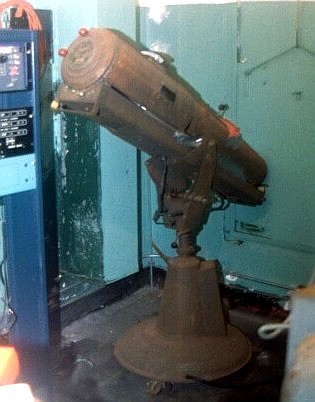
Strong carbon arc Trouper in origninal black paint.
If you restore one, it should come out looking just like this.
That's a strange looking spot, I never saw anything that looked like that. How old is it? It's got a sort of modern, streamlined look to it, but the fact that it's carbon, and quite rusty, suggests that it may be older than it looks. The lamphouse looks rather small, or is it just that the whole thing is very large, with a normal sized lamp? It's difficult to tell from the picture. How are the carbons arranged in this, is it a reflector or a condenser arc? Most of the spots I've seen over here have been 1930s Stelmar, or 1950s Philips, which look rather similar, with a 'haystack' shape lamphouse, and a colour magazine right at the front, operated by rods or wires. The bed of the thing on which everything is mounted is made of steel bars, and there are sliding weights, which can be moved to adjust the balance of the thing. I can't find a picture of one at the moment, but there are some pictures of a Stelmar spot on the www.cinephoto.co.uk site, in the 'Arcs and spots' and 'Odeon Leicester Square' sections. The Odeon also had a BTH spot. Can anyone tell me what this spot is: 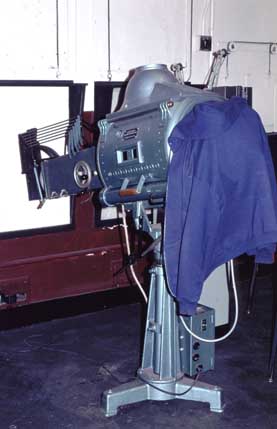 This is likely to be an American model, as I saw it in an American theatre. This looks like a half way between the sort of spots I am used to seeing, and the Strong one. A more typical European spot would have the pedestal further forward, with the lamphouse behind it, as with the Strong one. The National Carbon Bulletins available in the maunals section of the film-tech site mention a type of ac arc, where the carbons are almost parallel to each other. I have never seen this arrangement, what type of equipment used it? More modern spots seem to use mainly CSI, (I don't like the colour), or HMI lamps, xenons don't seem very common, but in film projectors, xenon is the norm, I have never seem an HMI projection lantern. Why the difference, is HMI cheaper to use in spots than xenon?
| IP: Logged
|
|
|
|
|
|
Paul Mayer
Oh get out of it Melvin, before it pulls you under!

Posts: 3836
From: Albuquerque, NM
Registered: Feb 2000
|
posted 09-14-2002 11:37 PM
The Trouper was the smallest carbon arc spot that Strong made. The lamphouse is about a foot or so in diameter and the entire instrument is about six feet long. It is an AC arc using 6x7 copper-clad carbons mounted in-line through a hole in the reflector. It was a very light-weight and fast-operating lamp, and was the mainstay of the lounges and showrooms here for many years. All of the Strong lamps except the Gladiator used carbons mounted in-line, with the negative feeding through the reflector. The Gladiator essentially used a Futura projection lamphouse with the negative feeding at an angle from under the reflector.In an interesting one-off, the Stardust Hotel here modified its center booth short-throw Super Trouper by fitting it with a Peerless Magnarc lamphouse in order to get enough light for use in the long-running Lido de Paris show. The Genarco Metro is my sentimental favorite since it was my "break-in" lamp at the Tropicana Hotel in 1974 when I was recruited into IATSE Local 720. The Metro was the total opposite in spotlight design philosophy from any of the Strong lamps. To wit: Operator position: Strong--right side, Genarco--left side Lamp optics: Strong--reflector, Genarco--condenser lens Carbons: Strong--in-line, Genarco--offset negative, rotating positive Size control: Strong--slide handle with auto-focus and separately controlled iris
Genarco--rack and pinion wheel with integrated iris and separate manual focus lever Shutters: Strong--horizontal blades; control mounted above the barrel; no lamphouse douser
Genarco--horizontal and vertical blades; controls mounted below the barrel; lamphouse douser Fader: Strong--internal doors or front-mounted iris
Genarco--front-mounted iris Color boom: Strong--magnetic pull up or mechanical latch
Genarco--gravity drop Output: Strong--varied with spot size, getting dimmer with increased size; efficient
Genarco--constant regardless of spot size; inefficient at any size smaller than flood The Genarco's were magnificent brute-force lamps that simply blew away the competition with raw light output, especially when set for flood. We had five of them here in town--the Tropicana's two are still intact though no longer in use. The Strong's were more of a finesse lamp perfectly suited for the precision cues demanded in showrooms back then. There must have been hundreds of them in town in their heyday. Many of today's smaller spots use HMIs instead of Xenon--probably due to cost and maybe safety concerns (spots do get banged around more than projectors). HMIs put out a very discontinuous spectrum somewhere in the 4000s K correlated color temp. Acceptable for stage use but not the best for image projection--colors get all messed up in a way similar to what happens when shooting under regular (i.e. not Kinoflo) fluorescent lamps. Regards, Paul
| IP: Logged
|
|
|
|
|
|
All times are Central (GMT -6:00)
|
This topic comprises 3 pages: 1 2 3
|
Powered by Infopop Corporation
UBB.classicTM
6.3.1.2
The Film-Tech Forums are designed for various members related to the cinema industry to express their opinions, viewpoints and testimonials on various products, services and events based upon speculation, personal knowledge and factual information through use, therefore all views represented here allow no liability upon the publishers of this web site and the owners of said views assume no liability for any ill will resulting from these postings. The posts made here are for educational as well as entertainment purposes and as such anyone viewing this portion of the website must accept these views as statements of the author of that opinion
and agrees to release the authors from any and all liability.
|

 Home
Home






 Printer-friendly view of this topic