|
|
This topic comprises 3 pages: 1 2 3
|
|
Author
|
Topic: TA-10 Motor-Start Problems
|
|
|
|
|
|
|
Paul G. Thompson
The Weenie Man

Posts: 4718
From: Mount Vernon WA USA
Registered: Nov 2000
|
 posted 09-22-2002 03:30 PM


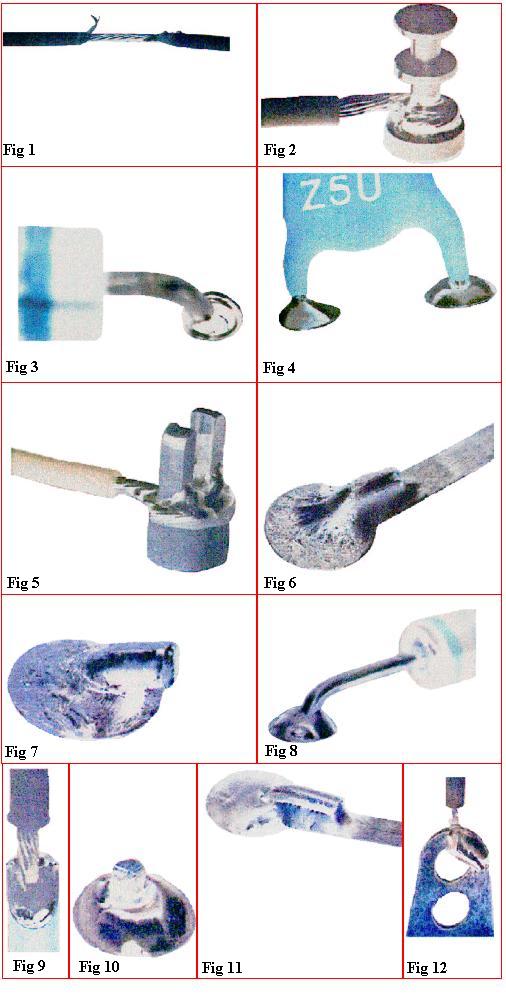
Gordon, what did the solder connection look like? Was it chunky, grainy, and greyish in color? That is a sign of an overheated connection. This can be caused by too high of a temperature of the soldering equipment, and possibility does exist the soldering equipment is dirty. This dirt and oxidation will transfer from the tip of the soldering equipment and burn into the solder and will prevent a good bond. Also, if the parts being soldered have not been cleaned, the possibility of either an overheated or a cold connection could occur. Naturally, we cannot forget about the current the connection is trying to handle.Or, was it a bright shiney connection that did not appear to whet out properly? It has an appearance of the solder looking like a ball sitting on the connection. This is a cold solder joint. It happens when there was insufficient heat used for soldering and/or the flux did not flow properly, or the connection had residues of some sort preventing the flux from doing its job. Or was the solder joint fractured, but otherwise looks OK. This could be a stress related factor that happens when there was insufficent solder used, and the connection mechanically cannot handle board flexing due to thermal stress or mechanical vibrations. These type connections can very easily break if excessive force is used to insert or remove relays. A fractured connection can also occur if there is mechanical motion between the parts being soldered as the solder passes through the "plastic state." 60/40 solder has a 9-degree plastic state. The temperature range of the 60/40 solder's plastic state is 361 degrees F to 370 degrees F. 63/37 solder does not have a plastic state. it is either a solid or a liquid. If memory serves me correctly, the transition of 63/37 solder is 361 degrees F. A good solder connection appears bright, and the contour of the solder is concave and free of stress lines caused by uneven heating during the soldering operation. The solder wetting should appear feathered out to all areas being soldered, with no evidence of ridges between the solder and the soldered parts. If the solder connection is convex in appearence, it could be a cold solder connection or too much solder. It can be difficult to determine it is a cold connection on inspection, because if there was improper wetting underneath the surface of the solder, it could never be detected. The old BGW-250 amplifiers had problems with fractured connections in their time-delay circuit. It was caused by insufficient solder and thermal stress.
| IP: Logged
|
|
Ken McFall
Jedi Master Film Handler

Posts: 615
From: Haringey, London.
Registered: Apr 2001
|
posted 09-22-2002 03:52 PM
Wow Paul....It may be easier for him to send the board direct to you.... and I'll send mine as well  I'm constantly amazed at the expertise that's given so freely here... in a very materialistic world it's very unusual . I rememeber an intermittent fault on a CP55 installed at my cinema that was eventually cured by sitting down at a bench with a hot iron and going over hundreds of connections..... an experience I hope never to have to repeat.... this could well be what'll have to happen in this case if it turns out not to be the socket. At least the TA10 has fewer connections to consider....... it's not a job for the inexperienced.... come to think of it it's not a job the experienced want either 
| IP: Logged
|
|
Paul G. Thompson
The Weenie Man
Posts: 4718
From: Mount Vernon WA USA
Registered: Nov 2000
|
posted 09-22-2002 04:05 PM
Ken, most of what I posted was from a NASA pamphlet that was in the military circles in the 1970's. It all about hand soldering techniques used on PC boards found in the space vehicles. Whether that pamphlet exists or not today, I don't know.This book was our "Bible" when we had to work on PC boards used in Military Aviation. Hi-tech industries used the same specifications.
| IP: Logged
|
|
Ken McFall
Jedi Master Film Handler
Posts: 615
From: Haringey, London.
Registered: Apr 2001
|
posted 09-22-2002 04:24 PM
Paul you are a fountain of information....Unfortunatly you are exactly what's missing in the industry today, people who not only know what they are talking about but have a love for the job. I've been doing this job for some 30 yaers now... boy, man and alcoholic  Guy's like yourself give much more than advice..... you pass on experience. Guy's like yourself give much more than advice..... you pass on experience. It's not where the information came from it's knowing how to use the knowledge and being prepared to pass it on.... thanks. Sounds like a suck up... but it's not. I've said before on this site it's important to be able to say "I don't know", I do it all the time... when no one's around of course!! The older guys have the best tips and the younger guys would do well to listen to them.... I hope I do.
| IP: Logged
|
|
Steve Guttag
We forgot the crackers Gromit!!!

Posts: 12814
From: Annapolis, MD
Registered: Dec 1999
|
posted 09-22-2002 05:30 PM
One of the big problems I find with wave-soldering is that their connections are truely dependent on the how well the wave machine is maintained and is run. The least reliable assemblies I've come across are wave-solder. The best are easy-bake (surface mount) and hand soldered. CP-55s and CP-65s and especially the Cat. 150E cards are hit and miss. The annoying thing is that they work for a period of time (years even) then just start to get flaky.The first few pages of any Heathkit manual will also show good techniques to good soldering. I like Kester 63/37 solder, my self. I only use 60/40 on fat connections (with fat solder). Steve ------------------
"Old projectionists never die, they just changeover!"
| IP: Logged
|
|
Paul G. Thompson
The Weenie Man
Posts: 4718
From: Mount Vernon WA USA
Registered: Nov 2000
|
posted 09-22-2002 07:09 PM
Steve said:
quote:
"One of the big problems I find with wave-soldering is that their connections are truely dependent on the how well the wave machine is maintained and is run."
Steve, you are absolutely correct. Here is a link that hopefully, all shoud be interested in.
http://www.hq.nasa.gov/office/codeq/solder.htm
| IP: Logged
|
|
|
|
|
|
|
|
|
|
Rick Long
Jedi Master Film Handler
Posts: 759
From: Toronto, Ontario, Canada
Registered: Nov 1999
|
posted 09-23-2002 08:03 PM
So if I understand correctly, the problem is with the n.c. side of the manual switch? Thanks Don, you saved me from disconnecting the board and "sweating" all joints around the motor relay.Ken, I agree this site is invaluable in getting information that others might be tempted to selfeshly hold back. I think the greater good is served, however, in that by helping each other with solutions to various problems, we help the world to make sure that "movies (especially on film) are still your best entertainment." P.S. Will get back to this theatre in the next day or so, and will post my results. Thanks again to all of you.
| IP: Logged
|
|
|
|
|
|
All times are Central (GMT -6:00)
|
This topic comprises 3 pages: 1 2 3
|
Powered by Infopop Corporation
UBB.classicTM
6.3.1.2
The Film-Tech Forums are designed for various members related to the cinema industry to express their opinions, viewpoints and testimonials on various products, services and events based upon speculation, personal knowledge and factual information through use, therefore all views represented here allow no liability upon the publishers of this web site and the owners of said views assume no liability for any ill will resulting from these postings. The posts made here are for educational as well as entertainment purposes and as such anyone viewing this portion of the website must accept these views as statements of the author of that opinion
and agrees to release the authors from any and all liability.
|

 Home
Home









 Printer-friendly view of this topic