|
|
This topic comprises 2 pages: 1 2
|
|
Author
|
Topic: Projectors that put electricity back into the grid
|
|
|
|
|
|
|
|
|
Steve Kraus
Film God

Posts: 4094
From: Chicago, IL, USA
Registered: May 2000
|
 posted 10-07-2002 09:56 PM


Here is a completely trivial case of a coasting projector generating a wee bit of power. This is how I have my projector motors wired, as I've previously described, with two switches. The wall switch will feed the motor and the Dolby Digital motor start relay; the base switch does not so the motor can be run with no concern of triggering the delayed DD switchover. 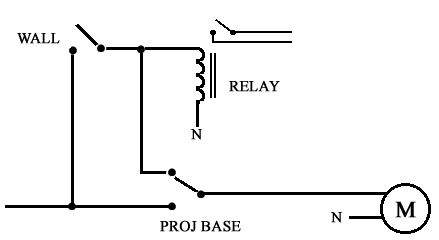 If you run the motor via the base switch (wall switch off) and then switch back to the normal position, the coasting motor will generate sufficient voltage to backfeed and lift the relay. This is seen by looking at the CP500D, which will sit in DD even with nothing running and only default to SR when it gets a contact closure on one or the other motor relays. Motoring at more than a low speed and as you switch off you see the CP switch briefly into SR then back to DD.
| IP: Logged
|
|
|
|
Jeffry L. Johnson
Jedi Master Film Handler

Posts: 809
From: Cleveland, Ohio, USA
Registered: Apr 2000
|
posted 10-08-2002 05:14 PM


The courts are deciding the fate of net metering in Ohio.Incentives in Ohio Database of State Incentives for Renewable Energy (DSIRE) Net Metering Last DSIRE Review: 07/18/2002 Incentive Type: Net Metering Rules
Eligible Technologies: Solar Thermal Electric, Photovoltaics, Landfill Gas, Wind, Biomass , Hydro, Renewable Transportation Fuels, Fuel Cells, micro turbines
Applicable Sectors: Commercial, Industrial, Residential
Limit on System Size: no limit
Limit on Overall Enrollment: 1% of peak demand for each retail electric provider
Treatment of Net Excess: New rules pending. See summary for details.
Utilities Involved: Investor-owned utilities only
Date Enacted: 1999
Authority 1: Ohio Revised Code 4928.67 (SB 3)
Authority 2: Case No. 01-0573 Summary: Enacted in 1999 by the State General Assembly as part of an electric utility restructuring bill, Ohio's net metering rule requires investor-owned utilities to offer a net metering option to customer-generators who own qualifying systems. Qualifying systems include wind, solar, biomass, landfill gas, hydropower, fuel cells and microturbines and must be intended primarily to offset part or all of the customer-generator's requirements for electricity. There is no cap on system size but the total installed capacity is limited to 0.1% of each utility's in state customer peak demand.
When the rule was enacted, the Public Utilities Commission of Ohio ordered utilities to purchase excess generation from their customers at a full retail rate. However, in June 2002, the Ohio Supreme Court ruled in favor of the utilities that this exchange was unreasonable and illegal, in Case No. 01-0573. While it is not yet decided how excess generation will be handled under this new ruling, it is likely that the utility will purchase excess generation from the customer at avoided cost, or that it will be credited to the following month for a period of up to three months.
Net metering system must meet safety standards of the National Electrical Code, the Institute of Electrical and Electronics Engineers, and Underwriters Laboratories. Utilities cannot require the customer-generator to comply with any further safety and performance standards. Contact:
Kurt Waltzer
Ohio Environmental Council Columbus, OH
Phone: (614) 487-7506
E-Mail: kurt@theoec.org
| IP: Logged
|
|
|
|
|
|
|
|
Steve Kraus
Film God
Posts: 4094
From: Chicago, IL, USA
Registered: May 2000
|
posted 10-09-2002 09:11 PM
Ah ha...a train analogy that didn't start with me.  Yes, depending on the electrification system and the type of equipment on the locomotive some use regenerative braking to slow or hold speed in check on downgrades without the use of regular brakes. The train going down the hill can quite literally help the train going up the hill by feeding power back to the catenary. Otherwise they typically have dynamic braking where the energy is burned up as heat in resistance grids. This is also a common feature on most but not all diesel locomotives. Most diesels use an electric transmission (engine drives generator; traction motors turn wheels) so this comes quite naturally with only a bit of added equipment although some flatland lines do without to avoid the expense. I believe the Acela train can feed dynamic braking-produced power into its DC link (the bus between the rectifiers and the AC traction motor inverters) as this bus also feeds the HEP ("hotel" power for the cars) inverter. Thus, free HVAC and lights aboard the train while coasting! IIRC it goes into dynamic automatically as it coasts across phase breaks (gaps in the overhead catenary) so there's no interruption in HEP and the lights don't go out in the cars.
| IP: Logged
|
|
|
|
All times are Central (GMT -6:00)
|
This topic comprises 2 pages: 1 2
|
Powered by Infopop Corporation
UBB.classicTM
6.3.1.2
The Film-Tech Forums are designed for various members related to the cinema industry to express their opinions, viewpoints and testimonials on various products, services and events based upon speculation, personal knowledge and factual information through use, therefore all views represented here allow no liability upon the publishers of this web site and the owners of said views assume no liability for any ill will resulting from these postings. The posts made here are for educational as well as entertainment purposes and as such anyone viewing this portion of the website must accept these views as statements of the author of that opinion
and agrees to release the authors from any and all liability.
|

 Home
Home









 Printer-friendly view of this topic