 |
|
 Home
Products
Store
Forum
Warehouse
Contact Us Home
Products
Store
Forum
Warehouse
Contact Us
|
|
|
|
This topic comprises 2 pages: 1 2
|
|
Author
|
Topic: 3-phase demand question
|
|
|
Steve Kraus
Film God

Posts: 4094
From: Chicago, IL, USA
Registered: May 2000
|
 posted 10-21-2002 12:23 AM


Too late at night, Steve, for math I can't recall but not too late for purty pictures.Everyone knows that the AC voltages we usually speak of are RMS average, right? That is, the voltage is varying continuously as a sine wave so we describe it as the average of the absolute value (a straight average would be zero since it's negative half the time). For a sine wave the relationship between the RMS average and the peak to peak voltage is the square root of 2 divided by 2 which is about .707. So your 120V USA household voltage is 120/.707 or about 170 Vpp.
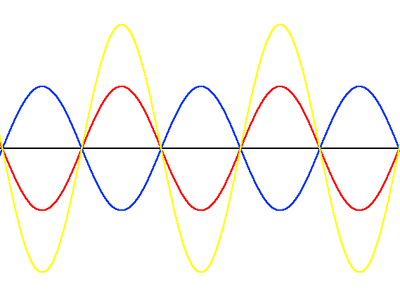
With single phase, the two legs from opposite ends of a transformer can be thought of as being 180° apart. The yellow line represents the difference between the two legs and would be the voltage you get connecting across them. I'm too lazy to show a scale but if the red and the blue are 170Vpp then the yellow is about 339Vpp, (times .707 = 240Vrms). 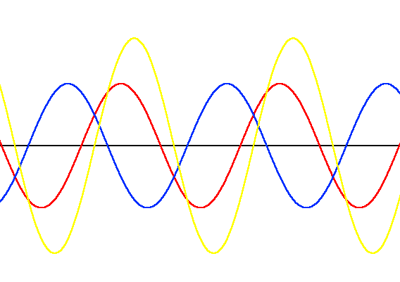 Here is three phase. Red and blue represent any pair of phases, and are 120° apart. Once again yellow is the difference between the two legs--you'll notice it is crossing the zero line when red and blue intersect. The lesser phase difference means this voltage isn't going to have as high a peak--only about 294Vpp. Times .707 gives you about 208Vrms.
| IP: Logged
|
|
|
|
|
|
|
|
Steve Guttag
We forgot the crackers Gromit!!!

Posts: 12814
From: Annapolis, MD
Registered: Dec 1999
|
posted 10-21-2002 09:01 AM

Actually, First year calculus often does the approximation by means of rectangles, then trapizoids and finally arcs...at least, we did.
Visually seeing the graph, as Steve K did it is easier to see how the two sources add up. The math form actually takes more effort due to the phase shift. The periodic sine wave takes on the form of A*Sine(theda + phi)Where A = the amplitude, Theda is the degree (in radians) of interest, and phi is the phase shift. If there is no phase shift, phi goes to 0 and it is a simple equation. When I have the time, I'll go through the whole process. Steve ------------------
"Old projectionists never die, they just changeover!"
| IP: Logged
|
|
|
|
All times are Central (GMT -6:00)
|
This topic comprises 2 pages: 1 2
|
Powered by Infopop Corporation
UBB.classicTM
6.3.1.2
The Film-Tech Forums are designed for various members related to the cinema industry to express their opinions, viewpoints and testimonials on various products, services and events based upon speculation, personal knowledge and factual information through use, therefore all views represented here allow no liability upon the publishers of this web site and the owners of said views assume no liability for any ill will resulting from these postings. The posts made here are for educational as well as entertainment purposes and as such anyone viewing this portion of the website must accept these views as statements of the author of that opinion
and agrees to release the authors from any and all liability.
|
|
|
|







 Printer-friendly view of this topic