 |
|
 Home
Products
Store
Forum
Warehouse
Contact Us Home
Products
Store
Forum
Warehouse
Contact Us
|
|
|
|
This topic comprises 2 pages: 1 2
|
|
Author
|
Topic: Audio Popping on Change-Over
|
|
|
Josh Jones
Redhat
Posts: 1207
From: Plano, TX
Registered: Apr 2000
|
 posted 11-09-2002 01:32 PM


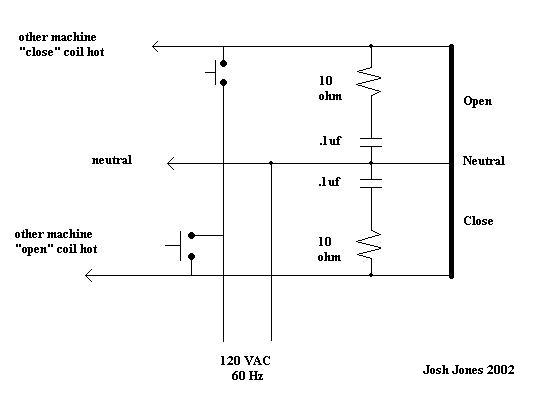
There is a piece of SLO cord coming out of the pedistal with three wires in it. Those 3 wires go into a erostrip and then up to the changeover. The snubber circuit, which had a .1uf cap and a 10 ohm resistor in series, was hanging out of the eurostrip and wrapped in yellow electrical tape.good memory eh? Josh ------------------
"Film is made of silver, video is made of rust"
'nuf said
| IP: Logged
|
|
Steve Guttag
We forgot the crackers Gromit!!!

Posts: 12814
From: Annapolis, MD
Registered: Dec 1999
|
posted 11-09-2002 05:56 PM
Oh Josh, I'm afraid you'll have to do better than that! A drawing or at least a description of a complete circuit. I (and probably Steve) could picture a capacitor connected somehow.Was the RC network across the coil or was it on one side to ground? Those are the answers we are looking for. Steve ------------------
"Old projectionists never die, they just changeover!"
| IP: Logged
|
|
|
|
|
|
|
|
Steve Guttag
We forgot the crackers Gromit!!!
Posts: 12814
From: Annapolis, MD
Registered: Dec 1999
|
posted 11-10-2002 07:01 PM
What about the resistors?They are the right way to do it on a theoretical level and seem to be doing the job here. A capacitor can not have it's voltage or current change instantaneously. Current through a capacitor is described by the equation i(t) = C*d v(t)/dt. That whole differential thing prohibits the instantaneous voltage change. As such, without the resistor, the small resistance in the wire must serve as the total resistance. Anytime you connect a capacitor or inductor directly it is technically bad design though often functional. In fact, it is this very same principle that is causing the popping sound. As the inductor (what we call a changeover coil) is disconnected, it too can not change voltage (or current) instantaneously. As the switch contacts release, the coil raises the voltage to the point it breaks down the air and causes and arc and the "pop" is born. The RC circuit gives the exponentially increasing voltage a place to go besides the switch. The capacitor directs high-frequency (a pop) to the neutral and away from the switch and other sensitive (sound) devices. So to answer your second question...it is best to put a snubber circuit as close to the source of the noise...in this case, the changeover. It isn't the switch that is causing the problem..it just receives the abuse...you would want the snubber right on the coil leads. Steve ------------------
"Old projectionists never die, they just changeover!"
| IP: Logged
|
|
|
|
|
|
All times are Central (GMT -6:00)
|
This topic comprises 2 pages: 1 2
|
Powered by Infopop Corporation
UBB.classicTM
6.3.1.2
The Film-Tech Forums are designed for various members related to the cinema industry to express their opinions, viewpoints and testimonials on various products, services and events based upon speculation, personal knowledge and factual information through use, therefore all views represented here allow no liability upon the publishers of this web site and the owners of said views assume no liability for any ill will resulting from these postings. The posts made here are for educational as well as entertainment purposes and as such anyone viewing this portion of the website must accept these views as statements of the author of that opinion
and agrees to release the authors from any and all liability.
|
|
|
|







 Printer-friendly view of this topic