Film-Tech Cinema Systems
Film-Tech Forum ARCHIVE


my profile | my password | search | faq & rules | forum home
  next oldest topic   next newest topic
» Film-Tech Forum ARCHIVE   » Operations   » Film Handlers' Forum   » Projector Light "Splatter" (Page 2)

 
This topic comprises 2 pages: 1  2 
 
Author Topic: Projector Light "Splatter"
Scott Norwood
Film God

Posts: 8146
From: Boston, MA. USA (1774.21 miles northeast of Dallas)
Registered: Jun 99


 - posted 12-01-2004 02:34 PM      Profile for Scott Norwood   Author's Homepage   Email Scott Norwood   Send New Private Message       Edit/Delete Post 
At least with 16mm, camera stock is shipped emulsion-in and the cameras that I have worked with in the past (Bolex, Beaulieu, Arriflex 16BL) are designed to take up emulsion-in.

Of course, camera stock is on acetate base (with exceptions for high-speed cameras) and is usually stored under something resembling controlled temperature and humidity conditions.

Hopefully John P. can comment on whether or not 35mm camera stock follows the same convention.

 |  IP: Logged

Monte L Fullmer
Film God

Posts: 8367
From: Nampa, Idaho, USA
Registered: Nov 2004


 - posted 12-01-2004 03:32 PM      Profile for Monte L Fullmer   Email Monte L Fullmer   Send New Private Message       Edit/Delete Post 
When movie cameras came into being back in the Edison silent days, wasn't the film path in the camera, the "S" configuration to begin with and it was just carried on from there?

Yes, I remember now, back when I was in a carbon arc,changeover house, of this discussion of the focus thing with various Union house operators if film is wound a certain direction on either the 4inch, or 5inch house reels. I've tried both, and yet couldn't tell any difference.

Had no problems changing the taps on the Goldberg rewinder motor to reverse direction, but didn't want to change the settings on the reel-end alarm being the spindle mounted variety, instead of the simple drop-ding. The firetrap roller assembly accepted either direction of payout from the supply reel. Everything was all Simplex, with XL's and Magnarcs up in the booth

Yet, there was a difference in film handling with platters on if the film was soundtrack up, or soundtrack down. I used to work at a 4screener that we had to wind soundtrack down (the film would then wind on the ring as if it was being wound on a takeup reel), for if we would wind soundtrack up, scratches would emit for some odd reason, and I would check every roller and path on where the scratching, which was flake scratching down the middle of the print, emulsion side, thus we make sure of the soundtrack down film winds soundtrack down - and this was with the old Drive-IN (Speco) LP-270's. Nice platters, but trickey problems with that plug-in diode in the switchbox, magnetic reed switch mechanisms and an occasional case of "hiccups" with the trombone's reostat. thx-Monte

 |  IP: Logged

Gerard S. Cohen
Jedi Master Film Handler

Posts: 975
From: Forest Hills, NY, USA
Registered: Sep 2001


 - posted 12-01-2004 03:54 PM      Profile for Gerard S. Cohen   Email Gerard S. Cohen   Send New Private Message       Edit/Delete Post 
The most common material for constructing a cone to prevent light leakage, in my experience, has been aluminum foil. It's easily available from the projectionist's lunchbag, is readily
shaped and easily removed.

I've heard such a cone called a "snood", "snoot" or "snout."

 |  IP: Logged

John Pytlak
Film God

Posts: 9987
From: Rochester, NY 14650-1922
Registered: Jan 2000


 - posted 12-01-2004 04:00 PM      Profile for John Pytlak   Author's Homepage   Email John Pytlak   Send New Private Message       Edit/Delete Post 
quote: Scott Norwood
Hopefully John P. can comment on whether or not 35mm camera stock follows the same convention.

Most raw stock is wound emulsion-in. I recall the film for the Aaton A-Minima is emulsion-out.

Winding orientation is more critical for projection, to reduce "focus flutter" from high levels of radiant energy.

 |  IP: Logged

Dominic Case
Expert Film Handler

Posts: 131
From: Sydney NSW Australia
Registered: Aug 2003


 - posted 12-01-2004 08:28 PM      Profile for Dominic Case   Author's Homepage     Send New Private Message       Edit/Delete Post 
quote: Stephen Furley
Negs seem to be returned from the lab emulsion out; does this mean that printers expect them to be this way?
Yes. Negs are universally stored and printed emulsion out.

 |  IP: Logged

Sally Strasser
Film Handler

Posts: 16
From: Tupper Lake, NY
Registered: Nov 1999


 - posted 12-01-2004 10:06 PM      Profile for Sally Strasser   Email Sally Strasser   Send New Private Message       Edit/Delete Post 
Blackfoil. Get it in the lighting tech's store.

It's the best thing invented for the annoying little places you get light spill. You can also use it to contain booth lighting. Great stuff! Like tin foil only matte black and a little thicker.

 |  IP: Logged

Dan Lyons
Jedi Master Film Handler

Posts: 698
From: Seal Beach, CA
Registered: Sep 2002


 - posted 12-02-2004 12:49 AM      Profile for Dan Lyons   Email Dan Lyons   Send New Private Message       Edit/Delete Post 
Oh hell.. back to the same old argument again. [puke]

Fact is that storing old films emulsion in leads to warp and base curl.
Example: Just handled a 1960's IBTech feature last week. Half the reels were emulsion in, half out. It had been stored this way for years. The emulsion out wind has good focus and the film has no warp. The "in" reels have warping and a HEAVY base curl with makes the focus flutter in and out.

I've handled several other older features like the above. Fortunately after some Film Guard and being stored tight on a core for over a year, prints tend to relax enough to play well, but still show some base curl.
Vinegar is not involved, all reels were tested with AD strips. [thumbsup]

Now then, let's get back to the topic of light spill.

[ 12-02-2004, 04:13 AM: Message edited by: Dan Lyons ]

 |  IP: Logged

Monte L Fullmer
Film God

Posts: 8367
From: Nampa, Idaho, USA
Registered: Nov 2004


 - posted 12-02-2004 01:14 AM      Profile for Monte L Fullmer   Email Monte L Fullmer   Send New Private Message       Edit/Delete Post 
Yea..remember in the old days when one would use a coffee can, split it on the seam all the way down, take tin snips to angle the edges, pop-rivet this tin back together in a cone fashion to be the "snood" of your early setups?

 |  IP: Logged

Frank Angel
Film God

Posts: 5305
From: Brooklyn NY USA
Registered: Dec 1999


 - posted 12-02-2004 04:01 AM      Profile for Frank Angel   Author's Homepage   Email Frank Angel   Send New Private Message       Edit/Delete Post 
quote: Sally Strasser
Blackfoil. Get it in the lighting tech's store.

....and unfortunately you'll pay thru the nose. Get regular household heavy duty aluminum foil instead and save some money. Or, better yet, they make a really heavy gauge foil in 6in rolls that is much heavier than the consumer heavy duty aluminum foil, but not as heavy as tin can material. It is used to cover air duct joints and (I think) they also use it to repair muffler pipes. It is backed by a strong adhesive too. None of these have a matte black finish, but in reality, if you are covering up a space where light is spilling, it really doesn't need to have that expensive black finish.....shiny aluminum works fine.

We use it all the time between lamphouses and heads in our portable system...wrap the stuff like a scarf around the shutter mouth and the lamphouse opening.

 |  IP: Logged

Kenneth Wuepper
Phenomenal Film Handler

Posts: 1026
From: Saginaw, MI, USA
Registered: Feb 2002


 - posted 02-23-2005 07:58 PM      Profile for Kenneth Wuepper   Email Kenneth Wuepper   Send New Private Message       Edit/Delete Post 
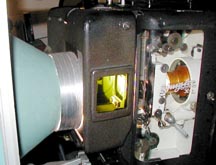
A neat way to shield the connection between lamphouse and projector case is shown here.

 -

This is the same expanding metal tubing used for stack venting of the lamphouse. It can be carefully sawed to the proper length and inserted between the lamp and projector. It can also be expanded slightly to fit as seen in the photo.

KEN

 |  IP: Logged

Darren Briggs
Master Film Handler

Posts: 371
From: York, UK
Registered: Dec 2001


 - posted 02-25-2005 07:32 AM      Profile for Darren Briggs   Author's Homepage   Email Darren Briggs   Send New Private Message       Edit/Delete Post 
I have found that 'Sound up' or Emulsion out is the best way to run on platters, helps against wraps, and helps prevent scratching of the last roller that feed the film onto the plate is miss-adjusted.
THe natural curve of the film been 'soundtrack up' means if the print is wanting to curve in, the natural curve of the film acts against the static, and minimises wraps a great deal. Not had a wrap at a site doing this for years.

Otherwise spools it s emulsion in.
Light spill is a problem and if you use Jax lights where the cell is super sensitive, it can cause all sorts of crackels and interference on the sound. Ive seen all sorts used to shield the lens-gate to prevent this.

Darren

 |  IP: Logged

John Pytlak
Film God

Posts: 9987
From: Rochester, NY 14650-1922
Registered: Jan 2000


 - posted 02-25-2005 08:32 AM      Profile for John Pytlak   Author's Homepage   Email John Pytlak   Send New Private Message       Edit/Delete Post 
quote: Darren Briggs
I have found that 'Sound up' or Emulsion out is the best way to run on platters, helps against wraps, and helps prevent scratching of the last roller that feed the film onto the plate is miss-adjusted.
THe natural curve of the film been 'soundtrack up' means if the print is wanting to curve in, the natural curve of the film acts against the static, and minimises wraps a great deal. Not had a wrap at a site doing this for years.

Remember, the "natural curl of the film" depends on the relative humidity. So the preferred winding orientation could change if the humidity is high enough to produce "negative" curl. But I do agree, that winding orientation is a factor in reducing "static cling".

 |  IP: Logged


All times are Central (GMT -6:00)
This topic comprises 2 pages: 1  2 
 
   Close Topic    Move Topic    Delete Topic    next oldest topic   next newest topic
 - Printer-friendly view of this topic
Hop To:


Powered by Infopop Corporation
UBB.classicTM 6.3.1.2

The Film-Tech Forums are designed for various members related to the cinema industry to express their opinions, viewpoints and testimonials on various products, services and events based upon speculation, personal knowledge and factual information through use, therefore all views represented here allow no liability upon the publishers of this web site and the owners of said views assume no liability for any ill will resulting from these postings. The posts made here are for educational as well as entertainment purposes and as such anyone viewing this portion of the website must accept these views as statements of the author of that opinion and agrees to release the authors from any and all liability.

© 1999-2020 Film-Tech Cinema Systems, LLC. All rights reserved.