|
|
This topic comprises 3 pages: 1 2 3
|
|
Author
|
Topic: How did 24 frams a sec. come about????
|
|
|
|
|
|
|
|
|
|
|
|
|
Leo Enticknap
Film God
Posts: 7474
From: Loma Linda, CA
Registered: Jul 2000
|
 posted 01-05-2005 05:59 PM


Dominic and Monte have got it, IMHO. The flicker/luminance trade off was the key issue, and the driving force behind it was a change in cinema exhibition patterns. Before WWI films were shown in multipurpose venues, they were relatively short and they were projected using portable projectors and limelight. The emergence of a Hollywood-led global film industry from the late teens onwards promoted a trend towards larger, purpose-built auditoria. The screens became bigger, as did the throw from projector to screen. Despite the introduction of carbon arcs, light output became a valuable commodity - hence the move from three to two-blade shutters and the consequent increase in projection speeds to get rid of the flicker.
At this point it wasn't 100% necessary to standardise shooting and projection speeds, as a margin of error exists within which most viewers won't notice that what they are seeing was shot a little faster or slower than the speed at which it's being projected. But the arrival of sound forced the issue, because the human ear is far more sensitive with audio.
The links to the SMPTE Journal reprints on David Pierce's website posted by Jeffrey tell the whole story. In addition (and as well as Eyman) the following are well worth a look, IMHO:
Kevin Brownlow, 'Silent films - What was the right speed?', Sight and Sound, 49/3 (Summer 1980), pp. 164-167.
Charlotte Herzog, 'The Motion Picture Theater and Film Exhibition, 1896-1932', PhD Thesis, Northwestern University (also 1980), UMI no. 8026823.
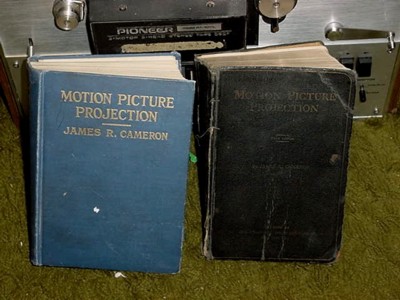
...plus also the numerous technical manuals written by a James Cameron (no relation of the director, AFAIK!) in the late '20s to early '30s for projectionists dealing with the rollout of synch sound, for a contemporary view of the standardisation process.
| IP: Logged
|
|
Jeffry L. Johnson
Jedi Master Film Handler

Posts: 809
From: Cleveland, Ohio, USA
Registered: Apr 2000
|
posted 01-06-2005 08:09 PM
"Edison Motion Pictures, 1890-1900 : an annotated filmography". Charles
Musser. ©1997. ISBN 1-56098-567-4.
quote:
Page 69:
1888-1890
Initial Formulations
Edison wrote a second and third caveat in March and August 1889; the
ideas articulated in these documents tried to solve some of the problems
inherent in his initial formulation. The inventor's fourth and last
motion picture caveat, of November 1889, was heavily indebted to the
serial photographic work of Étienne-Jules Marey, whom Edison met in
Paris while attending the 1889 Paris Exposition. This document outlined
a contrivance that passed a tape-like band of film past a camera lens,
halting and then exposing a single frame of film for a brief fraction of
a second, after which the strip was again moved forward, until the next
frame of film was halted in front of the lens and likewise exposed.
Despite the promising direction of this last formulation, Edison pursued
his cylinder experiments, from the time he opened a kinetoscope account
in February 1889 until sometime in late 1890.
Page 73:
1891
First Films
After the cylinder experiments Dickson and Heise began to explore the
possibilities inherent in the fourth, Marey-inspired caveat, in which a
narrow band of photographic film was passed through the camera. Heise
had been brought onto the project, in part, because he was expert in
devising ways to move tape-like strips of paper (or other materials)
through a machine. The Edison-Dickson-Heise experimental
horizontal-feed kinetograph camera and kinetoscope viewer, which used
3/4 [inch] wide film, were completed in the spring of 1891.
Page 79:
1892
Perfecting the Technology
Although the 3/4 [inch] horizontal feed camera worked in principle,
significant improvements in overall design were necessary before the
invention would be ready for commercial use. Following the successful
presentation of the horizontal-feed system to the press, Edison, Dickson
and Heise constructed a strudier, vertical-feed camera that utilized a 1
and 1/2 [inch] strip of celluloid film. Although the results were
similar to the system that Edison would subsequently commercialize, the
format and camera design had not yet achieved their final form.
According to notes in Edison's legal files, at least one film reflected
this intermediate phase.
Page 80:
During 1892, Dickson and Heise refined the design of their motion
picture camera. They took a number of films with this improved camera
in the late summer and early fall of 1892. Among other things, film
width was adjusted at about this time to 1 and 9/16ths of an inch
(approximately 35mm). If format is considered, these films can be
called the first modern motion pictures--though they were not shot with
commercial use in mind. Selected frames from several of these subjects
were subsequently published in "The Phonogram".
Page 83:
1893
The Laboratory Refigured
In December 1892, with the camera technology in place, the kinetograph
team commenced construction of the world's first specially-designed
motion picture studio, located on the grounds of the Edison Laboratory.
The Dickson-designed studio, completed in early 1893, was affectionately
known as the "Black Maria" after the police paddy wagons it was said to
resemble. Over the course of 1893, Dickson and Heise made at least
three films that were subsequently presented in the kinetoscope. These
were shot on film purchased from the Blair Camera Company, initially at
the cost of $2.20 per roll, 505 [inches] x 1 9/16 [inches]. (Blair
Camera Company to Thomas A. Edison, 29 April 1893, NjWOE.) The subjects
were also the first instances of commercial modern motion picture
production in the world.
Page 84:
On 9 May 1893, the Brooklyn Institute of Arts and Sciences, gave the
first public exhibition of Edison's 1 and 9/16 [inches], vertical-feed,
peep-hole kinetoscope, showing both _Blacksmithing Scene_ and _Horse
Shoeing_.
| IP: Logged
|
|
|
|
|
|
|
|
Monte L Fullmer
Film God

Posts: 8367
From: Nampa, Idaho, USA
Registered: Nov 2004
|
posted 01-08-2005 03:55 AM
...for all those are curious about the "standards" set by the SMPE of 1922:
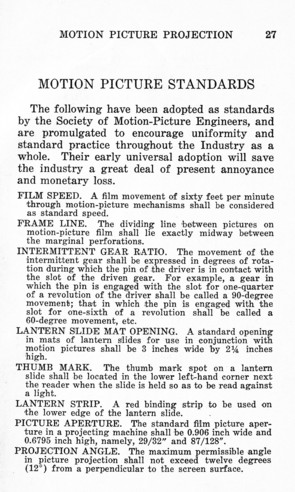
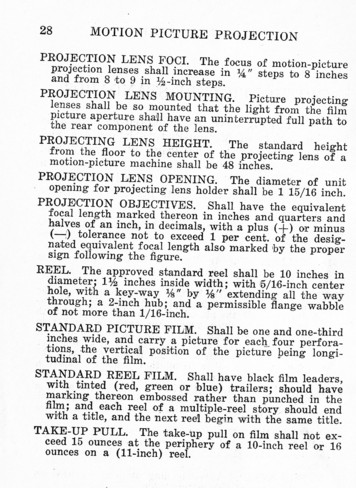
...which shows the basis of the start of this topic as for the history of the film speed.
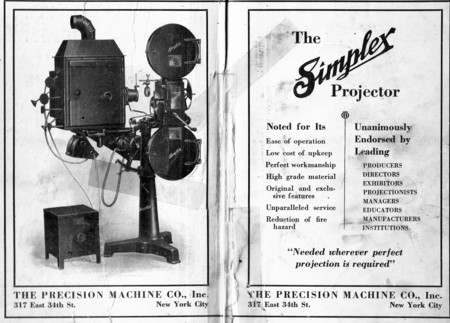
AND.....even though I erred in my earlier statement about the shutter speed for silent,16fps film speed, I wish to correct myself: I neglected to notice that the early machines of Simplex and the Powers had three blade shutters, in which the light pulse rate, with film speed at 16fps, would be 48 interruptions of light.
So, in a logical sense, with taking out a shutter blade to make the standard two blade shutter, the film speed was sped up to the now standard of 24fps to keep the same 48 interruptions of light.
Have to learn to "do the math."
thx-Monte
thx-Monte
| IP: Logged
|
|
|
|
Monte L Fullmer
Film God
Posts: 8367
From: Nampa, Idaho, USA
Registered: Nov 2004
|
posted 01-08-2005 05:16 AM
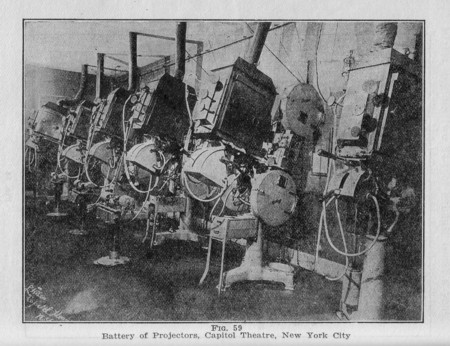
Here's a little diagram of the low-intensity lamphouse that were used in this era:
The arc rods were one size different - like 10mm positive and 8mm negative - both black, and positioned in the lamphouse at the 11 and 5 o'clock position. Low Intensity arcs were the voltage was higher than the amperage and the negative was forward a bit from the positive so the positive would burn the "bowl" needed for light emission to the condenser lenses in front of the lamphouse in that "snood" The arc burning emitted a high angle of light where the corners of the light was the same as the corners of the condenser lenses in the "snood". The condenser lenses had a long focus length where the light was concentrated to meet the aperture opening, thus why the long distance between the "snood" and the rear of the machine. These low-intensity arcs light output was so low is for the reason of such a long light angle-to try to get as much effective light to the machine as possible.
The Hi Intensity arc, both refractor (which also used the condenser lenses, like the lamphouses that Radio City Music Hall used behind those Simplex XL heads)which use a much larger condenser lens, and the reflector, which contained this angle within, thus the distance was taken up with the longer built lamphouse.
Here is a pict, with added drawings of how the Low Intensity operated behind these silent-era machines:
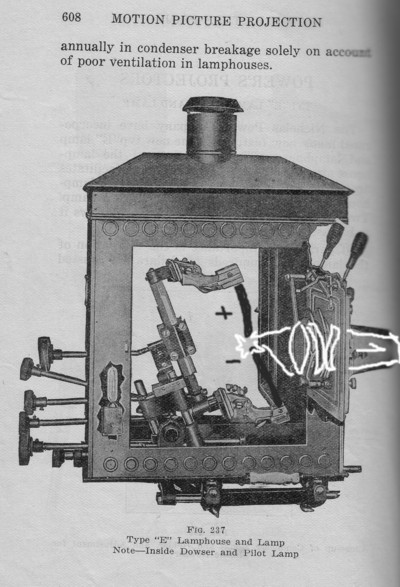
Hope this answers your question on this area.
thx-Monte
| IP: Logged
|
|
|
|
|
|
All times are Central (GMT -6:00)
|
This topic comprises 3 pages: 1 2 3
|
Powered by Infopop Corporation
UBB.classicTM
6.3.1.2
The Film-Tech Forums are designed for various members related to the cinema industry to express their opinions, viewpoints and testimonials on various products, services and events based upon speculation, personal knowledge and factual information through use, therefore all views represented here allow no liability upon the publishers of this web site and the owners of said views assume no liability for any ill will resulting from these postings. The posts made here are for educational as well as entertainment purposes and as such anyone viewing this portion of the website must accept these views as statements of the author of that opinion
and agrees to release the authors from any and all liability.
|

 Home
Home




![[Smile]](smile.gif) ), but I haven't ever seen any discussion of screen brightness in the context of screening speeds in those days.
), but I haven't ever seen any discussion of screen brightness in the context of screening speeds in those days.![[Wink]](wink.gif)



 Printer-friendly view of this topic