|
|
This topic comprises 2 pages: 1 2
|
|
Author
|
Topic: ORC rectifier goes on fire
|
|
|
Steve Guttag
We forgot the crackers Gromit!!!

Posts: 12814
From: Annapolis, MD
Registered: Dec 1999
|
 posted 07-26-2005 08:30 PM


Another controversy...
As to switchers...I only use them when I have wattage below 1600-watts or there is no choice (it is in the specification that I can't change).
I've watched switchers (current ones) die within 5-minutes of installation and no surge supressor was going to save it. Think that is bad...got a replacement...same thing happened.
Most failed rectifier based on brand/model...for us switchers...any generation. They are like ticking time-bombs with all their clocks set differently.
The big kicker is that they are not servicable. I require that if a switcher is to be in the specification, they must have a spare, just like the lamp.
As to IREMs...I've never been the big fan of them. They have that Italian elegance to them though. They cut their wires way too short and specify their components marginally. Their wire gauge and contactor choices seem to be based on the 380 voltage without any concern that more current is going to flow in countries that have 208 (nominal). The contactors that are in them now...the A16 for under 3K is only a 16A contactor and is marginal. The A30 is a 30-amp contactor and is marginal for the larger currents. We generally replace them with A26s and A40s and have cut those problems to non-existance. Likewise, on diodes, we go to 85A/1600 PIV.
IREM does charge extra for their "AFU" (aka choke) on the smaller rectifiers but it is standard on the N3-150 and up. It should be standard on all of them since they can be rough on lamps.
I have had IREMS that just sit there and do the job and those that HUM and Buzz wildly. Those that hum and buzz...it seems that even when you adjust the hum-out screws...it will just come back in a bit.
To their credit, the current adjustment just can't be beat. We have one theatre that has been chewing through diodes on the IREMs...installing surge supression has effectively arrested the problem.
I have had good and bad lamp life out of IREMS. The one location mentioned above has routinely attained greater than 5000-hours on their Christie lamps...in fact, I just changed one with 9000 hours on it! A tribute to the lamp but if the retifier was horrible, it would not have lasted either.
As to Christie rectifiers...for whatever reason, they have yielded the longest life lamps on average though they seem to be the most plagued with diode failure. Like the IREMs, upon surge supressing the power...the diode problems have gone away.
Kneisley is a rectifier that has routinely provided me with the worst lamp life so I don't know what to say about Mark's measurements...the lamps don't agree, regardless of lamp brand.
Strong's high reactance rectifiers seems to be somewhere in the middle. They do okay without much complaint. However the current version Strong decided to omit the output choke...that just can't be as good for the lamps so I expect to see shorter life spans due to lack of filtration and increased diode failure from lack of protection from the igniter coming back down the line.
MIT is the new kid on the block and they seem to have a promising rectifier. It uses SCRs instead of straight diodes. This lets them be contactorless and their troubleshooting circuit has LEDs to let the tech know which device has failed. Current is adjusted with a lever external to the unit and has 5 or so positions. I am curious about anyone that has used it and what kind of lamp life they are getting.
| IP: Logged
|
|
Mark Gulbrandsen
Resident Trollmaster

Posts: 16657
From: Music City
Registered: Jun 99
|
posted 07-26-2005 09:13 PM
quote: Steve Guttag
As to Christie rectifiers...for whatever reason, they have yielded the longest life lamps on average though they seem to be the most plagued with diode failure.
Steve,
The single biggest problem with Christie rectifiers is the lack of sufficient heat sinking. Do the math, I know you can. The real joke is that the sinks they provide are super innefficient, have low dissipation ability! You'll find that at an average power setting for a given model that only have 1/5th of the amount they really should have. You have to keep device temperature within a reasonable 30 to 40 deg. C. limiit that semis like that can stand over long periods of time. Indeed the majority of failed diodes in Christies that I replace are mechanical junction failures from repeated thermal cycling. Thank god they got smart and added a fan, but I also seem to replace ALOT of those. A smallish squirrel cage blower as was used on the old ORC rectifiers would have baan a better choice.
quote: Steve Guttag
The big kicker is that they are not servicable.
Wrong on that one, they are usually VERY easy to repair. Believe me Strong makes a pile of $$ on repairs. Shorted switching transistors account for the majority of problems with them. Unless the traces of the boards are seriously burnt off repair is simple although not as easy or as fast as working on say a Christie but it is really quite basic electronic repair. I like to think of them as huge Class D power amplifiers. The majority of time I've spent repairing them involves removing and replacing the two pounds of screws holding them together. The other thing that one must do is match the switching transistors for a VGS of about .01 volts so that all share the same amount of current. Doing so is VERY simple and the
devices are also dirt cheap... far less expensive than replacing all the diodes in a Christie rectifier. Only some of the very old Strong larger power switchers cannot be repaired because of semiconductor obsolescence.
I have quite a number of locations that get great lamp life with the Kneisleys... sold a boat load of them back in the Midwest area and customers report excellent lamp life. Might be more attributable to the hurricane blowers I always spec in on the lamphouses. I suspect that perhaps your problem may be with dirty power.
quote: Louis Bornwasser
I have no IREM's that make any form of noise.
Louis,
I just tightened up a buzzing Irem this past Saturday. I've had my share of buzzing units, especially the contactors in humid areas like yours. In all fairness ditto for Kneisley and loose cores!
As for the MIT units, its definately NOT a new idea but it does get around the expensive high current tap switch but who knows if the company will be around in a couple of years, they are a watch and wait type of thing for us. I hate selling equipment, no matter how good it is, from conpanies that then disappear in a short amount of time. Changing from diodes to SCR's is also something that can be done to just about any rectifier. All you need is a simple circuit to properly fire the gates. Many very high tech welding supplies have used scr rectification for years. Before SCR's they used Thyrister vacuum tubes.
Mark
| IP: Logged
|
|
|
|
|
|
|
|
|
|
|
|
|
|
|
|
|
|
Stephen Furley
Film God
Posts: 3059
From: Coulsdon, Croydon, England
Registered: May 2002
|
posted 07-28-2005 10:11 AM
quote: Mark Gulbrandsen
A large Mercury vapor rectifier tube.......
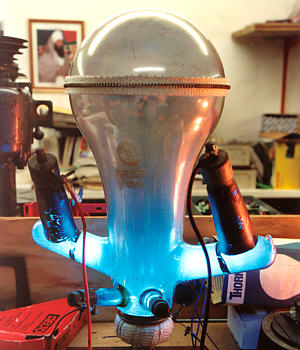
Mark, that's not large, that's tiny. A little two anode single phase job. You can get a rough idea of the size from the light bulb package behind, even if that's a large light bulb. I've seen glass bulb rectifiers over a metre high, and 12 anode steel tank ones about two metres high, and 2.5 metres across.
![[Smile]](smile.gif) The modern technology just isn't as interesting The modern technology just isn't as interesting ![[Frown]](frown.gif)
There used to be a substation on the London Underground that had rows of very large glass bulb rectifiers. At night you could see this wierd blue glow from ventilatation openings high up in the building. All long-gone now, just a few trays of solid state diodes replaced it all.
Where is that by the way? It looks like it's working, but it doesn't seem to be in the usual cabinet, with the cooling fan underneath. And what's that picture on the wall behind, it looks like Bin Laden!
| IP: Logged
|
|
|
|
|
|
All times are Central (GMT -6:00)
|
This topic comprises 2 pages: 1 2
|
Powered by Infopop Corporation
UBB.classicTM
6.3.1.2
The Film-Tech Forums are designed for various members related to the cinema industry to express their opinions, viewpoints and testimonials on various products, services and events based upon speculation, personal knowledge and factual information through use, therefore all views represented here allow no liability upon the publishers of this web site and the owners of said views assume no liability for any ill will resulting from these postings. The posts made here are for educational as well as entertainment purposes and as such anyone viewing this portion of the website must accept these views as statements of the author of that opinion
and agrees to release the authors from any and all liability.
|

 Home
Home







![[Cool]](cool.gif)


 Printer-friendly view of this topic