|
|
This topic comprises 2 pages: 1 2
|
|
Author
|
Topic: Radio Sound at Drive-Ins --- When?
|
|
|
|
|
Jack Ondracek
Film God

Posts: 2348
From: Port Orchard, WA, USA
Registered: Oct 2002
|
 posted 04-26-2006 09:19 PM


The Cine-Fi system is/was a package of rack-mounted components, which could be mixed and matched to fit your theatre and budget. If you had a working speaker system, and wanted to eliminate speaker maintenance and replacements, Cine-Fi was the way to go. It was like the LPB systems, except it was designed to work with your existing speaker wiring, instead of leaky coax. As most of Pacific's drive-ins were paved, I can see how a system like this would have been attractive to them.
The system was provided in both full-sized racks and half-sized open "relay" racks, usually on wheels.
The transmitters were 10 watt units, which were designed to feed into a "splitter" box. That box had screwdriver-adjustable pots that let you feed a portion of the transmitter's output to each of the theatre's existing rows of speaker boxes (the speaker wiring hooked up to the splitter). Some installs had a monitor of sorts, which would include an automotive AM radio, a 12v power supply and in some models, a small oscilloscope for adjusting modulation levels. A CB-type microphone allowed for paging, and there was a tape deck input for "non-sync". Larger installations could be purchased with emergency standby transmitters and switching panels to route input audio and ouput RF lines.
The system was literally self-contained. The sound-head solar cell connected right up to the transmitter, which had mic-level inputs for the projector and paging mic. Given the vintage and intended use, there was never any accommodation for noise reduction. After replacing the outside speakers with antenna clips, installation was more or less complete. At one point, all of Pacific's drive-ins in Washington State, and maybe even in California used this system. The sound was roughly comparable to what you'd get from a window speaker, which was a shame, because most AM radios back then could do much better.
There was a great article about this. I tripped over it while doing a search for something else. Can't find it now, but here's what I remember (blatant disclaimer for any inaccuracies):
In Japan, somebody had a building with an elevated parking lot. There was an activity of some kind there... can't remember if it was a drive-in, though... maybe. Anyhow, poles and speakers were out. Somebody there came up with the idea of sticking an incredibly low RF level into a wire with a clip. You clip the wire to your antenna to get the sound. In practice, some radios can pick up the signal without the clip, but a lot depends on evening skip interference.
Somehow, someone at Pacific Theatres got wind of the Japanese system and sponsored/imported/licensed its use in the US. Inventor Kiichi Sekiguchi (then of Cine-Fi International) received the 1978 Technical Achievement Award for the development of the CINE-FI Auto Radio Sound System for Drive-in Theatres (clickie).
By today's standards, Cine-Fi is pretty seriously outmoded. Of the two transmitters they made, one had a vernier analog tuning dial... really great when transmitting to today's PLL-locked radios (the transmitters drifted horribly with changes in ambient temperature). They didn't have any processing, either... not even basic limiting. You'd have to add a lot of outboard processing to make it sound very good. Some of the parts in there are pretty hard to come by, if you can find them at all.
As for FM in the '70s, there weren't many options, other than being lucky enough to have an "in" at a radio station with a good junk box. As for the 'do it yourselfers', did Broadcast Warehouse, Ramsey, Decade or Panaxis exist? Mr. Microphone, maybe ![[Smile]](smile.gif) . .
Shown below is a Cine-Fi installation, currently in use at the last "United Drive-Ins" location in Washington.
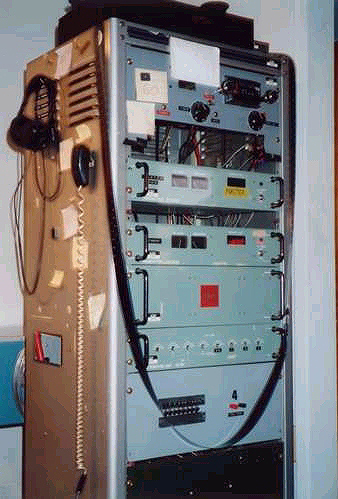
From top to bottom are:
The monitor panel (note the car radio at the upper right).
Two of the "newer" transmitters (dip switch frequency set with frequency readout, audio level and RF meters).
The "input panel", where source equipment is connected and leveled.
Finally, two versions of output splitting panels, to which the former speaker lines are connected.
| IP: Logged
|
|
|
|
|
|
|
|
John McConnel
Expert Film Handler
Posts: 118
From: Okmulgee, OK USA
Registered: Nov 2003
|
posted 04-29-2006 09:08 PM
The Riverside Drive-in in Norman, OK, had radio sound in 1959, as well as field speakers. It was an AM system, built by J. Eldon Peek of Oklahoma Theatre Supply in Oklahoma City. The antenna was a wire stretched horizontally between posts behind the back ramp.
On a different subject, Mr. Peek devised a system for the Riverside that helped prevent speaker theft. If a speaker wire were cut, the change in impedance would cause an alarm bell to sound in both the projection room and the boxoffice. The lot attendant would close the exit gate. An indicator light identified the ramp where the speaker was cut, and whether it was on the left-hand side of the field or the right-hand side. The projectionist then pressed a button, and a meter identified which pole the speaker was on.
The projection room was built above the concession stand, and the projectionist would step outside and holler to the lot attendant the ramp and pole number, and shine a light in the area of the cut speaker. Nearly all speakers were recovered.
Norman, OK, is a college town, and every new crop of students cut speakers. But after a few of them got caught, word got around, and the speaker theft stopped.
| IP: Logged
|
|
|
|
|
|
|
|
All times are Central (GMT -6:00)
|
This topic comprises 2 pages: 1 2
|
Powered by Infopop Corporation
UBB.classicTM
6.3.1.2
The Film-Tech Forums are designed for various members related to the cinema industry to express their opinions, viewpoints and testimonials on various products, services and events based upon speculation, personal knowledge and factual information through use, therefore all views represented here allow no liability upon the publishers of this web site and the owners of said views assume no liability for any ill will resulting from these postings. The posts made here are for educational as well as entertainment purposes and as such anyone viewing this portion of the website must accept these views as statements of the author of that opinion
and agrees to release the authors from any and all liability.
|

 Home
Home








 Printer-friendly view of this topic