Film-Tech Cinema Systems
Film-Tech Forum ARCHIVE


my profile | my password | search | faq & rules | forum home
  next oldest topic   next newest topic
» Film-Tech Forum ARCHIVE   » Operations   » Film Handlers' Forum   » quick guide to 35mm optical (mono vs. Dolby stereo) & Dolby Analog NR formats by year (Page 4)

 
This topic comprises 4 pages: 1  2  3  4 
 
Author Topic: quick guide to 35mm optical (mono vs. Dolby stereo) & Dolby Analog NR formats by year
Gordon McLeod
Film God

Posts: 9532
From: Toronto Ontario Canada
Registered: Jun 99


 - posted 09-24-2006 09:55 AM      Profile for Gordon McLeod   Email Gordon McLeod   Send New Private Message       Edit/Delete Post 
The cat 22 can also be set to a cleanup mode in a form of open ended NR
Also with the cat 44? red box one can turn the cat 22 into a impressive cleanup tool

 |  IP: Logged

Frank Angel
Film God

Posts: 5305
From: Brooklyn NY USA
Registered: Dec 1999


 - posted 09-24-2006 12:05 PM      Profile for Frank Angel   Author's Homepage   Email Frank Angel   Send New Private Message       Edit/Delete Post 
quote: Gordon McLeod
The cat 22 can also be set to a cleanup mode in a form of open ended NR

Gordon, you're such a tease; details...details.

 |  IP: Logged

Steve Guttag
We forgot the crackers Gromit!!!

Posts: 12814
From: Annapolis, MD
Registered: Dec 1999


 - posted 09-24-2006 12:27 PM      Profile for Steve Guttag   Email Steve Guttag   Send New Private Message       Edit/Delete Post 
Nope...gord is right on that one. I'm almost positive it was the Cat 42 that allowed one to tailor the expansion. In fact Dolby continued that theory with the Cat 280 cards by coming out with the Cat 420.

I have never laid eyes on the Cat 42 but I've sold Cat 420s...they went into cathedral situations.

Perhaps Ken or someone from Dolby will pop up and provide details on the Cat 42 or whatever the number was.

Also to note, the Dolby 364 (single channel NR unit for cinema) did have a "clean up" button.

 |  IP: Logged

Christos Mitsakis
Expert Film Handler

Posts: 242
From: Ag.Paraskevi, ATHENS, GREECE
Registered: Sep 1999


 - posted 09-25-2006 02:44 PM      Profile for Christos Mitsakis   Email Christos Mitsakis   Send New Private Message       Edit/Delete Post 
Steve,
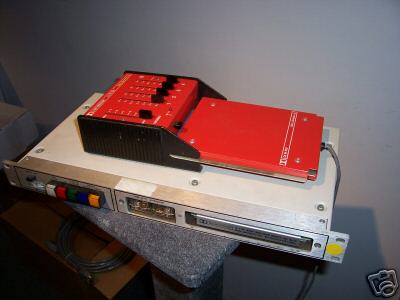
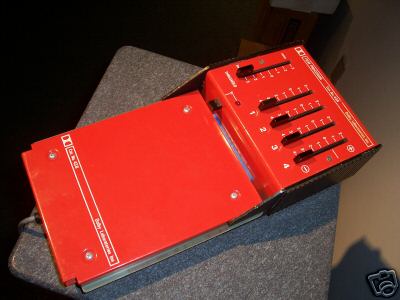
Is this the one you're refering to?
 -
 -
This was on e-bay a while ago and to be honest it is the first time I see one.
The seller said the system has been great for ambient noise reduction from location recordings. The CAT 43A differs from standard Dolby Type A noise reduction, the 4 faders control 30-80 Hz, 80-1 kHZ, 1-3 kHz, and 3kHz and up. The fifth fader is a threshold control.
I would like some more info on this.
Christos.

 |  IP: Logged

Steve Guttag
We forgot the crackers Gromit!!!

Posts: 12814
From: Annapolis, MD
Registered: Dec 1999


 - posted 09-25-2006 05:04 PM      Profile for Steve Guttag   Email Steve Guttag   Send New Private Message       Edit/Delete Post 
Yup, that is it...the Cat 43...I was mistaken above...the SR version is the is the 430...I knew that the two systems differed by a 10 multiplier (Dolby is that way on things if the Cat number is available).

The idea behind it is that one can control the expanders in the NR circuit to suit the needs of the signal. Thus one may apply only has much expansion as needed without introducing noticable pumping into the signal.

Since Dolby NR only ever affected signals below Dolby Level, one would have to set the threshold as well as the expansion (5 faders). Anything that is above the threshold is passed through un altered...anything below the threshold is expanded.

 |  IP: Logged

Charles Greenlee
Jedi Master Film Handler

Posts: 801
From: Savannah, Ga, U.S.
Registered: Jun 2006


 - posted 09-25-2006 07:01 PM      Profile for Charles Greenlee   Author's Homepage   Email Charles Greenlee   Send New Private Message       Edit/Delete Post 
I had merely pointed out that it wasn't simply beginning-1927 no sound, then sound on film. Something that is important if you are creating a timeline of basic sound formats, though retrospectivly, Fantasound didn't have much place except as a tehcnical note, nothing practical. I have seen and held a Vitascope film and disc, not that you'll ever have to worry about playing them. Most nowadays are dubbed over to mono-optical.

The cat 43, dosn't seem wholy relevant to the topic, it is something I'd like to learn about. Something that has never been fully explained to me is how compression/expansion works. The was Dolby NR works, as been explained to me, seems to be more of an equalization effect. The sound is augmented in the frequencies in which noise typically happens, then recorded to the media. At the processor, the NR decoder basically tunes down those fequencies, bringing the sound back to a normal level, and noise down with it. Is expansion/compression something different?

 |  IP: Logged

Cameron Glendinning
Jedi Master Film Handler

Posts: 845
From: West Ryde, Sydney, NSW Australia
Registered: Dec 2005


 - posted 09-26-2006 02:59 AM      Profile for Cameron Glendinning   Email Cameron Glendinning   Send New Private Message       Edit/Delete Post 
quote: Charles Greenlee
Is expansion/compression something different?
Charles this is about dynamic range (softest noise to loudest explosion), many sound mixers feel that they compress film soundtracks too much for there own liking. They are trying to play it safe, as the audience complains when its too loud!!

In the mixing suite well they have the best equipment and accoustics, so quite often it sounds great in there at Dolby 7. but real world cinema installs rearly match and cinemas often run at Dolby 5 so not to get complaints ect.

There were so many complaints about the original Jarrasic Park, that some cinemas turned up the center channel (dialogue) and reduced the dynamic range.

Ok when we listen to radio the sound is compressed to almost 1 soundlevel and played at maximum strength and uniformity. with the dolby cards above it would be possible to restore the compressed signal to its original expanded form.

sorry about the crappy explanation

 |  IP: Logged

Monte L Fullmer
Film God

Posts: 8367
From: Nampa, Idaho, USA
Registered: Nov 2004


 - posted 09-26-2006 03:01 AM      Profile for Monte L Fullmer   Email Monte L Fullmer   Send New Private Message       Edit/Delete Post 
..prob like the good ol' dbx expanders found on higher end VHS HiFi tape machines in as well as home audiophile systems..like this link points to... a few audiophiles know that audio capacity with HiFi units have about the same dB range as CD audio capacity before saturation, which was close to 90dB-thx to dbx processing. '

I would dupe cassettes, or any analog source on VHS tape using the HiFi mode and the reproduction would be astounding - thx again to the dbx process.

- Monte

 |  IP: Logged

Charles Greenlee
Jedi Master Film Handler

Posts: 801
From: Savannah, Ga, U.S.
Registered: Jun 2006


 - posted 09-28-2006 06:57 PM      Profile for Charles Greenlee   Author's Homepage   Email Charles Greenlee   Send New Private Message       Edit/Delete Post 
I see. So it'd be handy to have this unit, even for home use, if you knew what you're doing. It almost sounds like a necessity for cinema, it's a wonder why more places don't use it. I wish I had the money for one of my own, at ther very least, it's be fun to experiment with. That would teach me soo much more. You explanation helped alot, but hands on would really max out my understanding. Add this item to my Christmas list.

 |  IP: Logged

Cameron Glendinning
Jedi Master Film Handler

Posts: 845
From: West Ryde, Sydney, NSW Australia
Registered: Dec 2005


 - posted 09-29-2006 03:47 AM      Profile for Cameron Glendinning   Email Cameron Glendinning   Send New Private Message       Edit/Delete Post 
Charles dbx ect isn't so relevant today, Digital Sound doesn't really need anything more than good acoustics, quality gear and great speakers!!!!!

We really should not touch or play. Just allow the Filmmakers to do their thing. Its our job to realize their dreams, no matter how misguided they may be [Razz]

By having the gear lined up by a great tech, proper maintance of the equipment. That is what required to do our job professionally

 |  IP: Logged

Charles Greenlee
Jedi Master Film Handler

Posts: 801
From: Savannah, Ga, U.S.
Registered: Jun 2006


 - posted 09-29-2006 11:13 AM      Profile for Charles Greenlee   Author's Homepage   Email Charles Greenlee   Send New Private Message       Edit/Delete Post 
True, I was thinking for home partially, where even though I have a Dolby Digital, and DTS ready DVD player, I'm connected through RCA jacks. So I'm not getting digital sound, I'm running pro-logic. I need to get a new receiver.

 |  IP: Logged

Michael Coate
Phenomenal Film Handler

Posts: 1904
From: Los Angeles, California
Registered: Feb 2001


 - posted 10-09-2006 08:26 PM      Profile for Michael Coate   Email Michael Coate   Send New Private Message       Edit/Delete Post 
Some of you may find this off-topic, but considering the thread concerns itself in part with Dolby and its many flavors, I thought I'd make this post. I think it's worth pointing out that, in the early years especially, Dolby was something different depending on the title, which explains why the company felt "Dolby Stereo" was essentially an "umbrella" term for its family of audio formats. You'll also notice that many films (especially "A Star Is Born") were released in many versions.

Note that most of the early Dolby releases were also simultaneously offered in Academy mono (i.e. non-Dolby NR-encoded) versions. In fact, the majority of the print runs were of the mono version.

The first and/or significant/recognizable early titles follow.

Introduced 1974: 35mm optical, mono, A-type Noise Reduction
"Callan"

1974: 35mm magnetic, 3-track, A-type NR
"The Little Prince"

1975: 35mm optical, 3-channel, A-type NR
"Lisztomania"

1975: 35mm magnetic, mono, A-type NR
"The Rocky Horror Picture Show"

1975: 35mm magnetic, 4-track, A-type NR
"Nashville," "A Star Is Born"

1976: 70mm magnetic, 6-track (5-screen, 1-surround), A-type NR
"Logan's Run," "A Star Is Born"

1976: 35mm optical, 4-channel, A-type NR
"A Star Is Born," "Star Wars," "Close Encounters Of The Third Kind," "Saturday Night Fever"

1977: 70mm magnetic, 6-track "baby boom" version #1, A-type NR
"Star Wars"

1977: 70mm magnetic, 6-track "baby boom" version #2, A-type NR
"Close Encounters Of The Third Kind," "Days Of Heaven"

1978: 70mm magnetic, 6-track "split surround," A-type NR
"Superman," "Apocalypse Now," "Pink Floyd: The Wall"

1986: 70mm magnetic, 6-track "baby boom," SR-type NR
"Star Trek IV: The Voyage Home"

1987: 35mm optical, 4-channel, SR-type NR
"Innerspace," "RoboCop"

1991: 35mm digital, 6-track (5.1), SR-type NR
"Star Trek VI: The Undiscovered Country," "Newsies," "Batman Returns," "Honey, I Blew Up The Kid"

[Most of the above data first appeared in the article "Widescreen: 50 Years Of Innovation And Showmanship" (co-authored by yours truly) that appeared in Widescreen Review's 2004 Ultimate DVD Movie Guide special edition issue.]

 |  IP: Logged


All times are Central (GMT -6:00)
This topic comprises 4 pages: 1  2  3  4 
 
   Close Topic    Move Topic    Delete Topic    next oldest topic   next newest topic
 - Printer-friendly view of this topic
Hop To:


Powered by Infopop Corporation
UBB.classicTM 6.3.1.2

The Film-Tech Forums are designed for various members related to the cinema industry to express their opinions, viewpoints and testimonials on various products, services and events based upon speculation, personal knowledge and factual information through use, therefore all views represented here allow no liability upon the publishers of this web site and the owners of said views assume no liability for any ill will resulting from these postings. The posts made here are for educational as well as entertainment purposes and as such anyone viewing this portion of the website must accept these views as statements of the author of that opinion and agrees to release the authors from any and all liability.

© 1999-2020 Film-Tech Cinema Systems, LLC. All rights reserved.