|
|
This topic comprises 3 pages: 1 2 3
|
|
Author
|
Topic: nitrate still in circulation (aka Columbia Pictures and ETS/DFS, you suck!)
|
Steve Guttag
We forgot the crackers Gromit!!!

Posts: 12814
From: Annapolis, MD
Registered: Dec 1999
|
 posted 12-25-2007 04:46 PM


Sorry Scott...you are going to need to quote chapter and verse on that one...527 CMR 10.27 seems to be governing document in Mass and it appears that many locations will issue a 30-day permit for the storage and projection of Nitrate for a $25.00 fee. I didn't look into this too far but if there was a total ban, then the localities couldn't issue permits for it.
Normally what will put the fear in people is the insurance rider they will need to handle the stuff...particularly to store or project it.
While I certainly share Scott's reaction to having such a reel finding its way into general circulation as in that situation it will be handled by the wrong people. And more to the point, an unsuspecting people (both the workers and the public) as to the potential catastrophy that could result. That said, Nitrate gets WAY too much of a bad wrap as this time-bomb ready to explode at any moment buring all in sight.
There are those that actually claim that running nitrate on a platter has the advantage that they have more time to cut a burning piece of film before it hits the pack. On reels, you really are depending on the fire rollers to try and snuff it and that you only have 20-minutes, at most of fuel to burn.
This reel of film you found should definately be tested for Nitrate and pulled from circulation, regardless since it has the label of Nitrate on it...which at best misinforms and at worse confuses the issue. Hopefully, one could print a safety dupe (if none does not exist yet) that would be absent of the Nitrate designation on the edges.
At the LOC in Culpeper, being a federal installation, we only really need to adhere to NFPA-40 and LOC's own saftey regulations. Oddly enough, NFPA-40 does not carry the weight of law unless a government entity adopts it.
Steve
| IP: Logged
|
|
|
|
|
|
|
|
|
|
|
|
Stephen Furley
Film God

Posts: 3059
From: Coulsdon, Croydon, England
Registered: May 2002
|
posted 12-26-2007 05:08 AM
quote:
Section 89. The storage or distribution for purposes of public exhibition and all public exhibition of thirty-five millimeter or larger nitrate motion picture film is hereby prohibited. Violation of this section shall be punished by a fine of not less than fifty dollars nor more than five hundred dollars.
That's really badly worded; it seems to apply only to public exhabition of films, and so would presumably allow archives, labs etc. to store, transport, restore, print or otherwise handle nitrate film, which I would expect, given suitable facilities for doing so, as with other hazardous materials used in industry. But what does 'The storage or distribution for purposes of public exhibition' mean? Distribution presumably means sending a nitrate print out to a public cinema, but what about storage? Do the words 'for public exhibition' apply to distribution, or to both storage and distribution? You could read it either way, though one meaning ought to have a comma in it. I think an archive could store nitrate for preservation, but what about a depot storing nitrate prints for the purpose of sending them out for public exhibition in some other locaton where such exhibition was permitted?
Then it only prohibits public exhibition, so screening a nitrate print in a properly equipped cinema, with suitably trained staff is not allowed, but it sounds like a film society could use something like a largely wooden church hall, set up a portable projector at the back of the audience, and screen such a print, as long as it is only for members of the group, since it is not 'for public exhibition'. I am aware of somebody actually screening a few minutes of nitrate film in this way in this country many years ago. Totally inexcusable.
Then it only applies to 'thirty-five millimeter or larger nitrate motion picture film'. Why do they specify a minimum gauge? If whoever wrote the regulation thought that film smaller than 35mm was always on a safety base, then there would be no need for this. Do they mean that they're quite happy for you to screen smaller nitrate film, if you can find any? Leo and I have bot seen 16mm nitrate prints. In the very early days there were a number of small formats, mainly 17.5mm (not to be confused with the later Pathe Rural 17.5mm safety format) sometimes using standard size perforations, so that normal 35mm stock could be slit and used, this would be nitrate. Maybe you could copy the idea of the 34mm print of 'Around the World in 80 Days', take a nitrate print, reduce the width slightly, and then you could show it. I wonder how they would react if you were to claim that your nitrate print was badly shrunken, and was actually 34.85mm, therefore the regulation didn't apply!.
quote: Scott Norwood
In any case, the point of this thread was mostly just to warn people who (like me) figured that they would never see a nitrate print without a bunch of warning stickers and bands all over it that there are some out there that are not properly identified and can be dangerous to project without taking proper precautions.
Agree totally.
quote: Steve Guttag
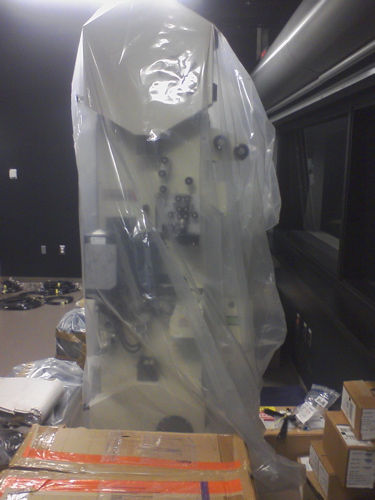
These are the screening room machines upon initial delivery. They are Kinoton FP38EQ projectors.
Steve, that's interesting. Is this a totally new building, an existing one being newly equipped for flm, or has it previously shown film, and is being refurbished?
The last newly designed and constructed cinema that I'm aware of to be licenced for nitrate was NFT2, which opened sometime around 1970, I think. The projection room is rather odd, in that it sort of extends into the auditorium, the rear part of which is actually underneath the projection room. The whole NFT complex is built on a difficult site, underneath the South end of a bridge over the river Thames, and space is very restricted.
I'd be interested to know what requirements were made in terms of design, construction, equipment and operating practice, for use of nitrate film in this place that you show. Do they have a nitrate vault on site, the NFT does, or would a print just be brought in for a show, and removed immediately, with no need for storage on site? The NFT machines have some sort of gas piped into the gates and spoolboxes; is anything similar required there? There's a raised platform at one side of the NFT2 box and there's a public walkway which crosses from one side of the bridge to the other, onto which a door leads. You can hear the projectors running as you walk past that door, and you used to be able to see the exhuust ducting rising from them, until they filled in a gap; the projectors themselves were too low down to be visible from there. I'm not sure how any members of the public would react to that door being flung open, and a couple or rather worried looking projectionists escaping from a room full of fumes! At one time you could actually see some of the stonework of the previous bridge on the othr side of the projection room, but I think this has ben covered over now.
The only obvious modification on the picture you show is the fitting of spoolboxes. These, as opposed to the plastic ones they make for some of the special venue machines just to keep dust off the film, appeared as an option fairly recently on the Kinoton website, probably within the last year or so; web page I thought it was rather odd that Kinoton should introduce them at this time. Do you know if they are a standard Kinoton product, or were they specially designed and made for this place, and Kinoton put them on the website i case anybody else was interested? There can't be many new machines being installed for nitrate now. I note that the machine shown fitted with them on the website is a FP-38EQ; is this possibly one of the machines built for that venue? I've just looked at the spec; nice machines but I wouldn't even want to think about the price!
| IP: Logged
|
|
|
|
|
|
|
|
Steve Guttag
We forgot the crackers Gromit!!!
Posts: 12814
From: Annapolis, MD
Registered: Dec 1999
|
posted 12-26-2007 09:37 AM
Monte
quote: Monte L Fullmer
..course, wouldn't it be much safer and easier to just strike poly reversal (or new negatives, then print positive) prints off these nitrate positives in fear of nitrate shrinkage due to the age of the stock itself-let alone of worrying about the chance of losing that non-replacable nitrate print in the first place??
Actually, safety prints are indeed made. One of the purposes of the screening rooms is to ensure that the dupes are as near to the original in quality as possible. The FP38EQ machines are special quality inspection machines capable of very slow motion or even "stills" (though not with Nitrate). However, there is never a true substitute for an original. I wouldn't expect you will see daily Nitrate shows...they would be special events.
quote: Jack Theakston
While I agree that nitrate prints can look pretty damn good, a well timed print off of the camera negative can look equally as rich with the right processing. Unfortunately, this is not always the case.
This has often been claimed by Kodak and some modern film makers. I have YET to hear ANYBODY that has looked at a Nitrate print ever compare any currently made film as being as good or rich looking. Nitrate just has that look. Kodak has always claimed it was the silver content but there is something else going on there.
That said, the real test would be to take an OCN and strike a Nitrate and Poly print of it and then do a critical comparison of that to minimize the variables...I doubt that has been done so all of this is subjective. I agree that a Vision Premiere EK print can look breath taking...then again, so can Nitrate...not too bad for something that is over 50-years old, at its most recent.
Stephen,
As to Mass law...in this country everything is multi-tiered. You have federal law, state, county, local...etc laws. Normally, it is the most restrictive that will apply on each item. Thus, even if the statute that Scott quoted doesn't specify the booth type, another section might (he was only providing what I asked about where in Mass. law does it prohibit showing Nitrate films since I found in County law within Mass. that one could obtain a permit to handle it. Most states (if not all) have adopted NFPA-40 into their fire codes which will put restrictions on projection rooms as well as storage facilities. So no one piece of law is sufficient to know all of the possible restrictions in this country. Each level of government has their own reasons for making (or removing) laws.
On to your questions...
quote: Stephen Furley
Steve, that's interesting. Is this a totally new building, an existing one being newly equipped for flm, or has it previously shown film, and is being refurbished?
This is a totally new building and projection facility.
quote: Stephen Furley
I'd be interested to know what requirements were made in terms of design, construction, equipment and operating practice, for use of nitrate film in this place that you show.
This is a Federal Installation (US Government)...as such it only must follow federal law. Being that it is also a Congressional installation, it really only has to follow their rules. It was a two-tiered level though...both existing Federal statutes (NFPA-40) as well as LOC's own safety regulations, whichever is more restrictive. There was no indication I could find that they ever tried to tip-toe around any saftey requirements though I was amazed at how little restriction is really in NFPA-40. For instance, the key elements to projection booths regarding Nitrate film being in the booth are that one can not exceed 75lbs. total. The film can also NOT be shielded from the sprinkler system. Thus, if the sprinkler system is activated by fire, the film is to be soaked...this is not to put out the fire (it can't) but to keep the non-blazing film from catching fire. There are also to be spinklers right above the magazines...presumably to keep the OTHER machine from igniting its waiting reel. There is no federal requirement for doors on the projectors but in states like Mass, not only were they required, they even had pieces to seal up around the lens opening (Simplex P-2970).
quote: Stephen Furley
Do they have a nitrate vault on site
Yes. This is the Nitrate storage facility for the Library of Congress (moved from Dayton, OH).
quote: Stephen Furley
The NFT machines have some sort of gas piped into the gates and spoolboxes; is anything similar required there?
Not gas, but sprinkled. The FP38EQ does have compressed air for the gates but not for any form of fire prevention...when in super-slow motion, it is used to increase film stability and focus by overcoming the effects of the heat from the xenon lamp distorting the film...again, not a feature for Nitrate as slow-motion (below 12fps) is prohibited for the Nitrate film...note too, the machines switch to 3-wing shutters below 20fps so unlike a conventional mechanical machine, there isn't this prolonged open shutter time on the film. Remember, DW Grifith was notorious for slow cranking speeds (12 fps and slower) to save on film costs!
quote: Stephen Furley
The only obvious modification on the picture you show is the fitting of spoolboxes.
The spool boxes and the firerollers are about it. They have been available for a few years now (and they are steel with a wire gauze opening for viewing of the film). They were designed to conform to Euro standards. They were most definately NOT made for the LOC project. Oddly enough, there is indeed a small market for Nitrate capable machines. I know of machines sold in the US other than LOC but not to conventional cinemas. One of many nice things about the Kinoton style of machines is that most of their features are a-la-carte. The Nitrate (or "retro version") is but an option to the FP30/38EQ. For some reason they don't want to offer it to the FP30/38ES or even the standard FP30/38E. The only thing I can imagine that would cause this is that the EQ version actively controls the lamphouse current and has a bit more control over projection speeds than the lesser units. Then again, those venues interested in dealing with Nitrate are likely also to want the features of a QC machine as well...I know it worked out that way for LOC.
Steve
| IP: Logged
|
|
Frank Angel
Film God

Posts: 5305
From: Brooklyn NY USA
Registered: Dec 1999
|
posted 12-26-2007 09:57 AM

quote: Jack Theakston
While I agree that nitrate prints can look pretty damn good, a well timed print off of the camera negative can look equally as rich with the right processing. Unfortunately, this is not always the case.
I ran quite a few nitrate prints when I first started out in the late 60s; now I realize how lucky I was to have that experience. WB as well as MGM were still sending out lots of the IBTech cartoons on nitrate stock and quite a number of still on nitrate shorts came our way. All the projectionists that I aprenticed under knew exactly what nitrate meant and pointed out all the precautions that were necessary to handle it safely. And this wasn't in a big city municipality -- it was in Brian-College Station....with dirt roads.
I must tell you that a nitrate print has a look all its own that I have never seen duplicated on any kind of safety stock. It is hard to describe other than it has a shimmering kind of quality that makes the image look "alive." OK, that sounds stupid, but I don't know how else to describe it, but I can tell you there is a papable difference and it is quite jaw-dropping, AND you can tell almost immediately when you are watching it. It is really a shame more people can't experience it. Yes, we all know the dangers nitrate presents, but we also know the dangers of lots of things but we don't forbid their use. As I said, for decades, nitrate films were shown in every theatre in the country day in and out, in booths that were properly outfitted with saftey devices, and people weren't emulated in fires. Of course a key factor was that the people handling nitrate were trained and knew what they were doing. I would wager that probably more people died in plane crashes over the years than died in theatre fires dues to nitrate film. No one ever advocated stopping air flight. Where there are safety issues with modern technology, you provide training and safety procedures to reduce the risk to as low as possible, and you get on with it and avoid acting like Chicken Little.
Banning the use of nitrate film for specific, controlled situations is assinine, IMHO.
[ 12-28-2007, 01:04 AM: Message edited by: Frank Angel ]
| IP: Logged
|
|
Leo Enticknap
Film God
Posts: 7474
From: Loma Linda, CA
Registered: Jul 2000
|
posted 12-26-2007 10:26 AM
quote: Thomas Pitt
There are non-fire ways to test whether a film is nitrate or safety, but they involve the use of unpleasant chemicals.
Trichloroethylene if you're talking about a float test - not what one would expect to find lying about in your average projection booth!
quote: Thomas Pitt
Besides, I would have thought most (if not all) nitrate prints would have deteriorated to at least stage 2 by now.
Depends on (i) the acidity of the wood pulp used to make the cellulose which goes into the original film base, and (ii) the atmospheric conditions in which the film is stored. Part of the reason the Mitchell and Kenyon collection (various elements from 1895-1913) survived with no more damage than a slight shrinkage and discolouration of the base is that, just by a lucky accident, they spent almost a century in a very cool and very dry cellar. In a warm and/or damp environment, they could have been gone within 20 years.
Personally I'd have thought that, in a 1930s nitrate print that showed up at random, you'd be more likely to have a problem with shrinkage than with the film having become sticky.
quote: Thomas Pitt
The leaders might be 'new' safety film spliced onto the original nitrate print, be careful what you test.
Agreed totally; and during the crossover period (1948 to mid-50s approx.), distributors would cobble together good prints by cutting and joining sections (and/or combining reels) from a number of existing flawed ones. When some of the inventory was nitrate and some acetate, you can imagine what happened. I've come across early '50s prints that are mainly acetate, but with the odd 300 foot section of nitrate spliced into the middle of a reel. The bottom line - if it's an original print from the danger period, check every foot. The characteristic mothball/camphor smell is the biggest nitrate giveaway, in my experience.
quote: Steve Guttag
I know of machines sold in the US other than LOC but not to conventional cinemas.
The Dryden Theater at George Eastman House in Rochester is nitrate-capable. They ran a nitrate screening evening at the AMIA conference in September. I'm afraid to say I skipped it in favour of dinner with some friends (the film was Portrait of Jennie; I've seen that once, and once was enough!) who I knew I wouldn't get a chance to see at any other point during the week, but people who went reported that it looked great.
| IP: Logged
|
|
|
|
|
|
|
|
All times are Central (GMT -6:00)
|
This topic comprises 3 pages: 1 2 3
|
Powered by Infopop Corporation
UBB.classicTM
6.3.1.2
The Film-Tech Forums are designed for various members related to the cinema industry to express their opinions, viewpoints and testimonials on various products, services and events based upon speculation, personal knowledge and factual information through use, therefore all views represented here allow no liability upon the publishers of this web site and the owners of said views assume no liability for any ill will resulting from these postings. The posts made here are for educational as well as entertainment purposes and as such anyone viewing this portion of the website must accept these views as statements of the author of that opinion
and agrees to release the authors from any and all liability.
|

 Home
Home







![[Wink]](wink.gif)




 Printer-friendly view of this topic