|
|
This topic comprises 5 pages: 1 2 3 4 5
|
|
Author
|
Topic: What is the worst film mess you've had to deal with? How did you fix it?
|
|
|
|
|
|
|
|
|
|
|
|
|
|
|
Marc Jensen
Film Handler
Posts: 20
From: Auckland, New Zealand
Registered: Jan 2006
|
 posted 06-20-2008 10:30 AM


A few months back I got a phone call with an opening line that went a little something like this: "I-was-doing-a-trailer-change-and-I-got-some-of-it-on-the-floor-and-I'm-really-panicking-man!"
In some ways it was a sentence, but some people might have reason to argue that it was more like a single, very long, compound word. It had been fired at me as if from a machine gun in the kind of staccato delivery that can be a bit worrying coming from a freshly trained projectionist.
Asking him how long he had before the next show I learned that it was still 45 minutes away, so I figured there wasn't much to worry about. I'd be able to give him some advice over the phone and that would be the end of it, right?
Wrong. ![[Razz]](tongue.gif)
As I listened patiently to the rapid-fire anecdote that didn't really make a whole lot of sense, my brain latched onto something he'd said and it was like seeing a light bulb labeled "Impending Doom" getting switched on.
"Wait, you're telling me there's a reel of the feature film on the floor?"
"YES!"
"K, I'll be right over." *click*
What greeted me as I walked in the door to the projection room was this:
- The entire trailer pack for the movie sitting in a scrambled heap on the floor.
- Reels 3, 4, 5, and 6 of the movie safely wound head out on a 7K spool near the rewind bench.
- Reel 2 was similarly on a 6K spool, also head out and attached to...
- Reel 1 out in the middle of the floor, apparently having flown there like a badly aimed flying saucer.
Naturally all my WTF moments for the week were taken care of right there. My head was reeling with questions like, "How does a simple trailer change reach the point where it becomes a polyester frizzbee?" "Ah, who gives a shit? The show must go on!" ![[fu]](graemlins/fu.gif) ![[evil]](graemlins/evil.gif)
The funny thing about film spinning at high speed is that it has a half-way decent chance of staying vaguely intact. I was was lucky in that respect, because it was a simple matter to slide the reel onto a wide sheet of cardboard, lift it onto a transport board, drop a spinner into the middle and drag it in onto that. From there it was easy to up-end onto the rewinder and wind it onto that 6K spool with reel 2. Once I'd done that I had two spools worth of movie, all head out and a platter waiting to receive.
Throughout my race to the show deadline the new projectionist to his credit moved away to attend to his show threading responsibilities. He also started dealing with the messed up trailer pack whenever he could spare the time, so I had something to be pleased about with that effort. As for me, I managed to get the print reassembled and threaded up in time for the show with a few minutes to spare.
Leaving the big question, "How?"
He'd had a trailer change to do, which was a fairly straight forward process with a movie sitting there and not playing. He had removed the ring and then started removing the trailers. So far, so good and everything was situation normal. Then the print had bulged inwards from a splice and getting the trailers out had started getting a bit awkward, so He had run into one of those one-thing-led-to-another situations with a bit of a problem developing. At this point the recommended strategy might have been to strip back to the nearest clean part of the presentation and run a show from there, or call me for advice, but instead he reverted back to what he knew... Print breakdown.
His theory that tackling the problem from the outside when tackling it from the inside was failing had one almighty flaw in it and as a result he learned a few valuable lessons that day:
1. It's best to seek advice early on when things start going wrong.
2. An inward bulge in the print is not really that big a problem (I actually shoved in the side of a running print just to prove the point)
3. A full speed platter to MUT print break down, with no ring securing the print, is a really bad idea. ![[Big Grin]](biggrin.gif)
| IP: Logged
|
|
|
|
Mark J. Marshall
Film God

Posts: 3188
From: New Castle, DE, USA
Registered: Aug 2002
|
posted 06-20-2008 02:32 PM
Not the worst problem, but a fun one none the less...
I came in to take over booth operations from a manager. Said manager was training a new booth guy, and for the moment, he only knew how to thread from the platter to the top roller of the projector then back to the platter, and that was what he was practicing.
The Problem
I came over to thread up Harry Potter V, and saw that his payout platter was spinning at a pretty good clip, and had apparently been spinning for quite a while because he had a brain wrap that went almost into the second reel of the feature. I stopped the platter and looked at the huge wrap of film thinking about my next move. The film was wrapped around the brain fairly tight, and there wasn't much hope of running it without figuring out how to undo or slack off at least part of the wrap. The show was scheduled to start in five minutes. It was the second biggest house, and it was sold out. I'm reminded of the line: "What would you do, hot shot... what would you do?"
The Solution
Step 1. Pulled the brain out of the platter, and some of the film that was wrapped around it with it. Found the splice between the leader and the first snipe, and broke it, leaving the leader on the platter. Then found the splice between the last two snipes before the feature and broke that. Lifted the resulting roll of film that made up the trailers out of the wrapped film on the platter, and laid that roll of loose film on the rewind table, tucking it all back together making it one nice neat roll.
Step 2. Put that roll of film on a split reel with a 4" core, and taped the inside of the roll of film (our first snipe) to the core itself. Mounted the split reel on the rewind table and ran the table at medium speed while holding the film loop in my hand. As the core on the split reel spun around inside the roll, it pulled the film from the roll in my hand to wrap around the core. No scratches.
Step 3. Took the 4" core off the split reel, and held it in my hand. Rewound the film on that core onto a new reel, bringing the head back to the outside of the reel, so I could run it back onto the platter.
Step 4. Put the reel on the make up table, and ran the trailers, heads in back onto the platter on an empty take up ring.
Step 5. Removed the take up ring, threaded the trailers through the brain, attached the first snipe back onto the leader that was hanging there. Finished threading the projector, and started the movie... on time. I now had about 12 minutes to figure out what I was going to do next.
Step 6. Installed a second brain back into the platter that held the print, where almost the entire first reel was wound backwards into a smaller diameter roll than the rest of the print. I threaded the head through the brain and placed it onto the left side of our Kelmar splicer which I had sitting on the platter, and disengaged the platter motor. Then we waited for the last trailer to go through. After the last trailer there would be two more theater snipes. One was our Silence Is Golden snipe which was attached to the film running through the projector now, the other was the Feature Presentation snipe which was still attached to the feature print.
*** WARNING: DO NOT ATTEMPT THIS NEXT STEP! YOU HAVE BEEN WARNED, SO DON'T EVER SAY "OH, I SAW THAT TRICK ON FILM-TECH!" IF YOU TRY THIS, THE OUTCOME IS ON YOU, NOT ME! SEE MORE DETAILS BELOW! ***
Step 7. When last trailer went through, we proceeded to pull our Silence Is Golden snipe through the brain and off the payout platter faster than the projector was pulling it, but not too fast - we didn't want to scratch it. Once we had it all off the platter, and I had it's tail in my hand, I attached the tail to the right side of the Kelmar splicer and made a quick splice to the Feature Presentation snipe on the wrapped print. Oh, I forgot to mention that I had peeled the tape off of the two ends earlier, so this was a new clean splice not a splice over another splice. Once the film pulled tight, we started spinning the payout platter (which was now the one with the wrapped print on it) backwards by hand. Since the film was wrapped backwards, if we didn't do this, we'd start wrapping the film around the brain again and we'd either scratch the film at the least, or worse risk a break and a show interruption.
Step 8. Once the feature was on the screen, we found a milk crate and set it on the floor next to the platter, sat the new guy on the milk crate and told him that his job was to spin the platter backwards by hand for the next 20 minutes until that whole wrap was through. I was back in time to re-engage the platter motor because I wanted to make sure he didn't do it too harshly and end up throwing the print off.
For good measure we cleaned the print during the next round, and everything was fine. No scratches, No dirt. But that didn't matter. Some dope scratched the movie before the week was over anyway.
For the splice on the fly routine, we had three guys. One guy pulled the tail of the film off the platter, and kept it untangled and off of the floor. I made the splice. A third guy stood by the "STOP" button on the projector just in case something went wrong and we had to stop. I do NOT recommend anyone ever try this, ESPECIALLY by yourself. It's very tricky and can easily result in a much bigger mess than you're trying to deal with. In about twenty years of projecting, I have only had to do this less than half a dozen times, always to try to keep a show on the screen... never for fun. It's not fun. And every time I do it in front of someone, I always tell them to NEVER attempt that.
I'm sure I'll get flamed for using this technique, and that's fine. The fact is the show went on, on time, the print was fine, the projector was fine, the splicer was fine, and even the new guy was fine, although he said he didn't want to be in the booth anymore after that day. All of the customers left happy and completely unaware of what happened upstairs. All in all, it was a happy ending.
| IP: Logged
|
|
Brad Miller
Administrator

Posts: 17775
From: Plano, TX (36.2 miles NW of Rockwall)
Registered: May 99
|
posted 06-20-2008 03:57 PM

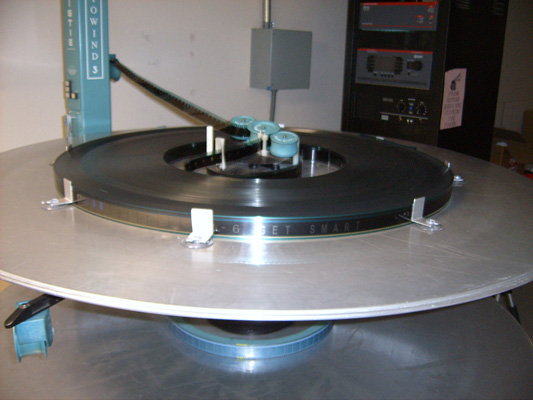
I've had to do something similar, but I did it differently since it wasn't caught until showtime. I just pulled the film out of the brain, removed the brain, took a 4 inch 70mm core (it was actually two 35mm cores taped together), wrapped it in film cleaning media, and with a loop of gaffer's tape I stuck it to the middle of the platter where the brain would have been. I then disengaged the platter motor and started the show.
For that next half hour or so, I had a worker spin the platter backwards. No big deal, it didn't flip over on itself since that tall core was in the middle. Then once the wrap was almost done with only a few revolutions left, I pulled the core off and popped the brain back in. Since it was a Christie platter and not a retarded design unlike the Strong brains, I was able to effortlessly drop the film back into the brain and the show continued. No marks of any kind and I had it up and running within a couple of minutes.
| IP: Logged
|
|
|
|
|
|
|
|
|
|
|
|
All times are Central (GMT -6:00)
|
This topic comprises 5 pages: 1 2 3 4 5
|
Powered by Infopop Corporation
UBB.classicTM
6.3.1.2
The Film-Tech Forums are designed for various members related to the cinema industry to express their opinions, viewpoints and testimonials on various products, services and events based upon speculation, personal knowledge and factual information through use, therefore all views represented here allow no liability upon the publishers of this web site and the owners of said views assume no liability for any ill will resulting from these postings. The posts made here are for educational as well as entertainment purposes and as such anyone viewing this portion of the website must accept these views as statements of the author of that opinion
and agrees to release the authors from any and all liability.
|

 Home
Home




![[Frown]](frown.gif)




 Printer-friendly view of this topic