|
|
This topic comprises 2 pages: 1 2
|
|
Author
|
Topic: 70mm reel changes vs. 35mm
|
Paul H. Rayton
Expert Film Handler
Posts: 210
From: Los Angeles, CA , USA
Registered: Aug 2003
|
 posted 07-09-2008 01:11 PM


Hi, Leo -- a couple of issues on the use of the "click" strips. What do you do if you have a **REAL** projector, like a DP-70, where you don't hear splices go through? And what about a really old print, which may have numerous splices, especially at reel heads and tails? It's an old print (and ergo "archival" -- but how does one differentiate between the clicks when, by necessity, you are standing some distance away from the outgoing machine? With all the various noises in the booth, I don't think it would be very reliable.
FWIW, the surpassingly protective George Eastman House's recommended system is chinagraph/grease pencil marks -- on the base side only, not emulsion. (You know that already, of course, but I thought I'd mention it here for the benefit of some newer readers, who may soon be finding film prints an increasingly-rare product.)
| IP: Logged
|
|
|
|
|
|
Scott Norwood
Film God
Posts: 8146
From: Boston, MA. USA (1774.21 miles northeast of Dallas)
Registered: Jun 99
|
posted 07-09-2008 02:26 PM


On occasion, with previously cut prints that lack the second set of cues but which have motor cues in place, I've figured out the proper threadup point and then used the "click" sound of the splice on the _incoming_ reel as the changeover cue. It works fine (and avoids re-cueing the print) but, as mentioned above, some projectors run splices just fine without making much noise. Straight-gate Centurys seem to be about the loudest.
Another idea for cue-less changeovers that I have considered but not implemented would be a large, visible LED display to show the DTS timecode readout. Determining the proper cue points would be an interesting problem, though, and this method would only work for DTS prints (of course).
Has anyone rigged an automation cue detector to, say, flash a light when the cue tape runs through? This would also work if the cues could be read on the edges of the film between the perfs (the FM35 can do this) where they would not be seen on screen. The operator would then just need to place the foil cues where the visible cues would normally go (plus the cue reader offset) and follow the blinky light instead of looking at the screen.
| IP: Logged
|
|
|
|
Brian Guckian
Jedi Master Film Handler

Posts: 594
From: Dublin, Ireland
Registered: Apr 2003
|
posted 07-09-2008 08:34 PM
IMHO the cues should be printed on the film as a matter of course, obviating the need for projectionist intervention via the various methods cited. They should be seen as an integral part of the film "real estate" - just like the soundtrack(s).
quote: Jonathan Goeldner
a very washed out print of 'Iron Man' produced some of the worst very visible reel change marks I've ever seen. 'Jumper' another film that looked nearly devoid of color on Uptown's screen looked terrible as well
quote: Stephen Furley
The scribed cues generally seem to be quite small, whereas many of the printed ones seem to be growing in recent years, and some are absolutely huge, and ugly, now. Of course, it's even worse on a 'scope print. Some of the printed cues I've seen have been well over 3mm in diameter. I don't know the reason for this, maybe it's a Disability Discrimination Act thing; you still have to be able to see to do a changeover even if you're almost totally blind. It looks really bad on screen.
Interesting that this has been brought up as I did research on this a few years back for a submission to a review of one of the relevant standards in this area.
This found that, for 35mm, scribed lab cues (UK sample used) were 1.40 mm / 0.055 ins in diameter whilst published standards such as SMPTE 301 stipulate a cue diameter of 2.39 mm / 0.094 ins.
Cue marks certainly shouldn't be increasing in size, unless standards are no longer being adhered to.
Plus, perceived obtrusiveness of cue marks may be caused by some laboratories inadvertently using older editions of standards that placed cue marks on 'Scope prints further into the frame area.
For example, the above submission found that whilst SMPTE 301 places 35mm cue marks for all ratios 7.14 mm / 0.281 ins in from the non-soundtrack edge of the film, a previous version of the standard placed the cue marks for 'Scope 9.70 mm / 0.382 ins in from the edge, possibly due to greater variance among cinema installations in the past.
It was also found that a print of Windtalkers ('Scope) from 2002 (to cite just one example) was still adhering to this former edition of the standard (apologies as I don't have a reference for same).
As part of the submission it was further proposed that the smaller, laboratory-style scribed cue could be adopted as an optional alternative to the standard cue, with a view to reducing perceived obtrusiveness.
(In hindsight, of course this would only be feasible for small print runs given the work required. Another possibility could be to scribe the internegative with the smaller cue but the question is whether this would be adequately visible on prints).
Regrettably, with all the focus on ![[dlp]](graemlins/dlp.gif) these issues seem to have fallen by the wayside in recent years. these issues seem to have fallen by the wayside in recent years.
| IP: Logged
|
|
|
|
Steve Guttag
We forgot the crackers Gromit!!!

Posts: 12814
From: Annapolis, MD
Registered: Dec 1999
|
posted 07-09-2008 09:19 PM
First...the AFI/Silver cues all of their film for automation use. They have EMK-1 automations (CA21's with Kinoton badges). They are a multiplex and all prints that in any way come from an "archive" even if previously plattered...are run on 2K reels...as such, to ensure no missed C/Os...all prints receive foil tabs though all theatres can and have run manually. As such, the AFI/Silver does NOT rescribe or add scribes to any prints that would fall into the above category though they have scribers for 16mm, 35mm and 70mm. Naturally, all foils are removed prior to leaving the complex.
As for lab cues...yes the standard was changed though I think it should not have. I much prefer the placement of the old CScope cue...it was smaller and safe, even on 2:1 screens. But more to the point...In my opinion, it seemed much less visible to be higher and further inside. It always seemed to get lost into the picture better.
As for 70mm in the USA...by and large...all of the prints I've seen have had lab cues...it is a very rare bird to see an un-cued print.
My version of "click tabs" is to use 3 or 4 pieces of tape, skipping a frame between tabs. It is generally audible, even on DP70s.
Note, Kinoton makes a rather nifty and relatively cheap changeover board for their current projectors. Put one in each machine and it will make changeovers back and forth. That is all it does; it is not a full automation.
Steve
| IP: Logged
|
|
Andy Frodsham
Expert Film Handler
Posts: 238
From: Stoke on Trent, Staffs, UK
Registered: Nov 2006
|
posted 07-10-2008 06:18 AM
Less of a problem now, but a real headache about fifteen to 20 years ago, was the sheer number of cues you would get on the tail of some reels. The second set of original cues would get closer and closer to the end of the reel (and finally dissapear altogether) because of careless frame removal by certain operators joining the reels together! Some 'kind' soul would subsequently oblige and add a replacement set of second cues! Now, of course, the distance between the motor cues and the change cues has been reduced, so another helpful individual adds a new set of motor cues! Now you have to sit through new motor cues, old motor cues and finally the new change cues! As the print gets even more 'eroded' away, more cues start to spring forth!
Add to this, the fact that most of these new cue dots were made using all sorts of exotic devices (none of them correct), helps indicate just what a state a lot of reel endings were in! Try doing a changeover with that lot!
| IP: Logged
|
|
Leo Enticknap
Film God

Posts: 7474
From: Loma Linda, CA
Registered: Jul 2000
|
posted 07-10-2008 06:32 AM
quote: Paul H. Rayton
Hi, Leo -- a couple of issues on the use of the "click" strips. What do you do if you have a **REAL** projector, like a DP-70, where you don't hear splices go through?
I've done click strip COs on a DP once or twice. I seem to remember that you had to open the front cover to hear them, but otherwise no problems. The only situation in which I really struggled was in a booth where the air extraction plant was so loud as to drown out more-or-less every other noise.
quote: Paul H. Rayton
And what about a really old print, which may have numerous splices, especially at reel heads and tails?
I can't remember ever having shown a print like that which didn't also have cue marks on (usually about umpteen sets, applied using a variety of methods, as Andy describes). The prints which tend not to have them are brand new ones, showprints and/or archive viewing copies of obscure titles which have had very little use.
| IP: Logged
|
|
|
|
|
|
Paul H. Rayton
Expert Film Handler
Posts: 210
From: Los Angeles, CA , USA
Registered: Aug 2003
|
posted 07-11-2008 03:30 PM
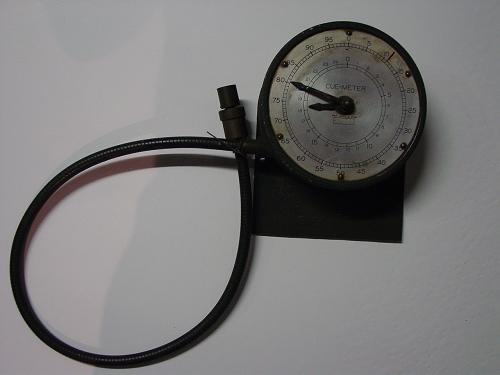
Ahhhh.... cue meters! Talk about a trip down memory lane. And -- I can provide photos!
These devices were sprinkled around many of the leading movie theatres in L.A., and I seem to recall the story was that it was devised by one of the projectionists in the L.A. theatrical local (Local 150), but I never heard a name. It says "patent pending", so maybe someone who's familiar with patent searches will be inspired from this writeup...
The other recollections are correct, it was mechanically driven, and gave you a descending display of the amount of film remaining on the reel. Here is a "long shot" of the actual device, with the drive cable:
The system wasn't exactly perfect. For one thing, it was dependant on the projectionist remembering to set the footage on the scale at the time of thread-up. Another issue was that it wasn't exactly "frame-accurate". Usually, the preparing projectionist would measure the length of each reel, in whole feet increments, which would then typically be posted on a cue sheet of some sort near each observation port, and usually be also written in tape on the leader of the reel. So, if a hypothetical reel was 1821', it would be set on the meter as shown here:
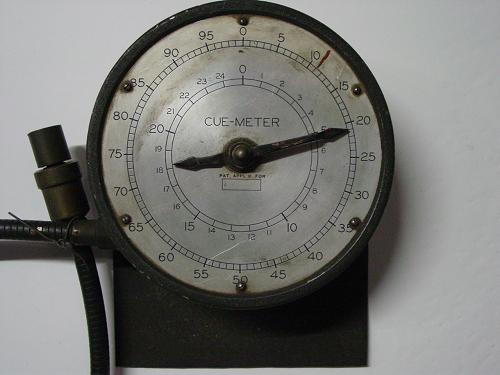
But if the reel was, actually, 1821' and 7 frames -- how did you account for that? You didn't. And, on that analog scale, you really couldn't micro-position the indicator pointer *that* closely.
When the projector started up, the pointers would operate counter-clockwise, giving an ever-descending indication of where you were in the reel. And an electro-mechanical contact inside would cause whatever bells, buzzers, and/or lights you hitched up to go off for you. Typically there would first be a "warning" at 111' and 101', and then, again at 11' and 1' points, which were the time to "do your thing". Here's a look inside, but this one seems to not have the electrical switch on it:
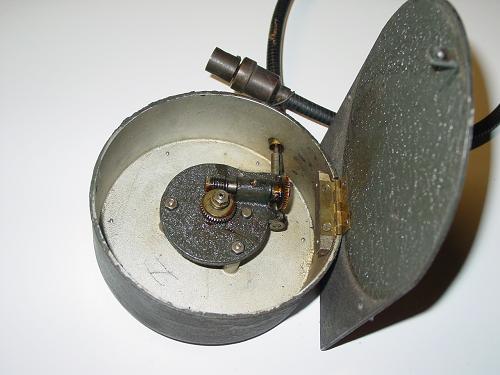
This one was rescued by yours truly from a now-closed venue on Hollywood Blvd., here in L.A., but I was unable to find the companion, so this one remains out of use. Besides which, these were more helpful for long runs, not our daily changes. Takes more time to measure every reel, is more risky for the print(s), and frankly, I'm just as comfortable with just using the optical cues anyway.
| IP: Logged
|
|
|
|
|
|
All times are Central (GMT -6:00)
|
This topic comprises 2 pages: 1 2
|
Powered by Infopop Corporation
UBB.classicTM
6.3.1.2
The Film-Tech Forums are designed for various members related to the cinema industry to express their opinions, viewpoints and testimonials on various products, services and events based upon speculation, personal knowledge and factual information through use, therefore all views represented here allow no liability upon the publishers of this web site and the owners of said views assume no liability for any ill will resulting from these postings. The posts made here are for educational as well as entertainment purposes and as such anyone viewing this portion of the website must accept these views as statements of the author of that opinion
and agrees to release the authors from any and all liability.
|

 Home
Home








 Printer-friendly view of this topic