|
|
This topic comprises 2 pages: 1 2
|
|
Author
|
Topic: What happened to Cinema Digital Sound?
|
|
|
|
|
|
|
|
|
|
|
|
|
|
|
William Short
Film Handler
Posts: 5
From: Southborough, MA, USA
Registered: Feb 2009
|
 posted 03-15-2009 02:45 PM


This recent thread reminded me I should dig up some archival materials and put them here for those curious about the early days of what eventually became CDS. In doing so, I don't mean to take away from the fabulous work done by Ron Uhlig and his team at Eastman Kodak and Howard Flemming and his team at ORC. This work was done independently, with their knowledge and cooperation, to get some quick sense of how bad the error rate might be with the small spot size they required on the film. The hope was that some quick and dirty measurements with readily available equipment would give some confidence before building up the specialized recorders and readers needed to do the definitive experiments.
I used a test target where the digital data in each column of the row was the same, so I didn't have to worry about tracking the film laterally. I made error measurements when the print was new, and then after several hundred passes through a Century C in a changeover house, spliced into their trailer reel, figuring that would be worst-case.
The photos show what the film looked like. No film cleaner in use in this booth (at least not back then). Film travel in all these images is left to right. The top image is a new print, the middle is several hundred passes, and the bottom is the image at a tape splice after several hundred passes.
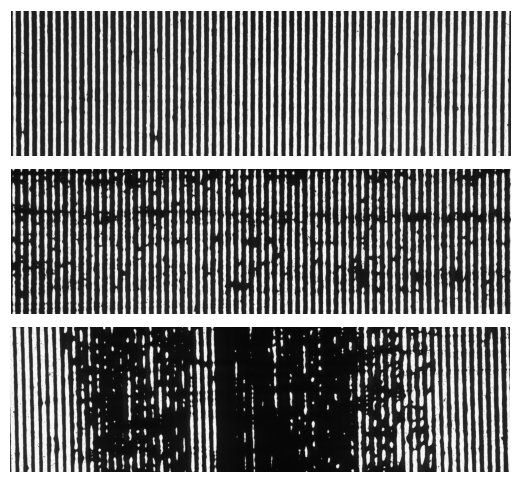
The images look pretty wretched, but the actual error rates were manageable, which encouraged the Eastman Kodak folks and ORC folks in the early days.
The next photos show the installation of the prototype CDS system in the screening room at the Eastman Kodak Hollywood sales office. The rack has a booth monitor at the top, three Yamaha stereo DSP units that provided third-octave eq, and then the rest is prototype processor. The prototype CDS reader sits atop the mag penthouse.
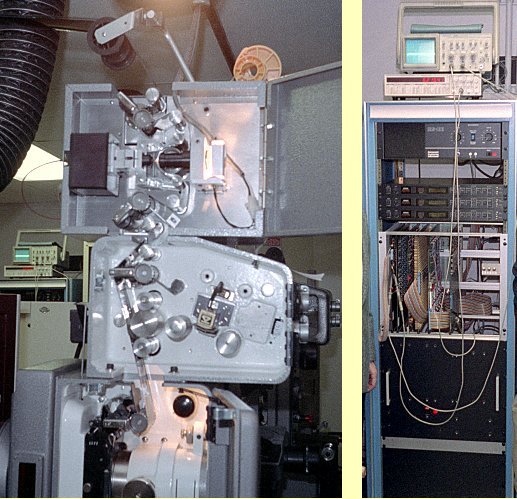
One of the reasons the processor was so big was that the custom high-performance DSP chip needed for the system failed to meet specs, and so four of these heat-generating power hogs were needed in the processor, rather than one as originally planned. Second generation processors (which were manufactured at least in pilot-run quantities, but I do not know if any were ever installed in theaters) were considerably smaller.
All the development work was done on 35mm. The reason to introduce on 70mm was purely a marketing decision, as far as I know. Track specifications were identical for 35mm and 70mm. Spot widths were the same, but spot length was 25% longer in 70mm, due to the faster linear speed of 70mm film.
One problem with 70mm was where to put the track. It had to be inboard of the perfs so it could be printed with existing machines, but there wasn't room between the perforations and the nominal projectable image. My recollection is that CDS cheated, and intruded into what nominally should have been projectable area.
The photos below compare the CDS data spot size on 35mm to the Dolby Digital 35mm spot size, at the same magnification. The individual spots on the CDS track can't be resolved at this magnification, so the track has a mottled appearance.
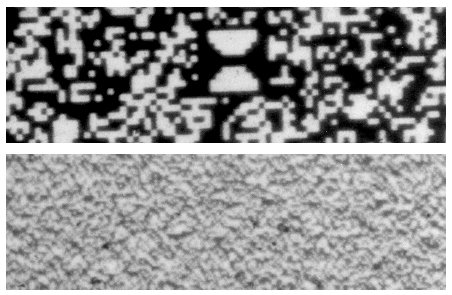
Here's a view of the CDS soundtrack image from a 35mm print at greater magnification showing the individual data spots.

| IP: Logged
|
|
|
|
|
|
|
|
|
|
|
|
|
|
All times are Central (GMT -6:00)
|
This topic comprises 2 pages: 1 2
|
Powered by Infopop Corporation
UBB.classicTM
6.3.1.2
The Film-Tech Forums are designed for various members related to the cinema industry to express their opinions, viewpoints and testimonials on various products, services and events based upon speculation, personal knowledge and factual information through use, therefore all views represented here allow no liability upon the publishers of this web site and the owners of said views assume no liability for any ill will resulting from these postings. The posts made here are for educational as well as entertainment purposes and as such anyone viewing this portion of the website must accept these views as statements of the author of that opinion
and agrees to release the authors from any and all liability.
|

 Home
Home















 Printer-friendly view of this topic