|
|
This topic comprises 4 pages: 1 2 3 4
|
|
Author
|
Topic: Century Projectors Retrofitted for Reel-to-Reel
|
|
|
|
|
John Hawkinson
Film God

Posts: 2273
From: Cambridge, MA, USA
Registered: Feb 2002
|
 posted 05-12-2009 06:51 PM


A and B wind are terms that only apply to single-perforated films, like 16mm; they don't have any meaning for 35mm.
B wind is not synonymous with emulsion-in (both A and B wind are emulsion-in). 35mm is not A or B wind, because it is double-perforated.
quote: http://motion.kodak.com/US/en/motion/Support/Technical_Information/Film_Video_Glossary/index.htm
A OR B WIND. When a roll of 16mm film, perforated along one edge, is held so that the outside end of the film leaves the roll at the top and toward the right, winding "A" should have the perforations on the edge of the film toward the observer, and winding "B" should have the perforations on the edge away from the observer. In both cases, the emulsion surface should face inward on the roll.
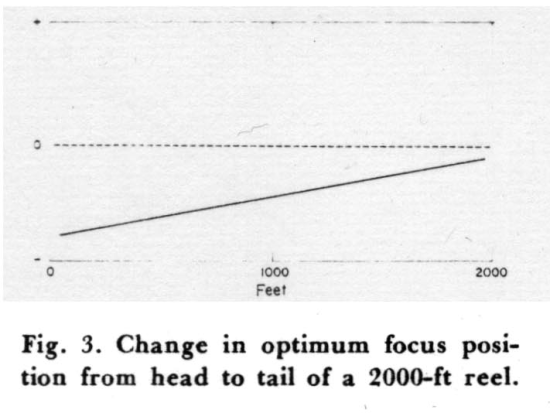
P.S.: Monte: it's not at all like eggs. Scientific measurements have been done and a twofold shift in focus position has been demonstrated for emulsion-in versus emulsion-out. You can certainly quibble about whether the measurements made in 1965 apply now, and whether they apply to polyester or just acetate, or whether they happen only at particular relative humidities. But there is no question at all of a difference under certain controled measured circumstances.
--jhawk
| IP: Logged
|
|
|
|
|
|
|
|
|
|
|
|
|
|
|
|
Brad Miller
Administrator

Posts: 17775
From: Plano, TX (36.2 miles NW of Rockwall)
Registered: May 99
|
posted 05-12-2009 11:55 PM

quote: John Hawkinson
Brad, are you saying it makes no difference for you on acetate film?
I think Brad has clearly said that emulsion-out is better for him on polyester film on platters.
My findings have been that in every instance, whether platter or reels, acetate or polyester, winding emulsion-out consistently produced the least focus drift AND didn't warp acetate film over time like storing emulsion-in does.
quote: John Hawkinson
I would not want to take-up with a halftwist on old brittle acetate prints for which this is the most pertinent (practically speaking)
Nobody should EVER twist the actual film on projector-mounted reel to reel system. If there is no other way to do it, then twisting the takeup belt is the proper solution.
quote: John Hawkinson
Also, relative humidity is very different in Texas (Brad) from the Eastern seabord (Steve and I, and for that matter, Rochester, NY, where Kodak's work was done by Preo and Yavitz). And it's well-documented that film's curl varies dramatically with RH (no debate!).
Agreed, but I have received prints that have been in storage for a long time in that area of the country that were wound emulsion in and they had severe focus drift on them when I first projected them, but once I leave them stored emulsion out for a long time, that focus problem lessened.
quote: Sam Chavez
Does anyone know what projector was used for these tests?
Sam may have very well pinpointed a MAJOR issue with the RP39 testing there.
quote: John Hawkinson
The end of the reel is definitely the place where this shows up
Yes, but the first couple of minutes matter too, but that is not from the film, it is from the optics being cold. ![[Wink]](wink.gif)
| IP: Logged
|
|
|
|
|
|
|
|
|
|
|
|
All times are Central (GMT -6:00)
|
This topic comprises 4 pages: 1 2 3 4
|
Powered by Infopop Corporation
UBB.classicTM
6.3.1.2
The Film-Tech Forums are designed for various members related to the cinema industry to express their opinions, viewpoints and testimonials on various products, services and events based upon speculation, personal knowledge and factual information through use, therefore all views represented here allow no liability upon the publishers of this web site and the owners of said views assume no liability for any ill will resulting from these postings. The posts made here are for educational as well as entertainment purposes and as such anyone viewing this portion of the website must accept these views as statements of the author of that opinion
and agrees to release the authors from any and all liability.
|

 Home
Home








![[thumbsup]](graemlins/thumbsup.gif)


 Printer-friendly view of this topic