|
|
This topic comprises 5 pages: 1 2 3 4 5
|
|
Author
|
Topic: Indian prints are weird
|
Christian Appelt
Jedi Master Film Handler
Posts: 505
From: Frankfurt, Germany
Registered: Dec 2001
|
 posted 07-06-2010 01:39 PM


Years ago, I had to handle a lot of Indian movies. We ran them single reel changeover, and most were old titles from the 1960s and 1970s, mostly art films, not the singin' in the rain stuff.
All black&white prints were acetate and usually dripping wet with oil. I couldn't imagine why, because even numerous runs through leaky projectors would not have left that much oil.
Later I talked to an film archive guy from India, and he explained it to me. He said that in India many films were run in 2000ft. changeover operation on projectors and reels in extremely bad condition. To keep acetate prints from being ripped apart by warped reel flanges and gates with maladjusted tension, some projectionists used to spread some oil on the side of each roll of film before they wound it on reels. Even if the warped flange hit the film, the stock was so slippery and soft that it would not tear.
Of course the oil didn't stop at the edges, it spread all over and took away a lot of light in projection. I never saw darker b&w projection although we had a small screen and more than adequate lamp power!
A few times the first half of a single reel left so much oil in the gate that we had to stop and clean because the image got so jumpy. Cleaning the prints before projection was impossible because they often arrived last minute. The only good thing about the oil was that it seemed to fill the base scratches at reel ends - India''s traditional FilmGuard (Ayurveda style)?
| IP: Logged
|
|
|
|
|
|
Galen Murphy-Fahlgren
Master Film Handler

Posts: 405
From: Canton, MI, USA
Registered: Oct 2007
|
posted 08-12-2010 09:47 AM
Jim, I had quite a few movies come that way. It is far better than many of the ways Indian prints often go.
Geena, that is nothing compared to the print that I got in a suitcase, out of the reel cans, no taped ends, missing several cores. The heads and tails were laying in the bottom of the suitcase, and the "reels" were hacked off somewhere in the middle of what were supposed to be the actual reels. Some were heads up, some were tails up. It was supposed to play three or five shows over a weekend and get sent out. I spent most of my time that weekend getting it sorted out, and finally got it built by the last show, which I think no one showed up for. I did confirm that it was built correctly and break it down to at least some kind of standard, what with reel cans, heads and tails marked with what reel it was supposed to be, and a burlap box. If anyone ever sees a south Indian print in reel cans that have the original labels covered in masking tape and the pertinent information scrawled in handwriting that resembles that of an illiterate vagrant, throw it off the roof for me. I would have myself, but I put too much effort into getting it on screen.
| IP: Logged
|
|
|
|
|
|
|
|
|
|
Jim Cassedy
Phenomenal Film Handler

Posts: 1661
From: San Francisco, CA
Registered: Dec 2006
|
posted 08-25-2010 09:58 AM
quote: F. Hudson Miller
Until the late 1990s all films made in Hollywood were cut and mixed on 1000 reels. After the final mix the sound stems (dia, fx, mx masters) were spliced together into A/B reels or Big Reels.
Several years ago, I was running a brand new direct-from-the-lab print of "Birdman Of Alcatraz". Since this was a new print, which arrived at the last minute, I didn't pay much attention when spooling it from the lab cores onto house reels, other than to make sure I had cue marks, since I was running change-overs.
Midway through the first reel, as I had my back to the screen inspecting another print, I thought I saw flashes of light reflecting off the port-hole onto the booth wall. But I turned around and everything was OK.
During the 2nd reel, I saw this again, and I turned around just in time to realize that the print I had was printed up from 1000ft 'editorial' reels, and for some reason the lab had not removed all the "TAIL:PART 1A - CUT HERE - HEAD:PART 1B- {COUNTDOWN}" leadercrap between the "A" & "B" sections.
I already had reel 3 threaded up, but I pulled it off the projector and found it was the same way. After making the necessary cuts just in time to re-thread & do the change-over, I went checked and found ALL the reels have been printed this way.
When I later informed the distributer of this, they were pretty pissed since they had paid the lab an extra fee to remove all the inter-reel heads & tails, which they apparantly had not done.
| IP: Logged
|
|
|
|
Jim Cassedy
Phenomenal Film Handler
Posts: 1661
From: San Francisco, CA
Registered: Dec 2006
|
posted 08-28-2010 10:26 AM
The biggest problem I've been having lately with prints
from foreign (excluding Canada & Hong Kong)labs is a lack
of consistant frame line position between reels of the
same print that are printed on different printers.
This causes one or more of the reels to be slightly "out
of frame" when the assembled print is shown.
(WARNING: MY USUAL ANTI-PLATTER RANT AHEAD! ![[uhoh]](graemlins/uhoh.gif) ) )
Of course this is no problem when I run changeovers,
since I can mark the frame knob with tape so that
I can frame each reel as required, but on platters,
it often results in having to find a 'compromise'
framing position which often cuts off tops of heads
or else still leaves a visible frame line on some
reels if no universal compromise framing position can
be found. (Of course, as far as I'm concerned, EVERY
platter show I run is a compromise, but I'll save
that for another rant!)
I recently had a print of an excellent German film
with one reel printed slightly out of frame. It really
bothered me. Due to running multiple screens, it would
be impossible for me to run to the booth to re-frame
twice during each show so that the frame line wouldn't
be visibile on screen. The picture was SCOPE, so there
was no 'wiggle room" with the framing as there might
be on a flat print. We couldn't get a replacement reel
or print.
Since it was only one reel that was bad, I cut an
extremely thin strip of aluminium I found in my junk
drawer to make a "mask" for the (Century)aperture plate.
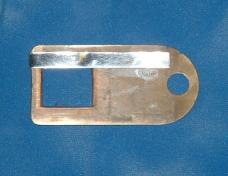
This actually worked without cutting off either subtitles
or tops of heads on the 'good' reels and perfectly hid the
annoying visible frame line on the 'bad' reel.
If you try this, the metal strip needs to be extremely
thin, or you'll have trouble getting your ap plate in.
One end is bent around the edge of the aperture plate,
and the rest held in place by friction once it's shoved
into the projector.
| IP: Logged
|
|
|
|
|
|
|
|
|
|
|
|
All times are Central (GMT -6:00)
|
This topic comprises 5 pages: 1 2 3 4 5
|
Powered by Infopop Corporation
UBB.classicTM
6.3.1.2
The Film-Tech Forums are designed for various members related to the cinema industry to express their opinions, viewpoints and testimonials on various products, services and events based upon speculation, personal knowledge and factual information through use, therefore all views represented here allow no liability upon the publishers of this web site and the owners of said views assume no liability for any ill will resulting from these postings. The posts made here are for educational as well as entertainment purposes and as such anyone viewing this portion of the website must accept these views as statements of the author of that opinion
and agrees to release the authors from any and all liability.
|

 Home
Home




![[Eek!]](eek.gif)





 Printer-friendly view of this topic