|
|
This topic comprises 4 pages: 1 2 3 4
|
|
Author
|
Topic: Stadium seating vs non-stadium seating
|
|
|
|
|
|
|
|
|
Bobby Henderson
"Ask me about Trajan."

Posts: 10973
From: Lawton, OK, USA
Registered: Apr 2001
|
 posted 10-13-2010 03:09 PM


quote: Manny Knowles
What are we defining as "stadium seating" ?
I consider an auditorium "stadium seated" if the aisles utilize stair steps for reaching most or all of the rows in the room. If the aisles don't have any stairs then obviously the auditorium is a traditional "sloped" room.
It's kind of funny to imagine a stadium seated theater with aisles that have no stairs, only steep ramps instead. Ah yes, the slapping thud of someone plotzing on the floor and spilling his snacks all over the place. Better yet, put a rise down at the bottom of the ramp right in front of the exit. Someone in a wheel chair could leave the room pretty damned quick! Weeeee!
quote: Richard Hamilton
Bobby, I'm gonna have to agree with Manny on this. A properly spec'ed and EQ'd room won't have "echo" problems.
Yet many of them do have echo problems. It's a common feature at a lot of AMC's theaters.
I have to repeat my complaint about many stadium seated theaters being under-equipped in terms of speakers and amplification. Lots of multiplex sites use the same surround enclosures in every auditorium from very small rooms to really big. They just use more of the tiny enclosures in the biggest houses.
It seems like the bigger the stadium seated room is designed the more shitty the sound will be. The larger cubic areas of air space seem to filter out some of the mid and upper frequency registers. A lot of the bass just falls dead as well. If the sound is turned up to an adequate volume it often sounds boomy and harsh. More often than not the sound is just pretty weak, particularly on the bass end.
IMAX typically installs more powerful sound systems appropriate to handle a large cubic area of air space. You get good and even powerful bass response in such theaters. However, I have never heard an IMAX auditorium sound excellent. And what I mean by excellent is very clean, clear response from bottom to top. The best sloped theaters I've visited have accomplished that task. Small auditoriums (with the right equipment) can accomplish that regardless of seating style, but at the cost of low seat count and a small screen.
This reminds me of the similar principle of how live concerts in various arenas usually don't sound so good.
By the way, a sloped auditorium delivers a better surround sound field than stadium seated theaters can manage. Some of this has to do with the shitty choices and shitty placement of surround array speakers in stadium seated auditoriums.
quote: Tom Petrov
What does anyone have to say about THX stadium seat theaters?
I think THX watered down their specs or something. The best stadium seated theaters I've visited don't sound nearly as good the best sloped theaters I've visited, particularly when it comes to comparing THX certified sites.
Properly maintained/equipped sloped THX theaters could feature an accoustically "dead" air space. The quiet nature of the room would give it a tight feel, even if you were standing in a big auditorium like the long gone GCC Northpark #1 house. And then if the sound system was well designed and maintained it could deliver one hell of an experience. Theaters originally built with stadium seating, the high ceilings, etc. just don't have that acoustic character.
| IP: Logged
|
|
|
|
|
|
|
|
|
|
Scott Norwood
Film God

Posts: 8146
From: Boston, MA. USA (1774.21 miles northeast of Dallas)
Registered: Jun 99
|
posted 10-13-2010 07:43 PM

Personally, I haven't been able to correlate sound quality with tiered vs. sloped seating. Some rooms sound great and some don't (and I am sure that some of this is the room itself and some is the quality of the sound system and installation). And the rooms that sound worst for film usually sound great for live music (and vice versa).
I'm still a bit clueless on proper room design, but wouldn't the room dimensions and overall shape have more of an effect on sound quality than the presence or absense of tiered seating? Or is the problem that the steps add extra reflective surfaces (unless carpted)? Is there a measurement for a room's "liveness"? If so, is there a cinema standard (other than "as dead as possible")?
One thing that I really don't understand is this: some rooms have problems with particular frequencies (which are the same in all parts of the room), while other rooms sound different everywhere (and will give radically different measurements on an RTA depending upon microphone placement). I assume that this has something to do with how "live" the room is, correct? If not, then what causes this? (Admittedly, most of the rooms that I know best are older theatres and are, to some extent, "problem" rooms. I haven't had the chance to take RTA measurements in a well designed modern multiplex auditorium. There may be something else going in in those houses.)
What is sort of interesting is that different rooms in the same multiplex can sound radically different. Assuming that the same person did the installation and alignment, this leads me to believe that the difference is in room design (or, perhaps, equipment selection).
| IP: Logged
|
|
Manny Knowles
"What are these things and WHY are they BLUE???"

Posts: 4247
From: Bloomington, IN, USA
Registered: Feb 2002
|
posted 10-13-2010 08:47 PM
I don't know about "as dead as possible" -- i've known a few rooms to be declared "too dead" and i've actually seen acoustic treatment, installed during construction, removed during tuning to bring some "life" back to the room -- and those rooms ended up sounding great to my ear.
dimensions do play a role -- i don't know if dolby still recommends a trapezoid shape (where the side walls are not parallel) to mitigate effects of standing waves -- that's more to do with shape, but in terms of dimensions, larger rooms will have longer reverberation times, which will render speech less and less intelligible -- so acoustic treatment becomes more critical in larger venues -- note that this has nothing directly to do with whether an auditorium has stadium seating or not -- for example, Mann's Chinese Theatre (in Hollywood) has raked seating whereas the cinemas around the corner at the Arclight are much, much smaller, with stadium seating -- Arclight is not perfect (even though they THINK they are) but their rooms DO (at least) APPEAR to be deader -- I would attribute this to the combination of room size and level of acoustic treatment applied.
As for why some rooms in the same complex sound different -- most obviously, some rooms are larger and some are smaller -- differences in shapes -- different equipment installed -- tuned by different people -- or by the same person at different times -- inconsistent approach to tuning -- whether by multiple techs or even the same one -- i know a few people who don't do it the same way each time.
| IP: Logged
|
|
|
|
Steve Guttag
We forgot the crackers Gromit!!!

Posts: 12814
From: Annapolis, MD
Registered: Dec 1999
|
posted 10-14-2010 06:57 AM
quote: David Stambaugh
With sloped seating, even with seats staggered and with plenty of legroom, how do you mitigate the possiblity of 1 or 2 people sitting in front of you with their heads blocking part of the screen? I like sloped seating too but even the best sloped design will have this problem. With stadium seating it's virtually impossible to have a head blocking part of your view. What am I missing?
What you are missing is an understanding of the physics of the problem. If you do a sight-line drawing, you will find that what is in play are the screen height, the slope and the seated eye-height of the particular patron.
It IS possible to design a sloped floor theatre without any obstructed views. It is also possible (and easy) do design a stadium theatre with obstructed views.
Depending on the risers of the stadium and depending on the screen height, a stadium theatre will indeed have some questionable rows...about 2/3rds back...typically. The key being to ensure your screen height is high enough so that your risers can overcome the effective lowering of the screen as the individual is raised by sitting in the rear portion of the theatre. A sloped floor does not raise the person as much and thus the screen high need not be as high for all persons to have an unobstructed view. When you get a stadium, typically, the front row is HORRIBLE with neck strain too excessive because the screen is SO high relative to that row
Again, do a sight-line study (preferably in CAD) and by moving the bottom of the screen you can quickly see the dynamics of how that screen height and riser height inter-play with each other.
As for acoustics...I have not found a distinct trend other than the ceiling gets much closer at the rear of the typical stadium. This can and has compromised the surround placement by simply not having any more ceiling height to raise them up. It also brings up the need to have the rear surrounds high/far enough away from the rear listeners yet be heard further down in the stadium.
As others have noted, is REAL important to allow for the stadium height and ensure the projection beam is not going to be obstructed by patrons either maliciously or accidentally as well as to allow for the surround speakers to be properly placed. The overall ceiling height must allow for that...then again, as the ceiling is raised...in the front you are going to have a harder time controlling the reverberation between the tall ceiling and the floor in the front of the room.
-Steve
| IP: Logged
|
|
Frank Angel
Film God

Posts: 5305
From: Brooklyn NY USA
Registered: Dec 1999
|
posted 10-14-2010 09:52 AM
quote: Joe Redifer
You name your auditoriums after people instead of numbering them? That seems a bit pretentious to me. It was bad enough when I worked for Madstone and they called the auditoriums by letters instead of numbers, but actual names?
Hey, what can I tell you -- we are a performing arts center -- pretention is our middle name. ![[Big Grin]](biggrin.gif)
Besides, we only have 4 theatres, and only three of them have names -- each named after a famous Brooklyn "son." The forth is a black box called The New Workshop Theatre. So it's easy to remember....even for the mentally challenged administrators with their barely functioning frontal lobes, although I must say, it would be fun seeing how they'd handle a megaplex of say 25 screens...heh heh.
And Ian, yah, the Sam Levenson may be the small one, but as everyone will tell you, it's not the size that matters, but knowing how to use it (everyone, that is, who've got small ones). ![[Razz]](tongue.gif)
Actually, Sam performed on our big stage many times in the day and to sold out houses too; he and the Levenson family were our more famous supporters. They were subscribers and donors for many seasons and when he passed, the family totally refurnished what was a lecture hall (hence the stadium seating) into this really sweet, intimate theatre space:
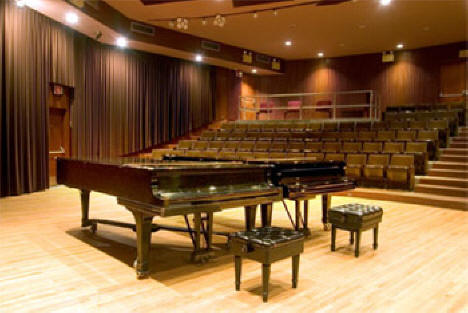
Only problem with it -- the projection booth is not centered and it's a short throw too, so there is sideways keystoning that I don't think even digital could fix....if we had digital (we don't).
Sadly, this theare will be demolished within a few months along with the George Gershwin -- two perfectly viable, functioning theatres...as well as our entire office complex.
Bureaucratic imbeciles. ![[Mad]](mad.gif)
| IP: Logged
|
|
Bobby Henderson
"Ask me about Trajan."
Posts: 10973
From: Lawton, OK, USA
Registered: Apr 2001
|
posted 10-14-2010 10:15 AM
quote: Manny Knowles
you're conveniently overlooking the plain fact that many sloped (or raked) houses exhibit the same problem. i think it's possible to do both auditorium styles correctly AND incorrectly.
I have heard echo problems much more often in stadium seated auditoriums than I have in traditional sloped auditoriums. Stadium seated auditoriums typically have a much larger volume of cubic airspace due to the really high ceilings. Add to that a giant, wall to wall fixed-width screen. That may aggravate the problem.
quote: Manny Knowles
and you have not answered my other question -- which "certain" frequencies "seem" to suffer? (and where's the data that proves the theory?)
I'll repeat what I said in my first post in this thread. I'm not an audio engineer and I don't have reams of data conveniently on hand to prove what I am saying. Nevertheless, I am not imagining things. Stadium seated theaters at their best never sound as good as the best sloped theaters.
Surround imaging has obvious problems in stadium auditoriums because of the extreme differences in vertical space from one speaker to the next. The back wall speakers have to be stuffed up close to ceiling height. Transient fly-by surround pans end up sounding far less convincing.
I've never heard a large stadium seated theater do sub-bass with excellent quality (tight punchy, clean bass that can move the air in your chest but not sound sloppy and boomy). Bass sound waves are gigantic, but perhaps the geometric shape of the stadium seated room is doing something to mess up those bass waves. Maybe the greater tendency of echo is causing reflection and cancellation problems. I don't know. At most newer multiplex sites whatever needs to be done in terms of proper speaker choices, wall treatment, room design, etc. is not happening. They can make these rooms sound loud, but not great.
Brad also repeated some of my same complaints about crappy sound in stadium seated theaters. He might have a little more detail on the specifics in how a big, cubic stadium seated auditorium design can mess up audio quality.
| IP: Logged
|
|
|
|
All times are Central (GMT -6:00)
|
This topic comprises 4 pages: 1 2 3 4
|
Powered by Infopop Corporation
UBB.classicTM
6.3.1.2
The Film-Tech Forums are designed for various members related to the cinema industry to express their opinions, viewpoints and testimonials on various products, services and events based upon speculation, personal knowledge and factual information through use, therefore all views represented here allow no liability upon the publishers of this web site and the owners of said views assume no liability for any ill will resulting from these postings. The posts made here are for educational as well as entertainment purposes and as such anyone viewing this portion of the website must accept these views as statements of the author of that opinion
and agrees to release the authors from any and all liability.
|

 Home
Home








 Printer-friendly view of this topic