|
|
This topic comprises 3 pages: 1 2 3
|
|
Author
|
Topic: Vistavision ????
|
|
|
|
|
|
|
Leo Enticknap
Film God
Posts: 7474
From: Loma Linda, CA
Registered: Jul 2000
|
 posted 11-19-2013 10:05 AM


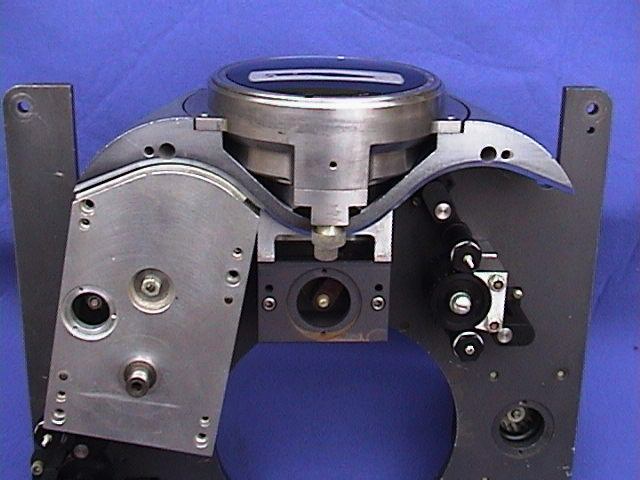
Being hypothetical and speculating aloud for a moment, I wonder how feasible it might be actually to do an (essentially) authentic VV screening? Assuming that at least one working projector could be assembled (and if only one, it could be fed from a platter, presumably, though it might need modification to run at 180 feet per minute, especially towards the start of the movie), the remaining obstacle would be finding, or making, a release print of a movie.
I'm going to assume that there are no remaining VV projection prints from the '50s that would still be showable. Acetate from that far back, even if it's spent some of its life in an atmospherically controlled archive vault, is likely to be so brittle that projection at 180 feet per minute is not going to be viable, even if colour dye fading doesn't rule that route out (though at least some of the '50s VV projection prints were IB - I've seen one on a bench).
So we're looking at a new print. Problem: most if not all of the major restoration projects of VV films have involved creating new preservation masters, either optically reduction-printed to 4/35, or by the Robert Harris technique of transferring the image (I believe by contact printing, though am not 100% sure) to 5/65.
The lowest-practical-cost route nowadays would probably be to scan a surviving VV IN (to avoid having to recreate photochemical post-production steps, e.g. timing and incorporating opticals, that you'd have to if you went back to the camera neg - in effect, a full-scale restoration), do basic, one-click colour correction on it, Arrilaser (or equivalent)-out a new IN, create a new track neg and then make your new print on a high-speed continuous contact panel printer, just as you would a normal 4/35 one. Sound cameras exist that can basically just take a balanced line in (e.g. this one), and so an existing restoration track master could be used as the source pretty easily. I'm not sure how possible it would be to master a new VD track (if you wanted to go the whole hog and incorporate Perspecta): at one point in the not-too-distant past, Martin Sawyer Sound Services in London offered this service (i.e. they had a VD sound camera in working order), but whether they still do or not, I don't know.
Even so, I'm guessing it would be a $50k-$70k project to come up with a release print of a full-length VV feature doing it this way. It would be a great museum project if it could be done, though, and one of the headline features for which the system became famous (e.g. White Christmas or North by Northwest) could be seen again in VV projection.
| IP: Logged
|
|
Stephen Furley
Film God
Posts: 3059
From: Coulsdon, Croydon, England
Registered: May 2002
|
posted 11-19-2013 11:11 AM
quote: Leo Enticknap
Being hypothetical and speculating aloud for a moment, I wonder how feasible it might be actually to do an (essentially) authentic VV screening? Assuming that at least one working projector could be assembled (and if only one, it could be fed from a platter, presumably, though it might need modification to run at 180 feet per minute, especially towards the start of the movie), the remaining obstacle would be finding, or making, a release print of a movie.
I don't think it would be technically difficult, but very expensive. If you couldn't find a complete original projector you could probably hire Mark's one, or the similar one which I saw at the exhibition at Grip House Studios probably still exists somewhere. (I don't suppose that was your machine there, was it Mark? You'd need to find some way to mount an optical sound head, possibly further away than normal, and delay the sound by a suitable amount. Depending on how authentic you wanted to be you could also use DTS; easier to fit a timecode reader than a soundhead.
Even with polyester would a complete VistaVision print fit on a platter? If it was much more than about two hours you'd probably need an intermission.
quote: Leo Enticknap
I'm going to assume that there are no remaining VV projection prints from the '50s that would still be showable. Acetate from that far back, even if it's spent some of its life in an atmospherically controlled archive vault, is likely to be so brittle that projection at 180 feet per minute is not going to be viable, even if colour dye fading doesn't rule that route out (though at least some of the '50s VV projection prints were IB - I've seen one on a bench).
The reel of 'Battle of the River Plate' which I saw was totally magenta, but the triacetate base seemed fine, and it ran through the projector ok, but that was probably about 15 years ago. I have triacetate prints of several shorts from the '50s which still run fine, and doesn't the NFT still run several of the Festival of Britain 3-D prints occasionally? I agree though, you'd probably need a new print; if a complete IB one existed in projectionable condition it would probably be considered to valuable to risk screening.
quote: Leo Enticknap
So we're looking at a new print. Problem: most if not all of the major restoration projects of VV films have involved creating new preservation masters, either optically reduction-printed to 4/35, or by the Robert Harris technique of transferring the image (I believe by contact printing, though am not 100% sure) to 5/65.
I believe the restoration of 'Vertago' was mainly done in 8-35, with conversion to 5-65 being done at the end of the process. There are some frames from a 8-35 workprint in the Widescreen Museum. I think a complete interpos, or interneg, or possibly both, exists. If an interneg then that would almost certainly be your cheapest option, but if only an interpos then the cost of making a neg would be high. The new 8-35 elements may be missing things like the restoration credits.
quote: Leo Enticknap
The lowest-practical-cost route nowadays would probably be to scan a surviving VV IN (to avoid having to recreate photochemical post-production steps, e.g. timing and incorporating opticals, that you'd have to if you went back to the camera neg - in effect, a full-scale restoration), do basic, one-click colour correction on it, Arrilaser (or equivalent)-out a new IN, create a new track neg and then make your new print on a high-speed continuous contact panel printer, just as you would a normal 4/35 one. Sound cameras exist that can basically just take a balanced line in (e.g. this one), and so an existing restoration track master could be used as the source pretty easily. I'm not sure how possible it would be to master a new VD track (if you wanted to go the whole hog and incorporate Perspecta): at one point in the not-too-distant past, Martin Sawyer Sound Services in London offered this service (i.e. they had a VD sound camera in working order), but whether they still do or not, I don't know.
Still sounds a very expensive process, unless the restoration was being done anyway and the new VV print could be made as part of that project. Could the print be made direct from the digital files, or would a negative have to be made for conventional printing?
I think Kodak ceased production of VD recording stock around 1965. I doubt if anybody else continued much longer, so you wouldn't be able to record a new negative. I think new prints can still be made from existing VD negatives, though existing tracks are sometimes re-recorded as part of a restoration process. If I remember correctly, this was being done with 'The Third Man' the last time I was at the BFI.
Not all VV prints were VD; the odd reel which I saw at the college when I was there had a VA track. I don't know what the film was. Isn't an existing track negative likely to be useable, and in better condition than Chromogenic picture elements? Perspecta is no problem; there are several original integrators in working order, or for an easier option use one of Dion's cards. I'd lend them mine, plus an old SA-4 to put it in if necessary!
quote: Leo Enticknap
Even so, I'm guessing it would be a $50k-$70k project to come up with a release print of a full-length VV feature doing it this way. It would be a great museum project if it could be done, though, and one of the headline features for which the system became famous (e.g. White Christmas or North by Northwest) could be seen again in VV projection.
I think that may be a conservative estimate the way prices are going these days, for a single print that will be shown how often, and in how many theatres? How many people would even know what the difference was? Probably better to make a 5-70 print; at 1.85 the frame area is similar, and there are plenty of places which can still run 70 mm.
| IP: Logged
|
|
|
|
|
|
|
|
|
|
|
|
|
|
|
|
All times are Central (GMT -6:00)
|
This topic comprises 3 pages: 1 2 3
|
Powered by Infopop Corporation
UBB.classicTM
6.3.1.2
The Film-Tech Forums are designed for various members related to the cinema industry to express their opinions, viewpoints and testimonials on various products, services and events based upon speculation, personal knowledge and factual information through use, therefore all views represented here allow no liability upon the publishers of this web site and the owners of said views assume no liability for any ill will resulting from these postings. The posts made here are for educational as well as entertainment purposes and as such anyone viewing this portion of the website must accept these views as statements of the author of that opinion
and agrees to release the authors from any and all liability.
|

 Home
Home







 Printer-friendly view of this topic