Film-Tech Cinema Systems
Film-Tech Forum ARCHIVE


my profile | my password | search | faq & rules | forum home
  next oldest topic   next newest topic
» Film-Tech Forum ARCHIVE   » Operations   » Film Handlers' Forum   » need a wiring diagram for Hertner Transverter (Page 3)

 
This topic comprises 3 pages: 1  2  3 
 
Author Topic: need a wiring diagram for Hertner Transverter
Steve Kraus
Film God

Posts: 4094
From: Chicago, IL, USA
Registered: May 2000


 - posted 05-07-2016 12:34 AM      Profile for Steve Kraus     Send New Private Message       Edit/Delete Post 
Bringing up this thread to ask if, before silicon rectifiers, were arc lamp supplies always M-G sets (AC motor spinning DC generator) or were they ever rotary converters like Stephan Shelley was discussing.

Like this:

https://en.wikipedia.org/wiki/Rotary_converter

I'll summarize in case the link ever fails that it was like a motor and generator merged into one but some of the energy can go directly (via brushes, slip rings, and commutator) while some moves mechanically (compared to an M-G where all the power goes through mechanically). They were common for electric railways.

I'm wondering if maybe the power output wasn't smooth enough for projection arc use where non smooth power would cause flicker as it interacted with the shutter. Or maybe they were only practical in very large sizes and for lamps an M-G was more cost effective.

 |  IP: Logged

Jim Cassedy
Phenomenal Film Handler

Posts: 1661
From: San Francisco, CA
Registered: Dec 2006


 - posted 05-07-2016 01:32 AM      Profile for Jim Cassedy   Email Jim Cassedy   Send New Private Message       Edit/Delete Post 
quote: Steve Kraus
were arc lamp supplies always M-G sets (AC motor
spinning DC generator) or were they ever rotary converters

In the very early days, huge mercury vapor rectifier tubes were
used to supply the DC for the arcs. I actually encountered a few
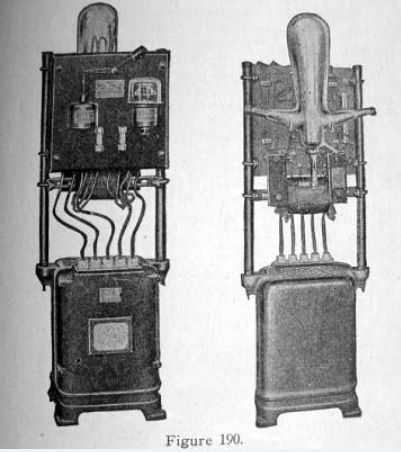
of these still in use in the early 1970's! Here's a front & rear
picture from a 1926 projection manual I have in my collection:
 -

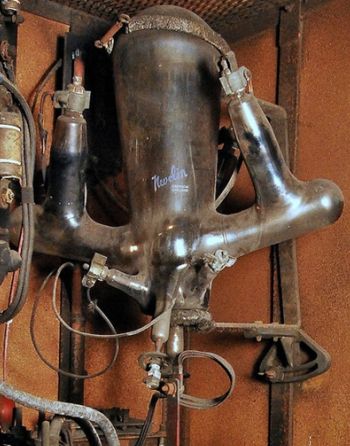
The tubes looked like some apparatus out of Frankenstein's lab.
I came across one of these mercury rectifiers in an old theater:
 -

 |  IP: Logged

Stephan Shelley
Jedi Master Film Handler

Posts: 854
From: castro valley, CA, usa
Registered: Nov 2014


 - posted 05-07-2016 12:42 PM      Profile for Stephan Shelley   Email Stephan Shelley   Send New Private Message       Edit/Delete Post 
I have heard from others that on rare occasions rotary converters were used in theatres for the DC supply for the arc lamps. The big drawback is they don't always sync the same and the polarity is a 50/50 chance of being correct. Usually theatres that used rotary converters would have a polarity reversing switch.

In the case of the railway power rotary converter there is a startup sequence done by a drum switch sequence and the motor that drives the drum switch also runs a small generator that polarize the field on startup so it always sync the correct way. Sacramento Northern portable sub 1 is the one I am familiar with and was designed to run automated and unattended. When the voltage dropped below the threshold level for an specific amount of time it would fire up and after the train passed shut down again all on it own. This is late teens electro/macanical tech. In this case made by GE.

 |  IP: Logged

Steve Kraus
Film God

Posts: 4094
From: Chicago, IL, USA
Registered: May 2000


 - posted 05-08-2016 12:52 AM      Profile for Steve Kraus     Send New Private Message       Edit/Delete Post 
Funny you mention that as the Illinois Railway Museum is just outside the little hamlet of Union, Illinois and utilizes about 4.5 miles of the right of way of the old Elgin & Belvidere electric interurban (trolley) line which folded around 1930. Union warrants a footnote in trolley history as the location of the first automated substation, working just as you describe.

 |  IP: Logged

Stephan Shelley
Jedi Master Film Handler

Posts: 854
From: castro valley, CA, usa
Registered: Nov 2014


 - posted 05-08-2016 01:39 AM      Profile for Stephan Shelley   Email Stephan Shelley   Send New Private Message       Edit/Delete Post 
The one I am referring to is now at the Western Railway museum near Rio vista CA. Years ago it was the sole source of 600 volt DC power for the museum now it is in standby service. I think they fire it up once a month. A sister machine also from the Sacramento Northern but was a fixed location is at the railway museum near Pairs CA. Interestingly the build that that rotary was in is at the Western Railway museum and houses a solid state supply. The Western Railway museum operates a section of the Sacrament Northern.

Back to the mercury valve rectifiers they were also used for railway power. No glass but metal enclosers. There is also the sister Ignitrons developed by Westinghouse.

 |  IP: Logged

Stephen Furley
Film God

Posts: 3059
From: Coulsdon, Croydon, England
Registered: May 2002


 - posted 05-09-2016 10:17 AM      Profile for Stephen Furley   Email Stephen Furley   Send New Private Message       Edit/Delete Post 
Those mercury arc rectifiers are tiny. Much larger ones exist, even as glass bulbs. Railways used both types; the Manx Electric Railway retired their last ones just a couple of years or so ago, and even the London Underground had some large glass bulb types, there used to be some in a substion next to one of the stations, and at night you could see the weird blue glow inside. The biggest steel tanks I have seen are 12 anode ones, about two metres in diameter.

There's an old pumping station in London with two very large triple expansion engines and two steam turbine sets, which is now a museum. The electrics are 200 V d.c. The original rectifiers were scrapped, but the museum people managed to obtain suitable replacements from the Royal Opera House of all places.

web page

Still quite small. I believe that the glass bulbs were blown by hand; must have been quite a job.

 |  IP: Logged

Tony Bandiera Jr
Film God

Posts: 3067
From: Moreland Idaho
Registered: Apr 2004


 - posted 05-09-2016 11:52 PM      Profile for Tony Bandiera Jr   Email Tony Bandiera Jr   Send New Private Message       Edit/Delete Post 
Here is the link to a video of a large mercury arc rectifier in action..The Manx Railroad on the Isle of Man:

Manx Mercury Arc Rectifier

 |  IP: Logged

Buck Wilson
Jedi Master Film Handler

Posts: 894
From: St. Joseph MO, USA
Registered: Sep 2010


 - posted 05-10-2016 12:31 AM      Profile for Buck Wilson   Email Buck Wilson   Send New Private Message       Edit/Delete Post 
I mean, I know those are "reliable" and "relatively safe" but dear god am I the only one that would not dare go near one of those things??

 |  IP: Logged

Alan Plester
Expert Film Handler

Posts: 209
From: great yarmouth england
Registered: Apr 2001


 - posted 05-10-2016 06:53 AM      Profile for Alan Plester   Email Alan Plester   Send New Private Message       Edit/Delete Post 
Fascinating thread and pictures. we had the cage of the old mercury rectifier in the defunct projection room , I often wondered what it really looked like when operating, my old chief, described it as a large octopus, and recalled the day it went bang, nasty mess

 |  IP: Logged

Jim Cassedy
Phenomenal Film Handler

Posts: 1661
From: San Francisco, CA
Registered: Dec 2006


 - posted 05-10-2016 09:09 AM      Profile for Jim Cassedy   Email Jim Cassedy   Send New Private Message       Edit/Delete Post 
quote: Buck Wilson
am I the only one that would not dare go near one of those things??
and
quote: Alan Plester
recalled the day it went bang, nasty mess
No, Buck, you are not alone. The very first theater I was permanently assigned
to had one of these monstrosities. It was a big, high-voltage device in an open
frame crammed into a small booth, and I was always a bit apprehensive around it.

My fears were not unfounded, as one night the thing "went bang" when I came
into work and threw the knife switch that turned it on. I was peppered with
glass shards, and fortunately I happened to be looking away from it when it
exploded or I might have gotten glass (and worse yet- - mercury!) in my eyes.
I was finding little balls of mercury all over the booth for weeks afterwards.

Believe it or not, they had a 'spare' tube, and continued to use the unit for
about another year before they replaced it with a "Sil-Tube" rectifier when
one of the transformer or choke windings in it overheated and began to
belch smoke and then 'flame-out' and burn up.

But as long as they continued to use the old unit, after the 'exploding bulb'
incident, I had always kept my distance and always turned my back to it
when switching it on at the beginning of my shift.

 |  IP: Logged

Stephen Furley
Film God

Posts: 3059
From: Coulsdon, Croydon, England
Registered: May 2002


 - posted 05-10-2016 03:19 PM      Profile for Stephen Furley   Email Stephen Furley   Send New Private Message       Edit/Delete Post 
I don't mind Mercury rectifiers, but I think I'd keep my hands a bit further away than the man in the video. Xenon lamps on the other hand do worry me.

 |  IP: Logged

David Buckley
Jedi Master Film Handler

Posts: 525
From: Oxford, N. Canterbury, New Zealand
Registered: Aug 2004


 - posted 05-10-2016 09:14 PM      Profile for David Buckley   Author's Homepage   Email David Buckley   Send New Private Message       Edit/Delete Post 
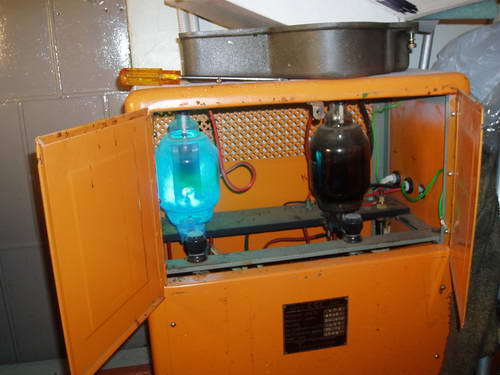
We had a mercury arc rectifier in our booth until relatively recently:

 -

And, of course, there is the old, now removed, mercury arc based New Zealand HVDC link, some really big mercury arc valves in that! (PDF).

 |  IP: Logged

Alan Plester
Expert Film Handler

Posts: 209
From: great yarmouth england
Registered: Apr 2001


 - posted 05-11-2016 05:25 AM      Profile for Alan Plester   Email Alan Plester   Send New Private Message       Edit/Delete Post 
WOW, they be some seriously big tubes.

 |  IP: Logged

Stephan Shelley
Jedi Master Film Handler

Posts: 854
From: castro valley, CA, usa
Registered: Nov 2014


 - posted 05-12-2016 03:51 PM      Profile for Stephan Shelley   Email Stephan Shelley   Send New Private Message       Edit/Delete Post 
The Royal Opera house may have had to do with spotlight power. Also some stage houses back in the day like to use DC for incandescent light sources so there is no flicker. There were some places like Shay's Buffalo that had 25 HZ AC. The flicker was noticeable.

 |  IP: Logged


All times are Central (GMT -6:00)
This topic comprises 3 pages: 1  2  3 
 
   Close Topic    Move Topic    Delete Topic    next oldest topic   next newest topic
 - Printer-friendly view of this topic
Hop To:


Powered by Infopop Corporation
UBB.classicTM 6.3.1.2

The Film-Tech Forums are designed for various members related to the cinema industry to express their opinions, viewpoints and testimonials on various products, services and events based upon speculation, personal knowledge and factual information through use, therefore all views represented here allow no liability upon the publishers of this web site and the owners of said views assume no liability for any ill will resulting from these postings. The posts made here are for educational as well as entertainment purposes and as such anyone viewing this portion of the website must accept these views as statements of the author of that opinion and agrees to release the authors from any and all liability.

© 1999-2020 Film-Tech Cinema Systems, LLC. All rights reserved.