|
|
This topic comprises 4 pages: 1 2 3 4
|
|
Author
|
Topic: Can You Identify This Lamphouse?
|
|
|
|
|
|
|
|
|
|
|
|
|
|
|
Monte L Fullmer
Film God
Posts: 8367
From: Nampa, Idaho, USA
Registered: Nov 2004
|
 posted 03-12-2015 11:46 PM


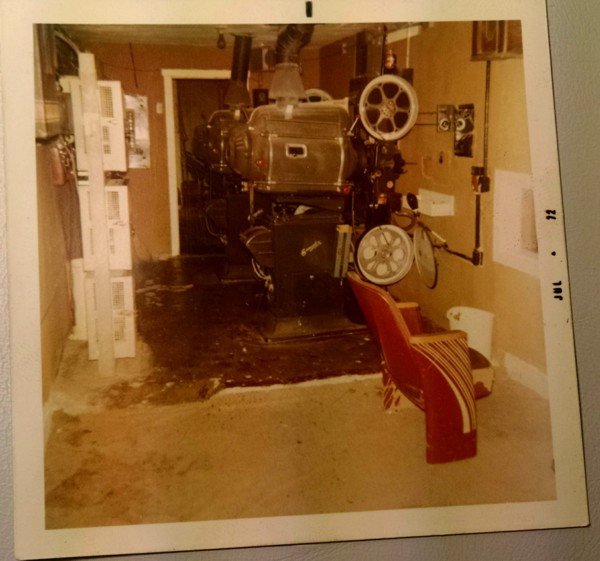
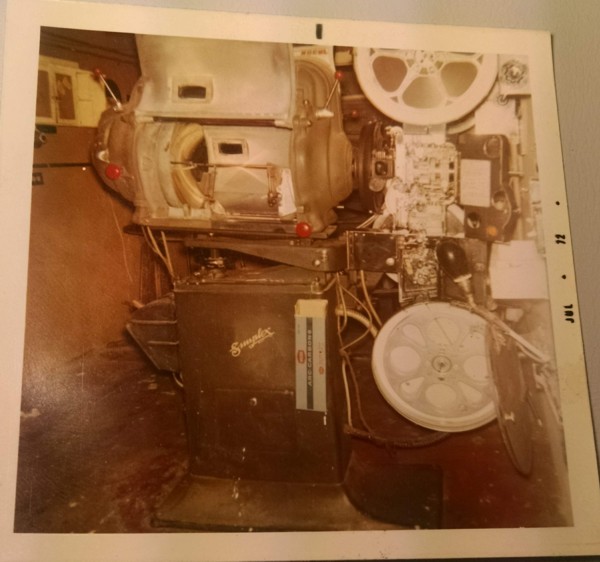
Booth I ran in 1971-1972. Royal Theatre, Rigby, Idaho.
Simplex E7
W.E.206 Sound heads
STRONG Mogul
Motiograph sound (location did have Motiograph Mag sound but the cheap owner yanked it out-too complicated for him.)
Booth wall used to end at the edge of the concrete, but the owner knocked that wall out to make the adjoining room like a screening room - complete with theatre chair, large viewing window and speaker, I mounted, above the window.
Place burnt down in 1980 from a coal furnace explosion. auditorium floor was wood along with the stage. In 1973, the above equipment were switched out for xenon, PR35's, early 5 star sound heads and 6K reel cue changeovers.
| IP: Logged
|
|
|
|
|
|
Monte L Fullmer
Film God
Posts: 8367
From: Nampa, Idaho, USA
Registered: Nov 2004
|
posted 03-22-2015 10:20 PM
Hi Jim ..
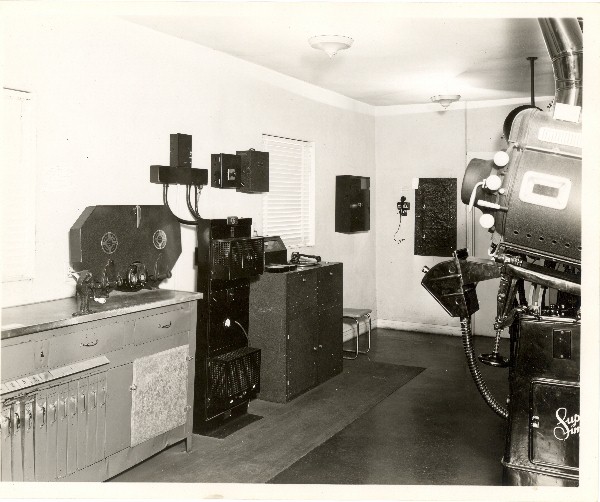
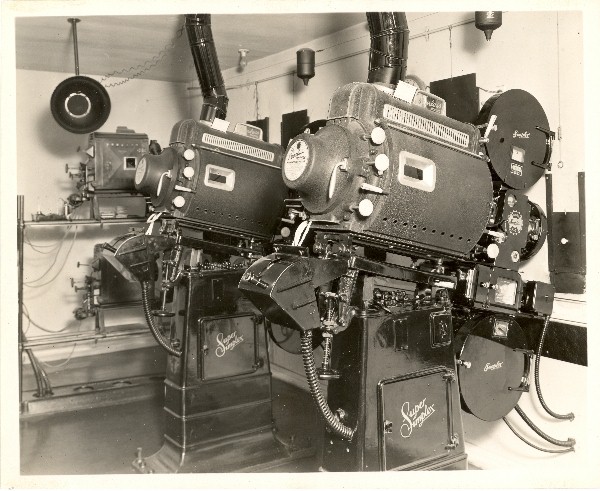
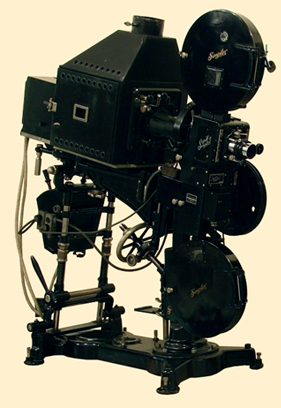
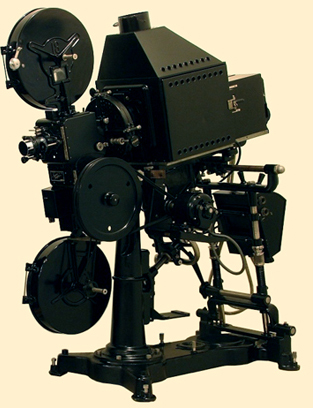
If you look at the publicity picture of the two Supers with the W.E.'s, then look carefully behind the picts that I posted, one can see that same flywheel behind the soundhead.
True, these predicate the current scanner drum setup with the sound gate.
This setup did function quite well with no problems.
I kept an eye on the twin round fibre belt condition and tension, which in itself was a trick with skewing the motor just right so the two belts were pulling at the exact tension together.
If the pulldown sprocket was new, or reversed to expose the good side of the tooth, the wow and flutter were held in check at a good rate - so explained to me by the service tech that would take care of these units on a contract basis...and how I began in the interest in projection technician field is with this setup since the mgr didn't have the foggiest on how to operate this booth in a professional manner.
there were two sprockets in the head - the upper one was the pulldown sprocket, and below it was the holdback sprocket, so a loop can be formed between the two sprockets-like a 4Star (or RCA) setup.
The pulldown sprocket was attached to the shaft that the flywheel was mounted on the other side.
Unit had a monster four pin, bulb photocell in the can behind the threading area.
With having this belt driven setup, these projectors ran superbly quiet along with very smooth ramp up to film speed.
With this slow ramp up speed, I had to frame down between "5" and "6", instead of the usual "8" in the lighted aperture plate area to make clean changeovers.
-Monte
| IP: Logged
|
|
John Eickhof
Jedi Master Film Handler

Posts: 588
From: Wendell, ID USA
Registered: Jan 2000
|
posted 03-23-2015 12:23 PM

Yes Jim, the WE 1A, 206 & 208 as well as the early RCA PS 2-22 soundheads had sound gates and were considered 'low fidelity'. The WE-211 was a sprocketless sound attachment that had a spring clutch equipped flywheel for better stability, it used the lower feed sprocket of the projector head to pull the film through it. The invention of the 'rotary stabilizer' in Europe by Tri-Ergon was the turning point where the flywheel action coupled with finer optics of the slit lens resulted in the 'high fidelity' systems. RCA had the PS-24 and then the MI-1040/1050 and then the MI-9001, and finally the MI-9030/9050 series. IPC used the Tri-Ergon style stabilzer also. WE built Century's R-2 and R-6 soundheads but had to use a magnetically coupled stabilizer as they would not pay the license fees to Tri-Ergon for the RCA style stabilizer. (It is still thought by many that there was no finer soundhead ever made in relation to wow and flutter than the R-2 / R-6) Ironically, the WE Designed Motiograph SH-2500 had the liquid filled Tri-Ergon stabilizer! Unfortunately, due to design, the flywheel was not hermetically sealed like RCA & IPC and the damping fluid was known to dry out in the Motios and severe wow would result! (Have seen many of them!)That is why Century used a solid flywheel with dampening rollers in all their subsequent designs. NTS did the same with the modern 5 Star Simplex soundheads. The cost of manufacture was greatly reduced not having to build the liquid filled stabilizer. Like Monte, I used to have to rack up on #3 on the leader when I ran WE 1A Universal Soundheads, even with a Regular or Super on them they would just be up to speed by changeover!
| IP: Logged
|
|
|
|
|
|
|
|
|
|
All times are Central (GMT -6:00)
|
This topic comprises 4 pages: 1 2 3 4
|
Powered by Infopop Corporation
UBB.classicTM
6.3.1.2
The Film-Tech Forums are designed for various members related to the cinema industry to express their opinions, viewpoints and testimonials on various products, services and events based upon speculation, personal knowledge and factual information through use, therefore all views represented here allow no liability upon the publishers of this web site and the owners of said views assume no liability for any ill will resulting from these postings. The posts made here are for educational as well as entertainment purposes and as such anyone viewing this portion of the website must accept these views as statements of the author of that opinion
and agrees to release the authors from any and all liability.
|

 Home
Home








 Printer-friendly view of this topic