|
|
This topic comprises 2 pages: 1 2
|
|
Author
|
Topic: Advice sought about image sizes in a historic theater
|
|
|
|
|
|
|
Frank Angel
Film God

Posts: 5305
From: Brooklyn NY USA
Registered: Dec 1999
|
 posted 06-07-2016 07:49 AM


Sometimes I think sometimes you just need to say, "This just won't work." The compromises will be too detrimental to the quality of the presentation and audiences really deserve better than that...and so do the filmmakers -- the directors and hundreds of actors and technicians who put their creative talents together to make that motion picture, not to mention sometimes years of their lives. All deserve that the last link in the chain -- the projection of that film -- will do it justice.
All the compromises mentioned will "work," sure, but for the most part are contrary to what good presentation requires. Sure putting the screen 10ft above the floor to get fairly decent sight lines might work, but it simply isn't what good practice would ever demand. In fact, we just need to dig out the old SMPTE handbooks on Projection Practices and see that most the solutions we can come up with (and compromises are ALWAYS easy to come up with) in this situation would be considered unacceptable. There was a time even when common-width was an undesirable compromise to what scope should look like, i.e, an image that got wider, not smaller. And of course we could argue the aesthetics of these point at length, but really, at some junction someone has to say that a particular space just isn't viable for decent film presentation....starting with a flat floor, which IMHO, is the greatest stumbling block in this room.
| IP: Logged
|
|
Jack Theakston
Master Film Handler
Posts: 411
From: New York, USA
Registered: Sep 2007
|
posted 06-07-2016 04:06 PM
Historically speaking, screens during the '20s and even up until the late '40s were small. For example, here were the suggested screen sizes based on seating in 1928:
*14’-by-10’ 6”; 16’-by-12’; 17’-by-12’ 8” for theaters seating under 2,000
*18’-by-13’ 6” for 2,500 seats
*19’-by-14’ 4” for 3,000 seats
*20’-by-15’ for 3,500 seats and up.
The big question is this: what is your business plan? What are you going to be running and how frequently? If you're going to be running repertory film, the choice is then to try to get the best real estate possible for all aspect ratios, so the 2:1 screen is the best compromise.
If you're looking to operate as a first-run or art-house and you're going to be running current product, you're going to have to compromise the architectural or historical integrity and set up a new screen in front of the arch for a proper presentation.
| IP: Logged
|
|
Monte L Fullmer
Film God

Posts: 8367
From: Nampa, Idaho, USA
Registered: Nov 2004
|
posted 06-07-2016 04:27 PM
quote: Frank Angel
All the compromises mentioned will "work," sure, but for the most part are contrary to what good presentation requires.
IN this, this is where the rules will have to be broken if one wants to make this project happen since, at present, there are factors that does go against the "del facto" of feature presentation.
Yes, hard floors, hard ceiling and walls along with smooth cross beams that will reflect sound where it wants to go.
But, we can't change that without cost of adding soundfolds and the similar.
We have to make do on what we got, which means breaking rules to make it work..and it will work well with the necessary adjustments to the rules to ensure a good presentation.
| IP: Logged
|
|
Mark Hajducki
Jedi Master Film Handler
Posts: 500
From: Edinburgh, UK
Registered: May 2003
|
posted 06-07-2016 04:33 PM
quote: Simon Wyss
A bold solution could be a curved screen popping out of the arch. It would fit in between stage floor and arch with a foot of room between each of them and extend over the opening to both sides. One would need a pair of curved rails, basically. The question is where to store them when not in use. Safest solution: lowered into a pit. There are more solutions.
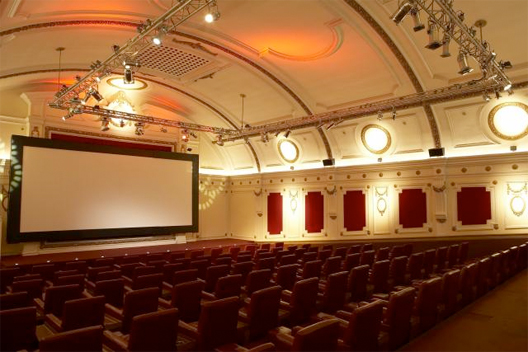
The Electric Cinema, Portobello Road, London has a screen that expands in front of the proscenium arch for widescreen formats-
From cinestructures.co.uk
quote:
If the seating configuration is unusual the screen arrangement is altogether unique and unlike anything seen before. The Academy sized proscenium arch had always posed a problem with aspect ratios greater than the Academy ratio of 4:3. The lighting truss system for the cinema was designed by Unusual Rigging and they were asked to come up with some ideas to overcome this dilemma. Unusual Rigging is a company which is world renowned for solving problems with rigging structures. The solution which they came up with has to be seen to be believed and is best explained by describing the film performance itself in The Electric Cinema. The lights are dimmed and the screen tabs are slowly opened to reveal the Academy sized screen within the proscenium arch. Images are projected onto the screen welcoming patrons to The Electric, including a short slide show depicting vintage shots of this 1910 cinema - England’s oldest operating cinema. Slowly the screen structure moves forward of the proscenium arch and proceeds to expand sideways, as the ads and trailers begin to roll, to take on the size of the Cinemascope or Widescreen picture. The house lights dim to zero as the feature film begins. The process is reversed when the film ends. This ingenious idea is made up of aluminium tubing over which the screen fabric is stretched, with the vertical rollers driven by tooth belt drive and the horizontal movement controlled by a scissor guide
From timeout.com
quote:
My favourite moment is when you are sitting in the wide, red leather seats (or if you’ve splashed out, on a two-seater sofa) and the screen unwinds from inside the proscenium arch.
| IP: Logged
|
|
|
|
|
|
|
|
|
|
|
|
|
|
|
|
|
|
|
|
All times are Central (GMT -6:00)
|
This topic comprises 2 pages: 1 2
|
Powered by Infopop Corporation
UBB.classicTM
6.3.1.2
The Film-Tech Forums are designed for various members related to the cinema industry to express their opinions, viewpoints and testimonials on various products, services and events based upon speculation, personal knowledge and factual information through use, therefore all views represented here allow no liability upon the publishers of this web site and the owners of said views assume no liability for any ill will resulting from these postings. The posts made here are for educational as well as entertainment purposes and as such anyone viewing this portion of the website must accept these views as statements of the author of that opinion
and agrees to release the authors from any and all liability.
|

 Home
Home









 Printer-friendly view of this topic