|
|
This topic comprises 3 pages: 1 2 3
|
|
Author
|
Topic: Hollywood’s Historic Egyptian Theatre Undergoes Retrofit For “Rare” 35mm Nitrate Film
|
Richard P. May
Expert Film Handler
Posts: 243
From: Los Angeles, CA
Registered: Jan 2006
|
 posted 08-02-2016 10:17 AM


Regarding the look of nitrate prints vs acetate:
Almost all color prints made during the nitrate days were Technicolor dye-transfer (IB) process. There was a notable difference in color quality between this and Eastman Color, which succeeded it in the '50s.
Comparison between a nitrate and safety print must include other factors, such as the above for color, and for B/W was the print from original negative, what lab made it, projection equipment where it is being viewed, and more.
The only way to make a true comparison would be to make a print on each type stock from the same element, process in the same lab, and project in the saame theater.
I suppose this argument has been going on for the last 60 years, so no point beating it to death again.
| IP: Logged
|
|
|
|
Leo Enticknap
Film God

Posts: 7474
From: Loma Linda, CA
Registered: Jul 2000
|
posted 08-03-2016 11:38 AM

quote: Richard P. May
Almost all color prints made during the nitrate days were Technicolor dye-transfer (IB) process. There was a notable difference in color quality between this and Eastman Color, which succeeded it in the '50s.
And also, not all IB prints are made equal. They range from astonishingly sharp, saturated and detailed - could almost be from an 8K DI printed onto 2393 - to fuzzy, misregistered, pale dyes and unwatchable. While at film archiving school we were shown a reel from an original release print the BFI's collection of the 1942 Jungle Book - it was terrible. The curator explained that it was known in the trade as a "north of Watford" (roughly equivalent to flyover state in the US) print, i.e. designated to play in the cheaper houses in the provinces, where the audience (it was believed) would be less discerning.
I actually hope that we get to show some of these when we start nitrate screenings, if only to bust the myth that all nitrate prints look beautiful.
quote: Ricahrd P. May
Comparison between a nitrate and safety print must include other factors, such as the above for color, and for B/W was the print from original negative, what lab made it, projection equipment where it is being viewed, and more.
Absolutely. A retired Kodak scientist I know recently emailed me, wondering if 1302 and 5302 at the time of the transition used exactly the same emulsion, and where we would have to look to clear that point up. If they did, this would bust the "more silver in nitrate" belief, and demonstrate conclusively that if there is any subjective difference in the way the two look in projection, it's down to the base.
quote: Richard P. May
The only way to make a true comparison would be to make a print on each type stock from the same element, process in the same lab, and project in the saame theater.
As nitrate base is not made anymore and neither are the release print emulsions in use at the time of the transition, to do this, you'd need to find a reel of the same content on both 1302 and 5302, made at about the same time, and that would mean a lot of searching in archives. If you could find them, though, a side-by-side projection test would be very, very interesting to see.
We know that there was certainly a big difference between the 1301 and 1302 (introduced in 1942) emulsions: 1302 was a lot slower and fine-grained, and shipped with instructions that printer lights might have to be upgraded. I do wonder if that had something to do with the "silvery" myth. If, as some believe, 5302 had reduced silver content in the emulsion in order to keep the per-foot list price down, that would explain a lot.
Another complicating factor is that all the surviving nitrate release prints in existence are at least 65 years old. Even among prints that have been stored cool and dry for most of their life and are still considered to be in an acceptable condition for projection, the optical properties of the base and emulsion will have shifted, at least a bit.
| IP: Logged
|
|
Randy Stankey
Film God

Posts: 6539
From: Erie, Pennsylvania
Registered: Jun 99
|
posted 08-03-2016 12:51 PM
You know, with all the technology we have, now, that didn't exist, back in the days of nitrate film, it seems to me that projecting nitrate film should be much safer.
It ought to be relatively simple to create a projector with fire sensors, monitored by electronic control systems that could stop the machine if a fire is detected or even prevent a fire in the first place. If, in the unlikely event, there is a fire, special ventilation systems could activate to draw out noxious fumes before they have a chance to harm anybody.
With all the technology we have, it ought to be almost trivial for a trained operator to project nitrate film safely.
| IP: Logged
|
|
|
|
|
|
Brad Miller
Administrator

Posts: 17775
From: Plano, TX (36.2 miles NW of Rockwall)
Registered: May 99
|
posted 08-03-2016 04:36 PM
quote: Leo Enticknap
And also, not all IB prints are made equal. They range from astonishingly sharp, saturated and detailed - could almost be from an 8K DI printed onto 2393 - to fuzzy, misregistered, pale dyes and unwatchable.
I actually hope that we get to show some of these when we start nitrate screenings, if only to bust the myth that all nitrate prints look beautiful.
You know Leo, there are lots of lenses on ebay that will give you that look you seek. ![[Razz]](tongue.gif)
quote: Steve Guttag
Oddly enough...I've heard the argument that running on a platter is safer in a sense that one has significantly more time to break the film before the fire reaches the roll. That said, if you are not fast enough, the potential "fuel" is much higher. Now, if the platter were moved to the "rewind room" and film choppers were placed on the entrance/exit of the film path such that in case of fire...chomp...the odds of a bad fire would be significantly reduced.
You are quoting my idea. But for clarity it doesn't HAVE to be from a platter. (It could be from a tower or double MUT.) It just HAS to be from a solid cement room with an adjoining booth wall. (Obviously the booth should still be built to basic nitrate specs.)
If actual reels were used instead of a platter though, they would have to run through a failsafe inside the film room, because once tension was lost, that failsafe would need to cut power instantly to that takeup reel's motor. (This would all be for nothing if the film caught fire killing tension, somehow the automatic chopper failed, and then the spinning takeup reel tried to yank burning film into the film room.)
For the purposes of my nitrate booth concept, it would be advantageous if the "film room" also had a viewing port to the screen as well as a door to get into the booth AND to get out of the film room into the auditorium or some other type of exit.
The basic concept is simple. Have yourself about 15 feet of "film flying" space between the projector and two tiny holes in the wall where the film passes to and from the "film room". These two tiny holes should have fire rollers on them.
Install "choppers" on the "film room" side of the wall on both feed and takeup routes to chop the film if tension is lost. Tie them together as well, so if one chops, they both chop. We want the choppers in the "film room", not in the booth, as if a fire breaks out, tension will drop and gravity will pull the half dozen frames within the wall into the booth for burning.
When the choppers go off, also some massive exhaust fans need to be automated to kick on to suck the air right out of the booth. At this point you just let it totally burn out that 30 or so feet of film. Don't even enter the booth!
Now in no way should the projectionist even need to be IN the booth at all! Simply install remote framing and remote focus controls on the projector and put your controls for everything right there in the film room. The projectionist can watch the show, make any adjustments as may be needed AND if by some chance any of the automated nitrate measures should fail, he could literally cut the film himself from inside that safe room and throw a bank of switches parallel wired with the automation into the emergency position (motor off/lamp off/forced exhaust on/anything else desired) and then turn and exit the film room for his own triple safety. Keep in mind even these "manual emergency override" switches is maybe 10 seconds of effort while the projectionist is safely in a totally separate fireproof room more than 15 feet to the projector. At that point he has left the room and is leaving the building and has never even been in potential harm's way.
Other items could be integrated as well would be things such as an IP or video camera on the projector's gate. Why? If the monitor was placed next to the viewing window into the auditorium, if the film caught fire it would turn that image on screen into a big flash of light (benefits of manual exposure) and that would pull this eyes away from the theater screen within about a second of the fire igniting. If desired even things like flame sensors and so forth could be integrated to double, triple, or quadruple the safety level already achieved if desired.
The worst idea in my mind is to have the reel of nitrate film right there on top of the projector. Seriously, inches from where the fire would break out is just silly in my opinion. And just how much time from the point of ignition does the projectionist have to reach in there and try to cut the film? Really??? With a system setup my way, running nitrate could be 100% safe to not only the audience, but also the projectionist.
If I was building a nitrate safe booth for Mr. Guttag, I would have to do it a little differently though. I would have one booth with 2 projectors, each fed by a separate film room on each side of the booth. All odd reels (leaders and all) would be spliced to one large reel (or plattered) and all even reels (again, leaders and all) would be spliced to a second large reel (or second platter in the other film room).
The show would then run just like a regular changeover show, just without the reloading. Yes this would require some custom automation to properly cue up the next reel on the roll, but I've been doing that fully automated and frame-accurate in my private screening room for some time.
So Leo, let me know if you want a "Film-Tech nitrate-safe" booth and automation system out there at the Egyptian. ![[thumbsup]](graemlins/thumbsup.gif)
| IP: Logged
|
|
|
|
|
|
Simon Wyss
Film Handler

Posts: 80
From: Basel, BS, Switzerland
Registered: Apr 2011
|
posted 08-05-2016 02:53 AM
Very good initiative with George Eastman Museum. Kodak CEO Jeff Clarke keeps saying that the motion picture film was invented by Kodak. That’s a lie. The flexible photographic film was invented by Rev. Hannibal Goodwin in 1887. Eastman, with the aid of the young chemist Reichenbach, began making film in 1889 in spite of Goodwin’s patent application. The patent, issued 1898, was valid and Eastman fined. Neither did Edison invent anything concerning motion pictures. If at all, it was his employee Will Dickson, and Dickson copied as well. It was Edison himself who instructed Dickson about what he had seen with Georges Démény in France: perforation, intermittent motion of a ribbon, much larger images. The rest was bought or stolen.
Two things I don’t agree with in that video:
1) Nitrate prints are not more sparkly or have better image quality in general.
2) Cellulose nitrate does not produce oxygen, it contains it. The oxygen is chemically compounded. Expression becomes more and more fuzzy and erroneous these days and I’m saying that for general.
Of course, cinematographic photography has fundamentally changed since the late 1950s. The dreamy aspect of movies has become obsolete, just about the way their original instantaneous or bold aspect was given up after 1914. To me the lowest point of cinematography was reached when the connection with the computer was made.
No photochemical film can be restored by other means than photochemistry and reprographic techniques. If film pictures are scanned, the entity of materials and images is given up. Not that it goes lost, it is abandoned.
There are films* on the market with a resolving power of up to 5,000 line pairs per millimeter (127,000 per inch). One has only to insure that good contact is established between the two films during exposure. Too little is done in this direction and too much digitally.
One can use the computer and software but then the paying and viewing public must be told most clearly that the content is only a binary-numerical derivative of a photographic object. Or computer data gained from (several) photochemical film strips. I am very sensitive to fraud. The computer world goes too lightly over a culture, starting from an abstract idea, which isn’t bad per se, but then have not the least filial piety.
I had no idea of what work with an ancient motion-picture printer means until I bought an old Matipo and put it into service in 2001. It takes not more than 2½ foot of film ahead of content for lacing the Debrie printer. After the last frame you can halt the apparatus and cut the raw stock with an additional foot or so. No other printer allows to keep waste that low.
______________________
*Black and white
| IP: Logged
|
|
|
|
|
|
Leo Enticknap
Film God
Posts: 7474
From: Loma Linda, CA
Registered: Jul 2000
|
posted 11-08-2016 02:31 PM
We played our first nitrate show last night following the booth upgrades (which actually aren't totally finished, but most of the work is now done and we are now nitrate legal). Thought you might like to see some pics...
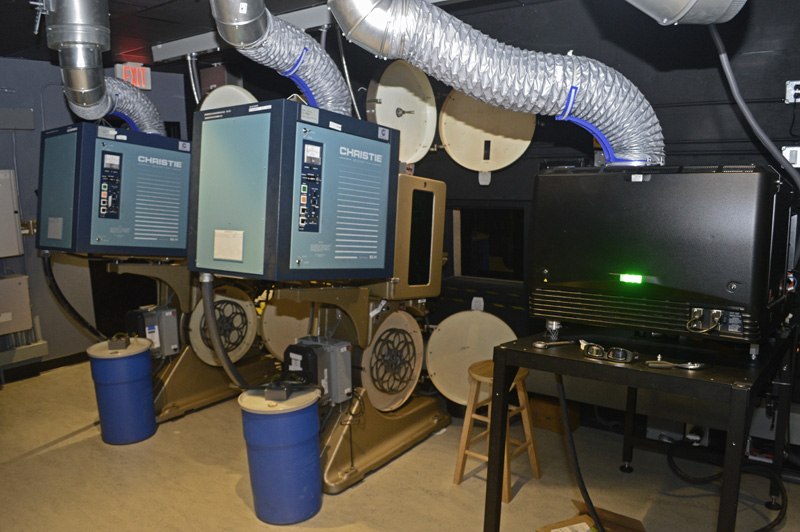
The "business end" of the refurbished booth, showing the two Norelco AAII (Philips DP70) projectors, with Christie lamphouses, and a Barco DP4K-32B digital projector. This is going to be replaced by a Barco 30L laser projector in a couple of weeks' time. Note the liquid cooling reservoirs below the film projectors: a very useful thing to have when playing nitrate prints. Even with the 6kW bulbs firing light through the film, the gate backplates feel cool to touch. The rectifiers are in a room directly below the booth.
We had to remove the SR-D, DTS and SDDS penthouse readers to get the nitrate magazines on. We are still trying to figure out a way to have both in place permanently, that will possibly involve building some sort of a blimp for the digital readers. For the meantime, they will have to be swapped on and off whenever we transition between nitrate shows and ones that need digital optical audio.
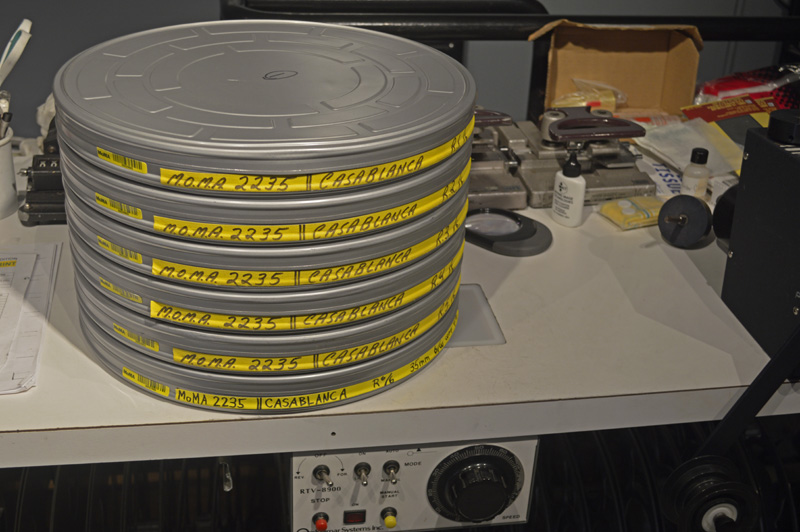
The print, as received from The Museum of Modern Art, via the Academy Film Archive. The plan is for all the nitrate prints we play to be shipped to the Academy initially shuttled to and from us from there, as their facility on Vine Street has proper cool, dry and safe storage, but we don't (apart from cabinets that will only hold a couple of feature prints).
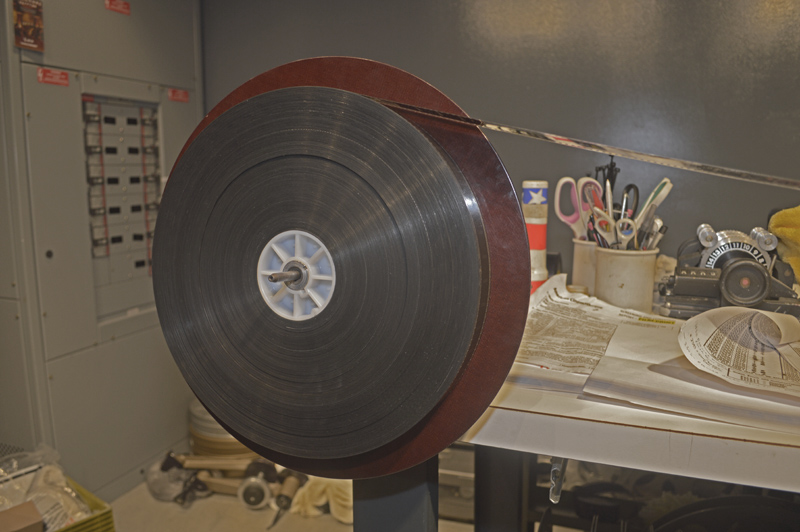
Inspecting reel 1. Note the very slight deformation of the film pack: this is characteristic of slight shrinkage. MoMA's report states that this print is an average of 1.5% shrunk: the CS sprocket teeth on our Norelcos can cope with up to 2% (ish) without any risk of perforation damage.
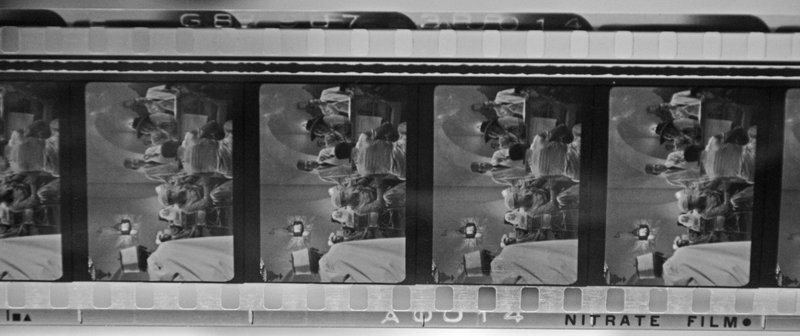
Positive edge code with nitrate identification and a date code on the extreme left. This date code is for 1947, indicating that this print is from a rerelease five years after the movie first came out. Note also the hard matte: with shrunken stock, you have to keep a very close eye on the framing, to avoid a frame line creeping into the projected image, because the shrinkage will not be even throughout the print, or even one reel. Unlike with most modern prints, framing is not a "set and forget" item with hard matted prints of this age.
Note also the RCA Duplex audio track: two unilateral tracks, but a negative image of a typical variable area track, and the bias lines are on the outside. These sound astonishingly good on nitrate - probably the best pre-Dolby optical audio system ever devised, IMHO.
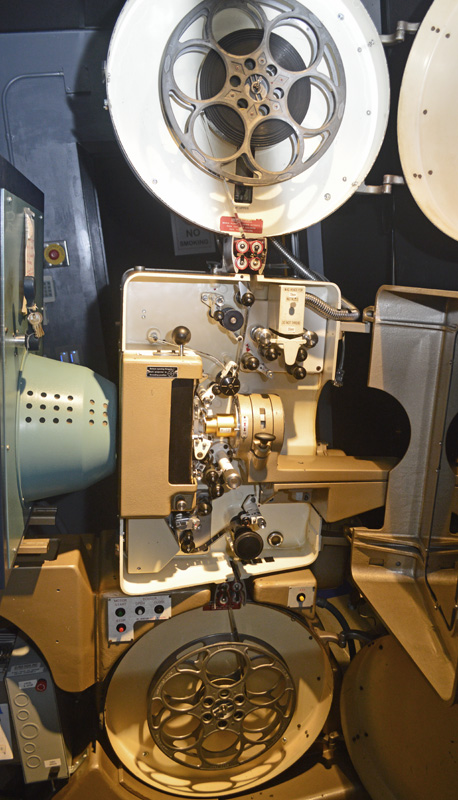
A reel threaded, but not quite ready to roll.
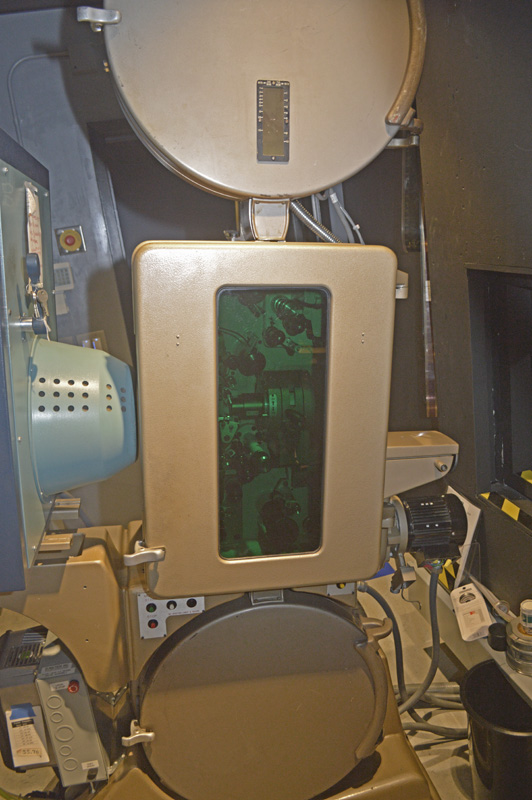
Now it's ready to roll! The magazines and mechanism cover must remain closed while nitrate is running with the lamp on. Even though it'll put some extra strikes on the bulb, we keep the lamp off during threading and until about a minute before each changeover, as an extra precaution. If the lamp were on, nitrate film was threaded and waiting to roll and then the liquid cooling pump failed, I wouldn't want to be next to that machine at the time.
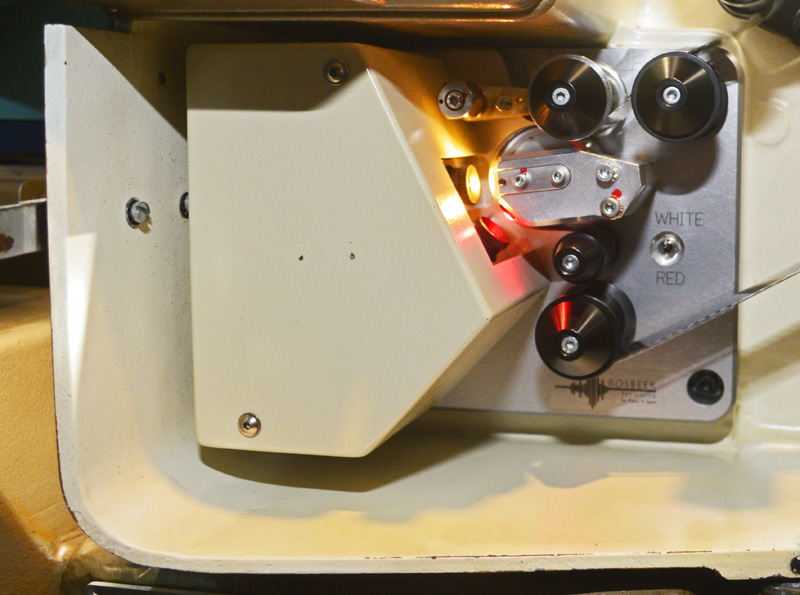
A very useful accessory to have for any theater that needs to project both older variable area prints and more recent ones with a cyan track: our Rosbeek Techniek dual white/red LED readers. Rosbeek takes your existing Kinoton analog/Dolby digital Norelco head and converts it to a dual white/red analog reader. Unilateral and RCA tracks have an order of magnitude more headroom and s/n with the white LED than they would with a red one, and sound significantly better even than with an conventional exciter.
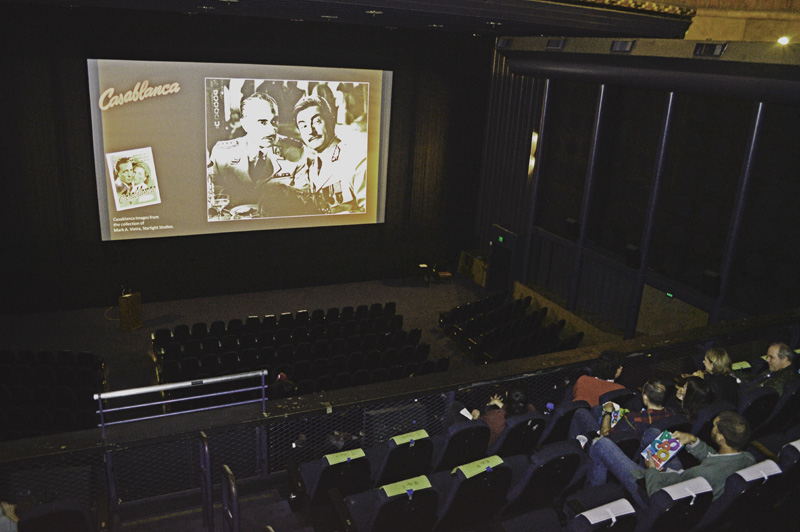
The audience arriving. The walkin Powerpoint shows are done by our publicity department. It's a nice touch to change the masking to 1.37 from this setting at the start of the feature, because the top and bottom bars move out, and so the screen gets bigger.
As for the show itself, there is definitely something in it to the claims that nitrate has a special look. This wasn't even the best (in terms of photographic quality) nitrate print that I've seen projected, but the detail in the image - especially in the midrange - is something I've only ever seen in a tiny number of acetate or polyester prints. Whether that's a quality of the nitrate base itself, a difference in the emulsion between 1302, 5302 and 2302, or something that labs did differently in those days, I don't know. In any case, it's great that we can now play the surviving nitrate prints out there for audiences to make up their own minds.
Last night's show was a private screening for an invited audience, mainly for the organizations that funded and sponsored the project, and American Cinematheque members. However, we have plans to start public nitrate screenings very soon, and I'll post details when things are finalized.
| IP: Logged
|
|
|
|
|
|
|
|
All times are Central (GMT -6:00)
|
This topic comprises 3 pages: 1 2 3
|
Powered by Infopop Corporation
UBB.classicTM
6.3.1.2
The Film-Tech Forums are designed for various members related to the cinema industry to express their opinions, viewpoints and testimonials on various products, services and events based upon speculation, personal knowledge and factual information through use, therefore all views represented here allow no liability upon the publishers of this web site and the owners of said views assume no liability for any ill will resulting from these postings. The posts made here are for educational as well as entertainment purposes and as such anyone viewing this portion of the website must accept these views as statements of the author of that opinion
and agrees to release the authors from any and all liability.
|

 Home
Home








 Printer-friendly view of this topic