Film-Tech Cinema Systems
Film-Tech Forum ARCHIVE


my profile | my password | search | faq & rules | forum home
  next oldest topic   next newest topic
» Film-Tech Forum ARCHIVE   » Community   » The Afterlife   » IT CAME FROM OUT OF SPACE now on 3D Blu Ray (Page 2)

 
This topic comprises 2 pages: 1  2 
 
Author Topic: IT CAME FROM OUT OF SPACE now on 3D Blu Ray
Bill Brandenstein
Master Film Handler

Posts: 413
From: Santa Clarita, CA
Registered: Jul 2013


 - posted 11-11-2016 04:58 PM      Profile for Bill Brandenstein   Email Bill Brandenstein   Send New Private Message       Edit/Delete Post 
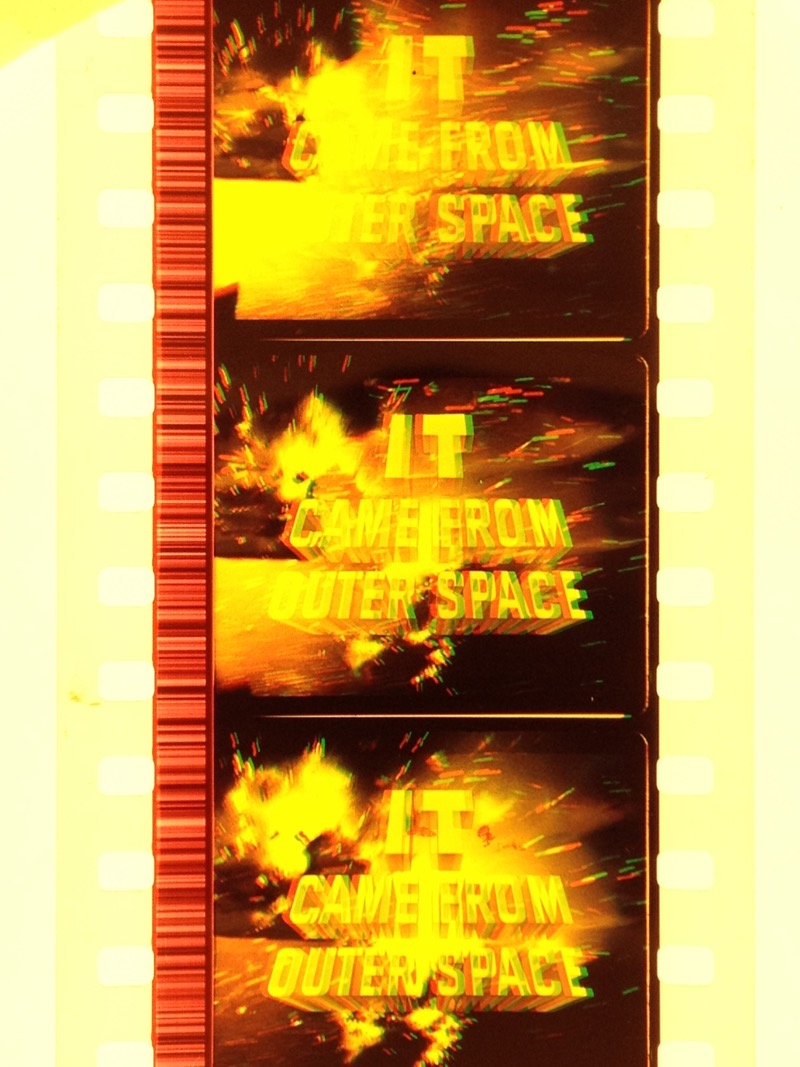
OK, now based on Frank's comment, Bob's image does NOT look like tinted base but tinted emulsion. Did the camera make it look that way, or is there different chemistry going on?

 |  IP: Logged

Manny Knowles
"What are these things and WHY are they BLUE???"

Posts: 4247
From: Bloomington, IN, USA
Registered: Feb 2002


 - posted 11-11-2016 08:26 PM      Profile for Manny Knowles   Email Manny Knowles   Send New Private Message       Edit/Delete Post 
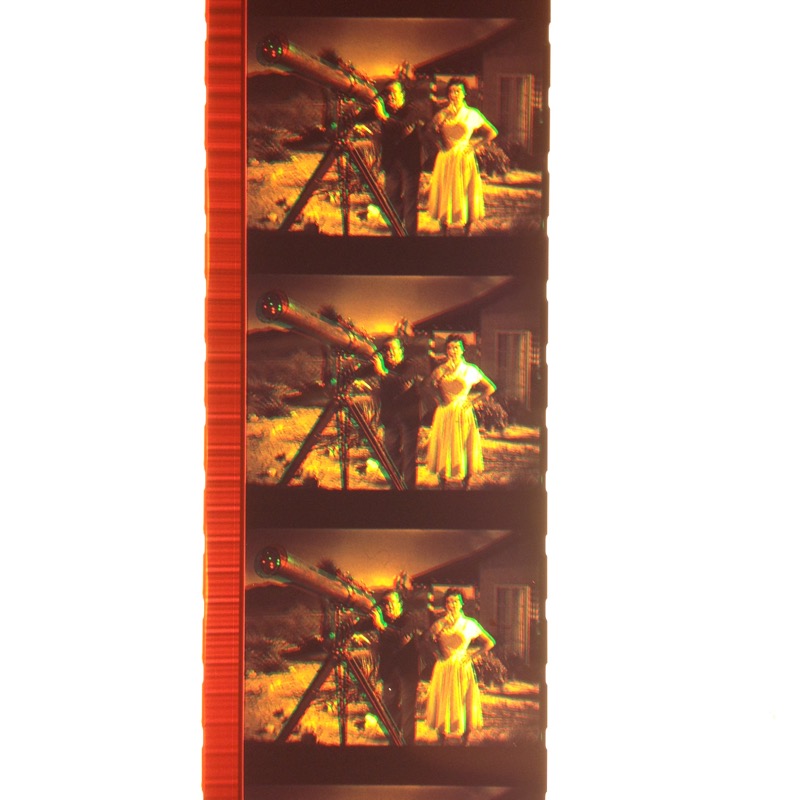
The 35mm print I showed last year was sepia toned -- it's unclear whether this was intentional, or bad printing.

Did someone mention bad printing? Consider the following:

Glasses needed to be "red-on-right" to get the 3D effect, even though the leader indicated "red-on-left."

 |  IP: Logged

Robert Furmanek
Expert Film Handler

Posts: 113
From: Clifton, NJ, USA
Registered: Jun 2012


 - posted 11-11-2016 08:48 PM      Profile for Robert Furmanek   Author's Homepage   Email Robert Furmanek       Edit/Delete Post 
That's a frame from the left side of a 3-D pair.

SPOOKS - and all the other Golden Age features and shorts (with a few exceptions) were shown in polarized 3-D. A few titles were reissued in anaglyphic in the 1970's.

See myth number one: http://www.3dfilmarchive.com/home/top-10-3-d-myths

The first sound feature released in sepia was THE GOOD EARTH in 1937.

 -

 |  IP: Logged

Frank Angel
Film God

Posts: 5305
From: Brooklyn NY USA
Registered: Dec 1999


 - posted 11-15-2016 01:54 PM      Profile for Frank Angel   Author's Homepage   Email Frank Angel   Send New Private Message       Edit/Delete Post 
So then it wasn't just tinting the base, but it was a way of toning the emulsion -- looking at the SPOOKS frame it seems quite apparent that the white lettering is still white while the rest of the image has the sepia tint in gray-scale, or better put, sepic-scale. I sure would love to get my hands on a sepia print of BEAST to book.

 |  IP: Logged

Bill Brandenstein
Master Film Handler

Posts: 413
From: Santa Clarita, CA
Registered: Jul 2013


 - posted 11-16-2016 11:56 AM      Profile for Bill Brandenstein   Email Bill Brandenstein   Send New Private Message       Edit/Delete Post 
That would look wonderful. The whites are white, the densest blacks would be too dark to think much of the sepia toning, and everything else in between would have a lovely tone to it.

Where does one ever see this? Was it true that the opening reel of "Wizard of Oz" would've used such a process?

 |  IP: Logged

Mark Ogden
Jedi Master Film Handler

Posts: 943
From: Little Falls, N.J.
Registered: Jun 99


 - posted 11-16-2016 01:25 PM      Profile for Mark Ogden   Email Mark Ogden   Send New Private Message       Edit/Delete Post 
Reels 1A & B and 5B of The Wizard of Oz use the process, although mid-50s re-release prints drop it for straight b/w. These ran a LONG time, I remember them from the old "MGM Children's Matinee" series back when I still was working on an apprentice card.

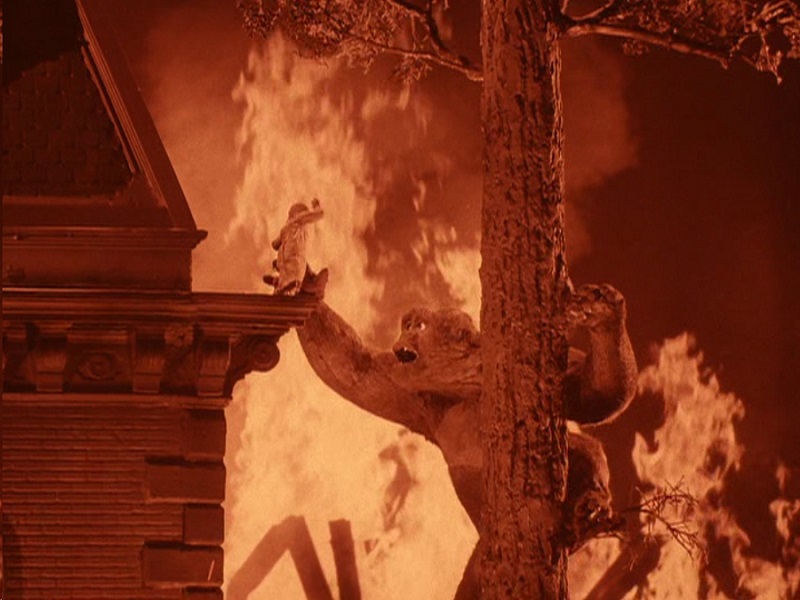
There is a startling sequence towards the end of the original Mighty Joe Young that contains an intensely dyed section, more vivid than just sepia. It takes place at the orphanage fire where Joe climbs the tree to save the little girl.

 -

 |  IP: Logged

Robert Furmanek
Expert Film Handler

Posts: 113
From: Clifton, NJ, USA
Registered: Jun 2012


 - posted 11-18-2016 12:20 PM      Profile for Robert Furmanek   Author's Homepage   Email Robert Furmanek       Edit/Delete Post 
That was for the 1953 reissue. The orphanage sequence in the original 1949 release used a complex combination of tints, tone and dyes created by Technicolor. That version has not been seen since the original theatrical dates.

 |  IP: Logged

Jack Theakston
Master Film Handler

Posts: 411
From: New York, USA
Registered: Sep 2007


 - posted 11-18-2016 03:20 PM      Profile for Jack Theakston   Email Jack Theakston   Send New Private Message       Edit/Delete Post 
Tinting is a process where the film is dunked in dye. The effect is like having a filter put in front of the image. Color and Black.

TONING is physically replacing the silver in the emulsion through chemical means with a silver salt. Hollywood labs typically had four toners to choose from—sepia, red sepia, blue and green. The effect of sepia toning, which was done with uranium ferrocyanide toning, gave a Brown & White image.

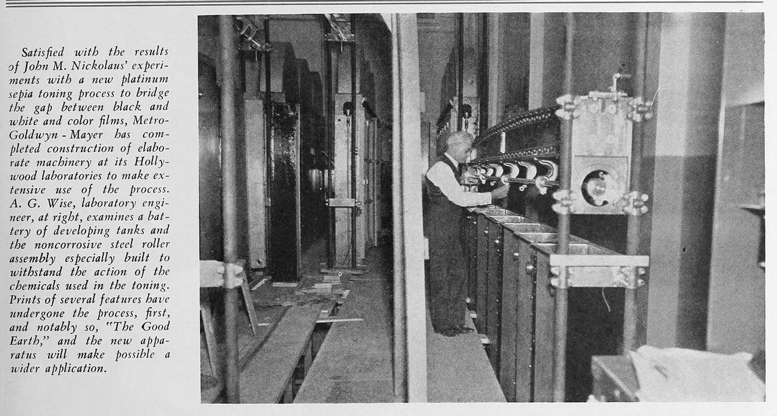
As Bob mentioned, MGM was big into Platinum sepia toning in the late '30s after testing it out on MAYTIME. It was a pet project of the MGM lab head, John Nickolaus. The studio called it "sepia-platinum," but many other labs offered it, too. But I've seen earlier sound prints that were Sepia-toned, including REACHING FOR THE MOON (1930) with Douglas Fairbanks.

WIZARD OF OZ, of course, is the most famous usage of sepia-platinum. The effect was so carefully conceived that the shot following the lab splice in Reel 2 goes to Technicolor, in which Dorothy opens to the door to Oz. The setting and her dress in that shot as she goes to open the door were carefully designed in sepia to match the tone of the first reel.

 |  IP: Logged

Manny Knowles
"What are these things and WHY are they BLUE???"

Posts: 4247
From: Bloomington, IN, USA
Registered: Feb 2002


 - posted 11-19-2016 11:29 PM      Profile for Manny Knowles   Email Manny Knowles   Send New Private Message       Edit/Delete Post 
I knew I took photos. Here they are...

 -

 -

 |  IP: Logged

Robert Furmanek
Expert Film Handler

Posts: 113
From: Clifton, NJ, USA
Registered: Jun 2012


 - posted 11-21-2016 04:48 PM      Profile for Robert Furmanek   Author's Homepage   Email Robert Furmanek       Edit/Delete Post 
That's not sepia. It's a fairly recent print struck from a faded circa 1972 anaglyphic negative.

 |  IP: Logged

Mark J. Marshall
Film God

Posts: 3188
From: New Castle, DE, USA
Registered: Aug 2002


 - posted 11-21-2016 07:31 PM      Profile for Mark J. Marshall     Send New Private Message       Edit/Delete Post 
quote: Robert Furmanek
The orphanage sequence in the original 1949 release used a complex combination of tints, tone and dyes created by Technicolor. That version has not been seen since the original theatrical dates.
Just to clarify - does that version still exist, or is it lost?

 |  IP: Logged

Robert Furmanek
Expert Film Handler

Posts: 113
From: Clifton, NJ, USA
Registered: Jun 2012


 - posted 11-23-2016 12:15 PM      Profile for Robert Furmanek   Author's Homepage   Email Robert Furmanek       Edit/Delete Post 
Sadly, I don't think the orphanage sequence survives with the original Technicolor tinting and toning.

 |  IP: Logged


All times are Central (GMT -6:00)
This topic comprises 2 pages: 1  2 
 
   Close Topic    Move Topic    Delete Topic    next oldest topic   next newest topic
 - Printer-friendly view of this topic
Hop To:


Powered by Infopop Corporation
UBB.classicTM 6.3.1.2

The Film-Tech Forums are designed for various members related to the cinema industry to express their opinions, viewpoints and testimonials on various products, services and events based upon speculation, personal knowledge and factual information through use, therefore all views represented here allow no liability upon the publishers of this web site and the owners of said views assume no liability for any ill will resulting from these postings. The posts made here are for educational as well as entertainment purposes and as such anyone viewing this portion of the website must accept these views as statements of the author of that opinion and agrees to release the authors from any and all liability.

© 1999-2020 Film-Tech Cinema Systems, LLC. All rights reserved.