|
|
This topic comprises 2 pages: 1 2
|
|
Author
|
Topic: AMC replacing MPX units?
|
|
|
Julio Roberto
Jedi Master Film Handler
Posts: 938
From: Madrid, Madrid, Spain
Registered: Oct 2008
|
 posted 03-08-2009 09:52 AM


quote:
deformable mirror device (DMD) developed by Texas Instruments
http://www.patentstorm.us/patents/5600383.html
[Link is to a patent abstract describing Texas Instruments Deformable Mirror Devices]
DMD are mems devices. They are the heart of DLP's. Perhaps you were implying the confusion when they changed the name to Digital Mirror Devices??? ![[Confused]](confused.gif)
quote: Paul Trimboli
Why not use 2 4k machines and use this image enhancement
Everybody wished TI could make DLP's of an acceptable size that are 4K. But they can not. About 2.5K is the best they can make under 1.2"
The only other technology that can produce images like that (or better) at good illuminations levels, GLV, is much more "exotic" and still requires a bit of development that nobody is pursuing for the DCinema since it "belongs" to Sony and for them it's much more profitable to do Lcos.
And Lcos, the technology used by Sony and many others that have tried to enter digital cinema business in the past (hughes-jvc) has one problem: it can not really stand the heat from high power lamps in the long term, so they are limited to small-medium screen sizes and significant degradation over long-ish time periods (say, 10 years lifespan).
Cinema needs projectors that can stand 4Kw and 6Kw for many hours a day 365 days a year for no less than 10 years, preferably 15, and still produce images that look almost like it did the first day. Right now, DLP is the only techonology trouble-free and fully developed to allow this.
But only at 2.5K max resolution on sensible (i.e. not too expensive) optical sizes (i.e. size of lens, prisms, mems, etc).
Thus, we are all stuck with 2K that's "good", "cheap" and "bright" or 4K that's "expensive", "ok" and "dark".
If there was a 4K projector of similar performance and price point as 2K today, I don't think anyone in the industry would complain about it ![[Wink]](wink.gif)
2K is fine and, if done right, conveys all the "information" (resolution/perceived detail) needed for the people sitting in the back rows of most modern movie theaters.
True 4K would do the same for everybody except those sitting in the first couple of rows.
True Imax would do the same for those too
But who knows. Maybe some projector manufacturer will start to do pixel-shift light engines, sort of like it's done for 8K.
http://news.bbc.co.uk/2/hi/technology/7617702.stm
[Link is for a video presentation, after a brief commercial, of UHDTV also known as super-hivision, an 8K TV standard following the SMPTE S2036-1-2007 formats of 3840x2160 pixels and 7680x4320 pixels for Quad-HD and UHDTV and EBU standards]
Of course, no need for that anytime soon, but it's there for our grandchildren to enjoy. In case you wonder, the approved standard is for 22 sound channels ![[Eek!]](eek.gif)
http://www.nhk.or.jp/digital/en/superhivision/
[Link is to a page about japan's NHK super-hivision system, an 8K adquisition and projection system they've been showing off at conventions and fairs for many years now, using pixel-shift and multi imagers tricks to obtain such high resolutions with today's manufacturing capabilities]
Everybody in the industry gives for granted that, once the new crop of cameras shows up later this year as IT improves, 4K will be a given minimun for most productions and that as soon as a 4K projector that meets cinema demands is available for reasonable $$$, the exhibition will quickly move to 4K too. How long that will take, it's anybody's guess.
As a result, what will be projected in digital movie theaters for a while WON'T be too different from what people can get in their homes (1080p), no matter what others may say. In a few specific cases, people will be seeing in their homes even better pictures than in cinemas.
I, for one, am not optimistic that the "4K exhibition part" will happen soon. Not because lack of will. DCI MANDATES servers to decode 4K masters and MANDATES projectors to accept the signal (and allows them to downconvert to 2K). It's just the lack of suitable 4K projection technology at huge light levels that is stopping it.
But I do believe the production part will fully move to 4K very soon. It's already doing it, with over 25% of new productions (for which it makes sense, i.e., non indies) already mastering 4K.
It's not a matter of "showing off" or "producer vanity". It's that they know in the (near-ish) future, their products will lose value if they are not 4K.
Imagine for a second that a new quad-hd tv standard shows up from nowhere and all of the sudden you see quad-hd TV's and quad-hd disc player's for $800 and $200 in stores (don't think it will happen, but pretend it does). Now, if your $100m movie is a 2K master ... what the hell are you going to sell in quad-hd (basically, 4K)?
4K is an assurance of future. A future that may not be too far away, but even if it is, it's a small (nowadays) price to pay for protecting the value of your $100m movie production.
The industry knows that 4K is a significant step up from 35mm once it reaches exhibition, while 2K is basically the same as "3 perf" 35mm, perhaps a bit better, perhaps a bit worse, depending who you ask, but not significantly superior to what we have seen in cinemas for over 50 years.
[ 03-08-2009, 05:25 PM: Message edited by: Julio Roberto ]
| IP: Logged
|
|
|
|
|
|
|
|
|
|
|
|
|
|
|
|
|
|
Mike Olpin
Chop Chop!

Posts: 1852
From: Dallas, TX
Registered: Jan 2002
|
posted 04-25-2009 10:46 PM

*Sigh. I guess it's been long enough. *
quote: Tim Rectanus
Is this attitude creeping into the IMAX booths around the world?
Yep. MPX allows multiplexes to upgrade their theatres to IMAX. But often times those theatres don't upgrade the most critical component in their booth - the operators. Instead their sloppy "projectionists" who can't even hold a 35mm show together are now tasked with a more maintenance intensive presentation system. What did you expect to happen?
Part of the reason my exodus from Regal was so turbulent is because I opposed and tried to correct some of the bad practices I saw occurring everyday. The MPX (film version) is a terrific machine and a marvel of engineering. If given the same operating conditions as most large IMAX theatres, that is to say a departmentalized IMAX team, professional training, and conscientious operators, the MPX would be a solid performer.
Unfortunately, many multiplex theatres are run by impatient managers who keep the brightest people on the floor and leave monkeys in the booth. Further compounding the problem is the corporate offices constant demand for performance. A show is not allowed to be retested after a repair, because then the auditorium would be dark for another 2 hours. Unacceptable if we're going to out gross the GM's best friend's theatre tonight!
Here are some pictures I took back when I was trying to document the whole thing.

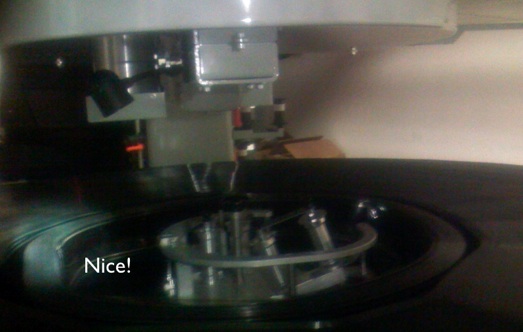
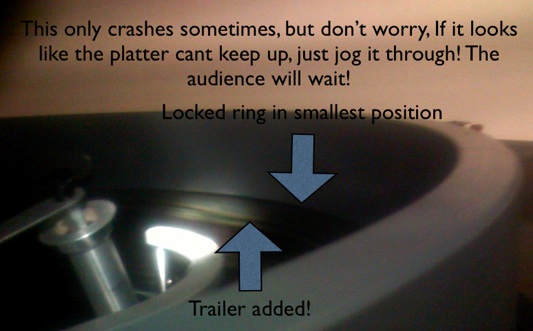
Here is a surprise that was left for me by the previous shift. Nothing in the log, no indication that anything out of the ordinary had occurred that day. Then a few minutes minutes into Harry Potter 5, this enters the projector.
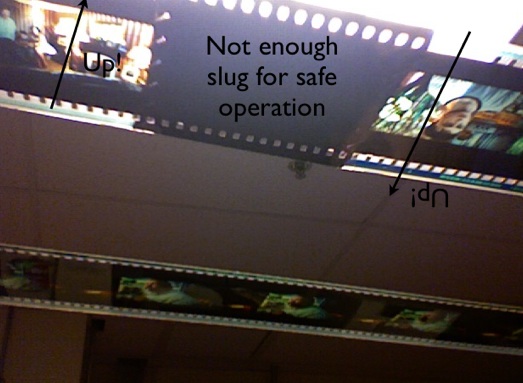
Of course, now they have DigIMAX, so I'm sure they haven't had anymore problems at all. Totally sure.
| IP: Logged
|
|
|
|
All times are Central (GMT -6:00)
|
This topic comprises 2 pages: 1 2
|
Powered by Infopop Corporation
UBB.classicTM
6.3.1.2
The Film-Tech Forums are designed for various members related to the cinema industry to express their opinions, viewpoints and testimonials on various products, services and events based upon speculation, personal knowledge and factual information through use, therefore all views represented here allow no liability upon the publishers of this web site and the owners of said views assume no liability for any ill will resulting from these postings. The posts made here are for educational as well as entertainment purposes and as such anyone viewing this portion of the website must accept these views as statements of the author of that opinion
and agrees to release the authors from any and all liability.
|

 Home
Home










 Printer-friendly view of this topic