Film-Tech Cinema Systems
Film-Tech Forum ARCHIVE


my profile | my password | search | faq & rules | forum home
  next oldest topic   next newest topic
» Film-Tech Forum ARCHIVE   » Operations   » Digital Cinema Forum   » Digital Projector (Page 2)

 
This topic comprises 3 pages: 1  2  3 
 
Author Topic: Digital Projector
Ron Funderburg
Jedi Master Film Handler

Posts: 814
From: Chickasha, Oklahoma, USA
Registered: Nov 2007


 - posted 02-07-2008 04:49 PM      Profile for Ron Funderburg   Author's Homepage   Email Ron Funderburg   Send New Private Message       Edit/Delete Post 
In one sense film is already a dying bread. Most of the TV shows produced now that were on film only 4 or 5 years ago are shot on DV equipment. It was standard practice in the 1960 to film every program at broadcast with a 16mm camera off of a TV set as an emergency back-up archive now even shows shot on film are archived in a digital format.

Movies (at least a lion share of them) are shot on 35MM and then transfered to an intermediate 2k digital print for editing and the back out to film. I realize that digital is a lot easier to work with as an editor but I can see a lot of them bypassing the shooting on film in the near future.

According to the director, producer Steven Spielberg he will always shoot on film he doesn't actually say he will distribute that way but he has said when the last frame of film that is run though a projector will be his film! This a bit telling as well he says he thinks film will disappear in his lifetime.

Digital is the future and I think Mike is right for the theater it is never going to get inexpensive to buy the projection equipment. But at some point there needs to be a formula in place where smaller markets can afford it a lengthy lease and updates to the equipment as you go. Or very quickly it will a big boys game only and only larger Cities will have theaters for public consumption of feature films, movies, flicks, or whatever you chose to call it!

 |  IP: Logged

Mark Gulbrandsen
Resident Trollmaster

Posts: 16657
From: Music City
Registered: Jun 99


 - posted 02-07-2008 06:02 PM      Profile for Mark Gulbrandsen   Email Mark Gulbrandsen   Send New Private Message       Edit/Delete Post 
quote: Paul Mayer
I wonder how much of the digital gear going in today will still be in service in 15 years? Sure, most booths will be digital but I doubt that any of today's specific units will still be there.
Well, DTS 6D's are a good example as are CP-500's of how long a "Digital Piece" can exist. The Air Traffic Control radar system which is very early 60's digital technology is also still in use in some airports and may be the nest example, although its being phased out by new gear... finally. How long a piece of gear will be suported is purely up to the manufacturer of that gear.... You can still get most parts for the GE Light Valve projectors and they've been obsolete for at least 20 years now.

What will a server even look like in 15 years... no one really knows! I think it'll be built into the projector. DLP will have come and gone by then and something laser based or similar will replace it.

quote: Martin McCaffery
I'll believe it when Brad changes the name of this place to Digital-Tech
There is already a Digital Cinematics forum but not at this site... when's your's makin an appearance Brad? Mike is right... no need to cange the name... it would just be another forum on this site...

Christie still calls the Digital Projectors "Movie Projectors".

Austrailia is deleloping what is called "Electronic Cinema" or E-Cinema. Its based on less expensive 30K dollar 3 chip DLP Panasonic and other projectors and a server of their own development. Some are already in use and at this point in time it doesn't involve encrypted material being distributed although they eventually feel it will have to be encrypted for wide spread use. The film still shows up on a hard drive though... I see no reason why this less expensive system couldn't also be sold here in the States.

Mark

 |  IP: Logged

Ron Funderburg
Jedi Master Film Handler

Posts: 814
From: Chickasha, Oklahoma, USA
Registered: Nov 2007


 - posted 02-07-2008 06:24 PM      Profile for Ron Funderburg   Author's Homepage   Email Ron Funderburg   Send New Private Message       Edit/Delete Post 
Well Mark it is still a movie no matter how it is presented! I guess they could call it electronic plays I guess but a rose by any other name is still a rose and movie is always going to be a movie!

 |  IP: Logged

Steve Guttag
We forgot the crackers Gromit!!!

Posts: 12814
From: Annapolis, MD
Registered: Dec 1999


 - posted 02-07-2008 08:52 PM      Profile for Steve Guttag   Email Steve Guttag   Send New Private Message       Edit/Delete Post 
First off...anyone that claims one brand is the defacto best is expressing an opinion...perhaps a well-founded opinion but an opinion, none-the-less. It is no different in this respect for DCinema than it is for Film-Cinema...what is the best projector?...we all have our likes and dislikes.

Christie does have a lot going for them...they have evolved their machines nicely and most techs speak well of them. Barco, in my opinion, slams the others for their software. In fact, their software (DCine Communicator for the older units...DP100 and before, and on-board for the current stuff), is the best for setting things up and doing special set ups with. I think the others are chasing Barco on this.

NEC has the rep of the best light per-watt for the 1st generation 2K machines. The NC1600 looks to try and continue that reputation though Barco's current line up is no slouch and the Christie CP2000ZX with a 3KSP lamp is a light cannon too.

As for image...you should get a great image off of any of the three. You are going to sell no more tickets for having one over the other unless you feel one is more reliable than the other.

If 3-D is in your plans...watch out on the smaller units...many can not take the Dolby form of 3-D since their filter disc must go between the lamphouse and the integrator. At present, the Christie CP2000ZX and the NC800C can not do Dolby 3-D. The Barco DP1500 and DP2000 can though they are more compact units. The NEC1600C can also accept Dolby 3-D though I'm not sure if all of the mounting is worked out yet or not. The plan, I hear, is for Dolby 3-D to be an option when you order a projector such that it will come pre-installed from the various manufacturers.

Christie is bringing up the rear on the .98 chip set machine and again, for 3D, the .98s have an advantage...the 1.2" machines can not run at this high bandwidths for 3D AND fill their whole imager...for 3D the image must be zoomed out (with the lens) so really less image is there. I hear that is not the case for the .98s so though they are all limited to about 4KW, they get to USE all of that light for putting the image on the screen...something to think about while planning.

As for servers/players...I have not heard one person not think that Dolby doesn't have the best planned out system. Mark was a little mistaken in that a complex can run without the Dolby Show Library (server) for up to Three (3) screens with one of the Show Stores functioning as a server for all three.

Once set up, the Dolby system should feel relatively intuitive...you build up shows kinda like you do with film...adding cues and such (without the sticky tape, of course) and just play the thing...stop it if need be and so on. One must plan out a bit in advance if they are going to play it on multiple screens or move the film down to another house...that can take time (depends on your network speed and how taxed it is). Since a Show Store can hold QUITE a number of shows, there is no reason to wait until the last minute either...you are really limited by the size of the Raid drives and they are getting larger by day, it seems. Most of this stuff can go one in the background and especially overnight when the various networks are not otherwise moving data.

As for screens...I don't agree that 1.8 is essential...it really does depend on the application. If you are going for a gain screen (anything above 1.3 or so), as Marks say, you need to curve it to keep the light uniform. This often will introduce geometric distortions that current DCinema machines can not accommodate (and more than film machines though there are lenses that can minimize it for film...like ISCO's Zoom Converters or their Curved field correctors). All a DCinema machine can do with a curved screen is "mask" the image which is almost identical to an aperture plate...you merely are blocking the light to those pixels (well, not turning them on). People's preferences for curved vs flat not withstanding.

With 3D...light is a big thing...regardless of whos 3D you go with, you need about 10x as much light for 3D as you do for 2D!!!!. And that is to achieve a whopping 3.5-5fL. Yep, that is all 3D can deliver (or should deliver to have the same color saturation as was planned for). If you are using a 1.2" machine, that almost always means a 6K lamp and under 40' widths and probably 4K for the new .98" chips.

As for sound...it really doesn't require more from your sound system than film's digital sound. The same limits and peaks are still there. They may be cleaner, clearer, crisper...whatever-er but as for level (and hence power requirements), the same maximums are still there. Digital is digital in that respect...when the registeres reach "1111111111...111"...that is all there is, data compression or no. Then again, most systems seem to under-amp, under speaker their systems in not only the subwoofer but surround departments.

You will need to deal with AES digital audio, in some respect. Doremi has an D/A card that I have been less than impressed with. As Mark said, both USL and Dolby offer products that add AES capability to any processor (and then some). What features your environments need will dictate which makes more business sense.

Note, Dolby does absolutely give benefits (controlability)if their stuff is used. Their stuff can be added to the auditorium network (via ethernet and switch) so that things like the DMA8+, and CP650 are controlled dirctly and can be part of a program.

As for obsolescence, boy that is anybody's guess but this is all "cutting edge" technology. The CP500 and DTS6D comparison that was given is not such a good comparison. Neither was cutting-edge technology. In fact, most built off of stale technology. The DTS system was so low-cost because it was based on a technology (PC) that used a much more massive industry to make the technology cheap. The cost in that unit was the custom boards that DTS made. But look at that unit...how many people had to pay for upgrade kits for those CD-ROM drives? In many cases, multiple times. Those drive kits often approched 10% of the value of the whole thing, if not more so. DTS also kept that technolgy mostly in tact from DTS6 to DTS-6D. This much the same as Dolby did with their sound processor evolution. The CP50 built off the CP100, the CP200 used the technology of the CP50...how long did it take before they stopped using the Cat 64? Of all the processors, the CP500 probably was the shortest lived, most flaky and desipte being only one generation away from DCinema...is no better supported than any other processor (from any manufacturer)for DCinema. What still makes the CP500 well supported as a purchase is the company that made it, Dolby. Not all companies are identical in that respect. Only Christie is born from a Cinema company that hopefully understands the need to support existing product for a very long time. I'm not sure that they have enough control over the industry that controls the technology to do that...remember Cinema is a TINY industry...under 40,000 screens in the USA. What has allowed film to last so long has been its established standards...35mm that can run ANYWHERE in the world and the fact that relatively low-tech has ever been required to make it work. The geneva movement and sprocket machining being the "fancy" part of our technology.

Discounting Sony for the moment, TI is the sole supplier of imagers for the world. Anyone that deals the least amount with semiconductors knows that having a sole supplier is the most risky thing engage in.

Take a closer look at TI and the DLP technology. It is a dwindling technology, not a growing one! Sure it is growing leaps and bounds for us in cinema but for the world...TI was banking on Rear-Screen Projection TVs and that is all but dead...their DLP sales have dropped the better part of 30% as a division and it is expected to drop at a progressively faster rate. Sooner or later, the bean counters are going to pull the plug on the DLP technology when it ceases to be profitable...which from what my sources tell me...is at about 1-million units ber annum. If every cinema in the USA switched to DLP tomorrow, we wouldn't do more than 140,000 chips for all those machines...once converted, that would turn into a 3,000-5,000 units to cover new-builds, upgrades, repairs. This industry has no means to support that technology. The rest would have to come from A/V type machines...there are not enough of those either to make up the short fall.

Fortunately, the post-prod side of things is not dependant on DLP for recording imaging...from what I can tell...things will probably move towards 4K rather briskly for post (and hopefully beyond)...so will DCinema move to 4K projectors to finally at least have about the same resolving power as film is resolving its worst 35mm format using typical cinema projectors? If so, then what about the 2K machines? The digital world has a very bad track record of looking back to its older kin...they will likely be obsolete very fast, DLP or no.

Note, One of the features of Dolby's system is that those items that are using fast-to-outdate technologies...like data storage...are in separate devicces from the things that run the movies. It makes them MUCH more obsolete proof. I can' speak to how the other systems will keep up with the changes in technology...perhaps you will just have to throw it away and buy some more.

So, in my opinion, I would not have complete faith in DCinema being able to support its technology for very long (in cinema terms) and it is entirely possible it could suffor some major set-back due to forces outside of its control. It is also true that for an exhibitor, film remains the least expensive system to own (by a pretty wide spread), and in 2008, still retains greater potential image resolution, contrast and color space. Proceed with your eyes open on either technology and DAMN it bring back 70mm! It still spanks them all!

 |  IP: Logged

Mark Gulbrandsen
Resident Trollmaster

Posts: 16657
From: Music City
Registered: Jun 99


 - posted 02-07-2008 10:15 PM      Profile for Mark Gulbrandsen   Email Mark Gulbrandsen   Send New Private Message       Edit/Delete Post 
quote: Steve Guttag
At present, the Christie CP2000ZX and the NC800C can not do Dolby 3-D.
Thats absolutely false about the ZX, in fact the 3kw SP lamp is intended to be installed in place of the regular 3kw lamp in a theater also running Dolby 3-D. Donno on the NEC... thats also a much smaller projector than the ZX and I believe the small NEC uses a CERMAX lamp module and that presents a serious limitation in itself.

quote: Steve Guttag
As for servers/players...I have not heard one person not think that Dolby doesn't have the best planned out system. Mark was a little mistaken in that a complex can run without the Dolby Show Library (server) for up to Three (3) screens with one of the Show Stores functioning as a server for all three.

That actually depends on what software the servers are running. However Dolby certainly reccomends that one be installed over two screens, thats stated right in the manual. In order to network several screens you have to use one of those screens servers solely as the server for Show Manager... this is the only way it'll work and if you happen to need to reboot that particuluar server it can create headaches beyond imagination on a busy night... oops.. Show Manager just disappeared! With the Show Library running it acts as the server for Show Manager and rebooting individual servers on other screens won't upset any thing else. You also have the huge advantage of being able to load in content 24/7 without having to wait for the show to be over... remember that for some USB formatted content the ingest time into the Show Store or Library can be hours. So with the Library at hand you can be ingesting content any time you wish. Then moving content to another screen's server only takes half the actual run time of the film... Say you open a film in the large autitorium on Friday and it doesn't fill the place but some other auditoriums film is doing better, that night you can schedule to swap those two films around while you're fast asleep... you can also load content to other screens all day long since it can be scheduled to load content automatically to a given screen's server and it will do so when ever that screen's server is not running a show. Anyway, once you see what its capable of and the amount of flexibility it affords not to place a Show Library even in a small plex is a very foolish mistake. Running an all digital booth takes a bit more thought and weelky planning than an all film booth because of the need to plan for enough time for ingest and moving prints around. Actual build up takes 10 minutes or less and really isn't much of a factor. If a location has many features to ingest in just a day or two and the convenience it affors it could literally pay for itself over the course of the life of the installation.

quote: Steve Guttag
NEC has the rep of the best light per-watt for the 1st generation 2K machines. The NC1600 looks to try and continue that reputation though Barco's current line up is no slouch and the Christie CP2000ZX with a 3KSP lamp is a light cannon too.

Actually Christie has patented coatings on the light engine prisms that none of the other manufacturers have. This is a fairly recent development which I believe was first deployed with the ZX projector. I have had both the DP-100 and Christie ZX in our shop running side by side and the ZX trounced the BARCO in contrast and image snap. Both had similar Konica/Minolta zoom lenses on them. Hence this now also places them in the efficiency trophy department. These coatings are one of the main reasons why the ZX can do a 46 foot screen with a small lamp while other manufacturers have resorted to the .98" chips and a whole new optical design and still are not close. There is also a new 6KW SP lamp just becomming available for the CP-2000S... Again they've just left everyone else in the dust as far as lumens go. Christie does have the huge advantage of having USHIO behind them but that "force" also greatly benefits the end user. Replacement parts are also far more reasonable for Christie gear and this has to be taken into account but rarely is and many times purchasing parts for some European manufactured gear can place you in the heart attack catagory! For instance, replacing a $9,000.00 lamp module in a BARCO DP-100 will ruin some small theaters profitabilities for the year!

As for the DLP chip itself... should TI abandon it which some day they more than likely will its certainly something that a smaller semiconductor company can pick up... this has happened many times in the past with semiconductors. Also, keep in mind that its not JUST the DLP chips involved here... there is the whole range of boards from formatters all the way back to the interface board that all DLP projectors(not just D-Cinema) require and these are supplied by T.I. and on those boards are hundreds of other T.I. semis...

I am curious about the Kinoton DLP projector... what if any advantage is there going for it. Doesn't it just use the BARCO light engine? It costs nearly twice as much for a DP-100 light engine as it does for the one Christie produces.

 |  IP: Logged

David Stambaugh
Film God

Posts: 4021
From: Eugene, Oregon
Registered: Jan 2002


 - posted 02-07-2008 10:35 PM      Profile for David Stambaugh   Author's Homepage   Email David Stambaugh   Send New Private Message       Edit/Delete Post 
quote: Mark Gulbrandsen
As for the DLP chip itself... should TI abandon it which some day they more than likely will its certainly something that a smaller semiconductor company can pick up... this has happened many times in the past with semiconductors.
Hmm, I'm a little skeptical about that. DLP chips are not just another IC that any semiconductor plant can make. It's pretty specialized. I suppose TI might sell off that manufacturing line though if they get tired of it, and assuming someone else can continue making DLP and make some money at it. That seems doubtful too though, with such low production and flat panels taking over the consumer market.

 |  IP: Logged

Steve Guttag
We forgot the crackers Gromit!!!

Posts: 12814
From: Annapolis, MD
Registered: Dec 1999


 - posted 02-07-2008 11:06 PM      Profile for Steve Guttag   Email Steve Guttag   Send New Private Message       Edit/Delete Post 
quote: Mark Gulbrandsen
Thats absolutely false about the ZX, in fact the 3kw SP lamp is intended to be installed in place of the regular 3kw lamp in a theater also running Dolby 3-D.
I would double check your sources on that. My information comes from Dolby and it is as recent as TODAY from those responsible for the Dolby 3-D program. Believe me I hope the ZX can handle Dolby 3D...it would be of a great benefit in an upcoming installation.

With respect to light, Mark, I think I pretty well qualified my statements and nothing you have said here can dispute it. The ZX is not a 1st generation 2K machine and I put it in the "light cannon" category in my description. Why do you feel the need to promote Christie in this fashion? Your need to make a non-relevent correction denotes a bias, for whatever reason.

As to contrast improvements in the ZX and other projectors...please show us your measurements. I mean, if you had both in your office, take advantage of having such an opportunity to make actual critical measurements. What are the contrast ratios of each...both sequential and with a suitable checkerboard (real contrast). I know that Barco is boasting above 2000:1 sequential on their new machines as is NEC, I think...but that is normally a bogus number since simultaneous (checkerboard type) patterns tell the actual contrast ratio of a system. Note, this isn't a bait for you...I'm genuinely curious about the differences.

As to TI and DLP...if TI folds the DLP division...it is highly unlikely that anyone will continue the technology. It is a VERY expensive technology to produce with (relatively as compared to other semi-conductor productions) poor yields. There are very few semi manufacturers that can handle such a technology and they would have the same costs/market issue. Furthermore, confidence in the technology would plumet if no further development were to be done to increase resolution and other factors.

As to Kinoton's digital projectors...they will suffer from the very poor dollar/Euro trade. At the moment, it really does price them outside of other alternatives.

What they bring to the table are a born-cinema company that thinks like a cinema company. They are probably the easiest to service of the group as they have made access to damn near everything real easy. If you like DCine Communicator like me, then you are in luck as it runs on the Kinoton too. Kinoton has their lens be the furthest thing sticking out to ensure that one can get it very close to the port...which should minimize depth as well as the need for larger ports. There are other cinema things like using a Kinoton power supply and the backing of Kinoton...which is not the worst name in the industry.

What I think it will not have as compared to their film projectors is that Kinoton normally represents the best presentation quality and features. If one looks at what they get get on a Kinoton film projector and the quality of the image/sound, it really does vastly out-do all others (mechanical or electronic). I don't think they will have that going for them in the DCinema world, at least not from what I can see at this point in time.

Oh and as to Barco support...while I have heard numerous complaints about service/support from them (so I don't doubt it)...they have treated me/us better than the others...even on the now obsolete 1.3K machines.

Lastly, as a follow up to 3D. Digital 3D is undefined in the DCinema spec (DCI). There is no such thing as a DCI compliant 3D system. As such, they are all as risky as the 1.3K DCinema projectors. Most of the movies coming out in 3D require different PCF files from other 3D movies...as such, it is a moving target. I hear that DC28 with SMPTE is working on a 3D "standard" which would hopefully put an end to that nonsense of changing as the wind blows. I still think that 3D remains in the fad category and will cease to be the draw it is now when the fascination goes away.

Steve

 |  IP: Logged

Mark Gulbrandsen
Resident Trollmaster

Posts: 16657
From: Music City
Registered: Jun 99


 - posted 02-08-2008 08:35 AM      Profile for Mark Gulbrandsen   Email Mark Gulbrandsen   Send New Private Message       Edit/Delete Post 
Yes, I will make contrast measurements on one the next batch of ZX's. But there is/was an obvious clear difference. Keep in mind that the Christie light engine in the ZX and in the latest CP2000s has undergone many small improvements over time... the coatings being the major improvement. There are also differences in formatter boards and in the memory on those formatter boards. I would in fact place the present light engine around generation 2. Just because it uses the same 1.2" chips doesn't mean they've been standing still on the technology around the chips! The new forthcomming smallish Christie DLP projector meant for screens up to 26 feet in width will however utilize the new .98" chips. Which will be Christie's first foray with these chips. They are hoping for around a July release.

Instead of talking to Dolby why not talk to the guys at Christie up in Canada about weather or not the Dolby 3-D works on the ZX. When I attended the first US Christie DLP class last November they firmly said that it had been worked out and that one had been converted. Although I'm also taking the 3-D thing with a grain of salt myself. Its always been a come and go fad... this time a VERY expensive one!

Although I do appreciate some of the easy functionality built into the BARCO software I actually do prefer the web based Christie idea. Sure the software is a bit clumsy right now but they've promised that by the time version 2 hits it'll be much more refined. and the ZX just went to version 1.1, however being able to use my I-Phone whilst sitting in the theater to do a minor touch up on a machine is a very nice advantage, in fact I couold use it to do the whole setup if needed say if my laptop died... you can't load Cinecommunicator on the I-Phone. For the overall DLP setup however I much prefer to use the T.I. software. It not only offers much finer adjustability of almost all aspects involved but it is also much more comprehensive in what it can do, especially with masking and curved screens.

I'd be interested in seeing the Kinoton but to me it sounds like just a BARCO in another box.. along the lines of what MIT is doing. The fact that it runs on Cinecommunicator tells me there is at least a collaboration there. The ZX and CP-2000 lens's also stick out considerably allowing you to get very close to the port. We in fact use the smallish 12X18 Kelmar port for them. I also love Christies magnifier lens for doing scope and its MALM motorized lens mount. You only see a 6% light loss though the magnifier and its sharp as a tack with almost zero distortion. It seems a cleaner way of doing scope than zooming to the extreme other end of a zoom lens that is already questionable in quality. But beware on the ZX... be ready with more of a hold down bar than the cheesy hold down strap and plastic buckle they give you. I doubt that the hold down strap would stand up to an earthquake or decent earth tremor... or explosion... the ZX with the magnifier and motorized lens mount are extremely front heavy! We added our own hold down bar and threw the cheap straps away.

Mark

 |  IP: Logged

Scott Norwood
Film God

Posts: 8146
From: Boston, MA. USA (1774.21 miles northeast of Dallas)
Registered: Jun 99


 - posted 02-08-2008 08:40 AM      Profile for Scott Norwood   Author's Homepage   Email Scott Norwood   Send New Private Message       Edit/Delete Post 
Assuming that there are no license agreements that prohibit it, would someone be willing to post pictures of the insides of the current DLP units? I am curious about how the lamphouse optics work, as well as the 3D attachments.

 |  IP: Logged

Mark Gulbrandsen
Resident Trollmaster

Posts: 16657
From: Music City
Registered: Jun 99


 - posted 02-08-2008 10:00 AM      Profile for Mark Gulbrandsen   Email Mark Gulbrandsen   Send New Private Message       Edit/Delete Post 
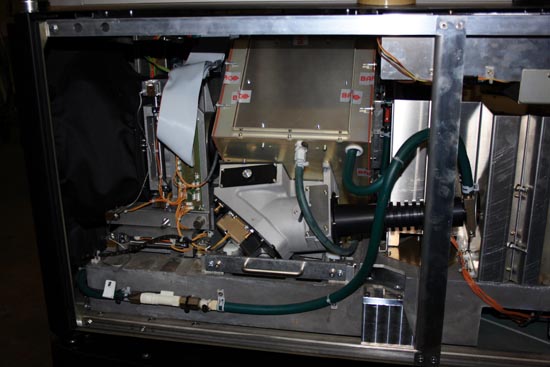
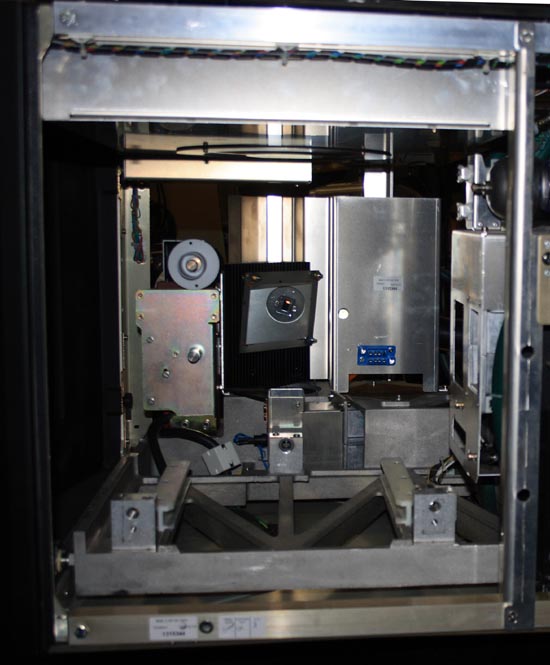
Here's a cople of pics of the optical path of the DP-100... I don't remember if I took pics of the ZX's or not but I will look. I do have pics of the insides of the NEC 2500 at home and I can post them tonight.

Buisness side of the optical path showing integrator rod, fold mirror and light engine box... The water cooling block for the aperature plate is at the right with the green hoses going to it.
 -

Lamp module pulled... You can see the right angle mirror and aperatire plate. Neither model Christie projector utilizes the angled mirror on the input end which to me is a clear advantage. The Christie's light path places the light directly on the aperature plate first.

 -

 |  IP: Logged

Brad Allen
Jedi Master Film Handler

Posts: 688
From: Evansville, IN, USA
Registered: May 2000


 - posted 02-08-2008 03:29 PM      Profile for Brad Allen   Email Brad Allen   Send New Private Message       Edit/Delete Post 
Just a few tidbits I'll throw out there, Sony, although not using DLP's, have already stopped making rear projection TV's. They were selling very poorly.

From what I read from this years CES, it appears that only Samsung and Mitsubishi will be the only ones left making rear proj Tv's for the next model year. And Mitsubishi has already announced a laser based RP to be released this summer.

So, DLP's are already fading fast into the history books.

I would like to thank everyone contributing information/views/opinions on this subject. Makes for some great info for all to know that otherwise we may not have access to. [beer]

 |  IP: Logged

Scott Norwood
Film God

Posts: 8146
From: Boston, MA. USA (1774.21 miles northeast of Dallas)
Registered: Jun 99


 - posted 02-08-2008 05:35 PM      Profile for Scott Norwood   Author's Homepage   Email Scott Norwood   Send New Private Message       Edit/Delete Post 
Thanks, Mark. Nice pictures.

 |  IP: Logged

Ron Curran
Jedi Master Film Handler

Posts: 504
From: Springwood NSW Australia
Registered: Feb 2006


 - posted 02-08-2008 09:50 PM      Profile for Ron Curran   Author's Homepage   Email Ron Curran   Send New Private Message       Edit/Delete Post 
Mark, your note about Australian cinema adopting an e-cinema model is correct for the independent scene. There is no model in place for dci roll-out to the majors and the minors are not under consideration.

Major distributors are still issuing prints. Mid-range and independent distributors are pushing e-cinema.

E-cinema has many advantages for independents. With the right set-up it looks pretty good – often better than 35mm for sub-run because the image has not been degraded by first-run cinemas and the digital track hasn’t worn off. Smaller releases can get to your screen earlier via hard drive. Successful films can be re-booked via e-mail (no need to check print availability). There are some worthwhile titles that are available ONLY in the digital format. Newer generation servers can be modified for encryption.

A major disadvantage is that distributors have no standard for Scope films, so it is essential to check the aspect ratio before committing to an e-cinema file, and risking a letterbox file. There is also a large variation in the quality of presentation but that is true for 35 as well.

E-cinema continues to develop in the absence of a dci model. Servers and projectors are upgradeable at reasonable cost.

 |  IP: Logged

Steve Guttag
We forgot the crackers Gromit!!!

Posts: 12814
From: Annapolis, MD
Registered: Dec 1999


 - posted 02-09-2008 10:33 PM      Profile for Steve Guttag   Email Steve Guttag   Send New Private Message       Edit/Delete Post 
quote: Mark Gulbrandsen
Instead of talking to Dolby why not talk to the guys at Christie up in Canada about weather or not the Dolby 3-D works on the ZX. When I attended the first US Christie DLP class last November they firmly said that it had been worked out and that one had been converted.
A fair question. The answer...I was standing in Dolby's SF office.

I will ask Chrisite BUT Christie is more than infamous for their boasting of having something working LONG before they actually do. Take the P-35xxx. How many attempts did they make before getting their basement reader to actually work? I remember the P-35 (original) being boasted as having the most wow-free/flutter free soundhead...despite HEARING wow and flutter in the thing and its absolute inability to handle a splice in the soundead. Then the "Central Pivot" was supposed to fix it all....and so forth and so on. A manufacturer (any) that feels the need to boast a capability to avoid losing sales is probably the worst source to ask about something.

Regarding software on the DCinema units...I guess we can use the versions we prefer. As to Barco's on the "web based"...hook a wireless router to the projector and adjust all you want from in the theatre if you don't want to string an ethernet cable. I can't think of much easier to resize/mask, color set...etc than the DCine Communicator.

I don't doubt that Christie has improved their products and I know that Barco has made changes to theirs as well.

Note, Kinoton boasts (though I have not verified) that their projector is notably brighter than others of like technology. As I said...manufacturers will say they can do anything that will get the sale. The Kinoton absolutely uses the Barco light engine...there is no attempt to conceal that. I do prefer that Barco seals their light engine over Christie's open approach. Anything that blows air, blows dirt...not matter how hard one tries to filter it.

Steve

 |  IP: Logged

Mark Gulbrandsen
Resident Trollmaster

Posts: 16657
From: Music City
Registered: Jun 99


 - posted 02-10-2008 10:33 AM      Profile for Mark Gulbrandsen   Email Mark Gulbrandsen   Send New Private Message       Edit/Delete Post 
quote: Steve Guttag
Regarding software on the DCinema units...I guess we can use the versions we prefer. As to Barco's on the "web based"...hook a wireless router to the projector and adjust all you want from in the theatre if you don't want to string an ethernet cable. I can't think of much easier to resize/mask, color set...etc than the DCine Communicator.

Actually I do just that anyway... being at the end of a 100 foot ethernet cable is nasty. I merely mentioned the I-Phoone thing because its a nice feature to have if you notice a touch up you need to do and the laptop is already put away. Some pocket computers will also work but again only on the Christie because of its web based software. Personally, I think after you use the T.I. software you'll never use Cinecommunicator again for the DLP setup... except for making up macros and and saving the backup files. The T.I. offers alot more finesse and obviously it works universally with all DLP D-Cinema projectors. It does however take some getting used to!!!

I don't think you'll get to use "what ever" version of software on the Dolby Server gear... There are obviously going to be versions that are non-functional because of internal board upgrades and some are not as stable. Megaplex here in SLC has been one of the beta test sites for many versions of the software and it's been interesting seeing Mike deal with this. The present version of both the Show Store and Show Player software are extremely stable and artifact free so I personally would stick with them on upcomming installs if at all possible. Dolby also simplified the networking part of the software on this later version. And I think the version number may to some extent dictate how many servers can be safely networked without a Show Library running as the central server. As you mentioned the present allows three but the manual(based on an older version) only allows two. I think after two screens a location is actually going to need the Show Library anyway to allow it the fliexbility in programming if need be... especially if they do much on 2nd run, matinees or hold over... or if they just plain want to move stuff around quickly.

Regarding the sealed vs. non sealed... Its basically an irrelevant thing since the imaging chips are in such close contact with the face of the prisms. Dirt is very unlikely to get in there. Its at the light input and output side that you will ultimately end up with a layer of dust and weather you have the face of the prism or the face of a piece of optical glass covering a seled light engine you still will have to clean eith3er down the road. I only see the sealed light engine as something thats really un-necessary, that will make the projector yet more expensive. Just be darn sure you know what you're doing when you clean the prism faces!!!! The Laminar Air Flow devices in the Christie are there to aid in cooling more than for dust and yes, the air is double filtered.

BTW: Forgive me if I'm so biased towards both Dolby and Christie D-Cinema gear... I've been fortunate to witness all the brands operate over a long period of time and on a fairly large scale here in SLC, I think we are at around 70 D-Cinema screens out here. I only stay biased with these brands because they have given those involved the best results, provided the best technical support, phone support, and parts availability or next day unit exchange. They are also very good at returning your phone calls on weekends and odd times in a dire emergency. FWIW: NEC would be choice #2 for projector and Doremi Choice #2 for the server. After these... in my book there is nothing else worth sticking my neck out for at the moment to sell at the very high price this gear sells for.

Mark

[ 02-10-2008, 11:50 AM: Message edited by: Mark Gulbrandsen ]

 |  IP: Logged


All times are Central (GMT -6:00)
This topic comprises 3 pages: 1  2  3 
 
   Close Topic    Move Topic    Delete Topic    next oldest topic   next newest topic
 - Printer-friendly view of this topic
Hop To:


Powered by Infopop Corporation
UBB.classicTM 6.3.1.2

The Film-Tech Forums are designed for various members related to the cinema industry to express their opinions, viewpoints and testimonials on various products, services and events based upon speculation, personal knowledge and factual information through use, therefore all views represented here allow no liability upon the publishers of this web site and the owners of said views assume no liability for any ill will resulting from these postings. The posts made here are for educational as well as entertainment purposes and as such anyone viewing this portion of the website must accept these views as statements of the author of that opinion and agrees to release the authors from any and all liability.

© 1999-2020 Film-Tech Cinema Systems, LLC. All rights reserved.