Film-Tech Cinema Systems
Film-Tech Forum ARCHIVE


my profile | my password | search | faq & rules | forum home
  next oldest topic   next newest topic
» Film-Tech Forum ARCHIVE   » Operations   » Digital Cinema Forum   » Yellow splotches on the screen? (Page 3)

 
This topic comprises 3 pages: 1  2  3 
 
Author Topic: Yellow splotches on the screen?
Brad Miller
Administrator

Posts: 17775
From: Plano, TX (36.2 miles NW of Rockwall)
Registered: May 99


 - posted 12-07-2011 04:57 AM      Profile for Brad Miller   Author's Homepage   Email Brad Miller       Edit/Delete Post 
quote: Mark Uhde
Carsten, both SXRD and DLP exceed the contrast ratio of movie film. That's one of the things I LOVE about D-Cinema, better contrast.
Ummmm sure...if you were comparing using shitty 35mm lenses.

 |  IP: Logged

Carsten Kurz
Film God

Posts: 4340
From: Cologne, NRW, Germany
Registered: Aug 2009


 - posted 12-07-2011 07:38 AM      Profile for Carsten Kurz   Email Carsten Kurz   Send New Private Message       Edit/Delete Post 
And shitty highspeed prints. Most prints I see recently have the same bad black levels as digital projectors.

- Carsten

 |  IP: Logged

Mark Uhde
Film Handler

Posts: 9
From: Kalispell, MT USA
Registered: Jul 2009


 - posted 12-21-2011 07:23 AM      Profile for Mark Uhde   Author's Homepage   Email Mark Uhde   Send New Private Message       Edit/Delete Post 
Yes, I should be clear, a GOOD film print can theoretically beat DLP and SXRD panels for contrast. But what I know is the real world. And that is film prints generally shown in movie theaters have horrible contrast. I enjoy going to the movies here so much more since they switched to digital cinema, and the deeper, darker blacks are THE main reason why.

 |  IP: Logged

Mark Gulbrandsen
Resident Trollmaster

Posts: 16657
From: Music City
Registered: Jun 99


 - posted 12-21-2011 03:51 PM      Profile for Mark Gulbrandsen   Email Mark Gulbrandsen   Send New Private Message       Edit/Delete Post 
quote: Mark Uhde
Second, as to the green panels failing first (so they're failing to a purple color?), Sony has to be doing something really, seriously wrong in their design. Blue light contains the most energy in the visible spectrum. Thus, it destroys the blue panel first. I can't imagine what Sony could be doing WRONG with their green panels that they'd fail first despite simple physics demonstrating the blue should die first.


The only energy that blue light might contain is some enrgy is UV that has not been filtered out enough. The color split is actually this and although these figures may not be 100% correct they are very very close. Green 56%, Red 28% Blue 16%. All of this color percentage today is still based on the original color tv studies of the 1940's and the division of the colors is purely based on the color sensitivity of the human eye... nothing more, nothing less. In Sony and DLP this is based on green, blue, and red wratten filters that are cemented to the prism to filter the light. In DLP is is filtered before the light hits the DMD.

This is why the green panels fail first, they are doing all the work. When your local Sony fails you will know it as the image will develop first a yellowish brown cast to it and then become very brown if it is not tended to soon.

The best way to see this color division is to look at the individual Green, blue, and red color test patterns that are available on any decent DLP projector. It will become immediately obvious to you that as you go from green to red to blue they become progressively harder to see. In the old NTSC color days the blue channel in any given TV camera was ALWAYS noiseier then red or green. Usually a specially selected "Blue Tube" which had a specially treated target was used in that channel in attempt ot gain a littloe more sensitivity and generate less noise. Blue channels even in modern HDTV CCD cameras are still exttremely difficult to align properly because of the lack of output.

White light through a prism. Blue DMD at the bottom red DMD at the top and green DMD at the left. Blue is so weak as to be over powered by green. Some red is visible at the top...
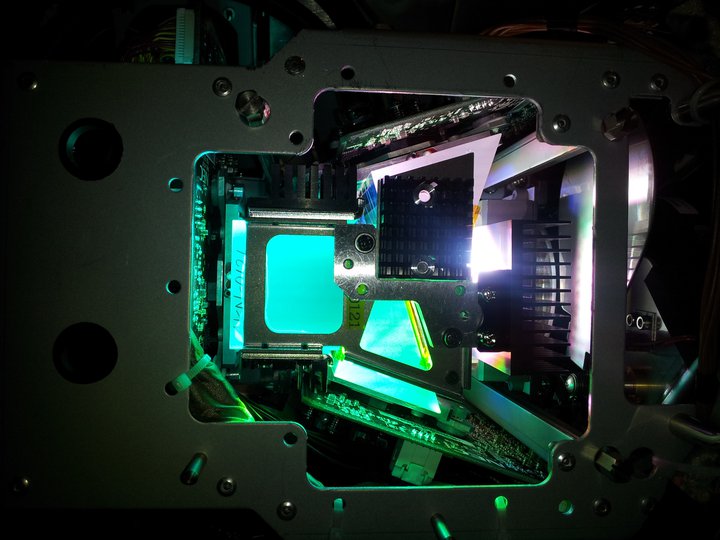
 -

 |  IP: Logged

Mark Uhde
Film Handler

Posts: 9
From: Kalispell, MT USA
Registered: Jul 2009


 - posted 12-21-2011 11:04 PM      Profile for Mark Uhde   Author's Homepage   Email Mark Uhde   Send New Private Message       Edit/Delete Post 
I'm referring to the energy of the wavelength, not the overall percentage of the light. Blue is the shortest wavelength.

http://wiki.answers.com/Q/What_is_the_relationship_between_wavelength_and_energy

The higher energy of blue light (as well as any stray UV as you noted) has traditionally caused blue imager panels to fail first.

The human eye is most sensitive to green, and makes up the abundance of what needs reproduced for "natural" color reproduction, as you noted.

EDIT - to further clarify, I'm NOT referring to the total amount of energy hitting the panel. I'm referring to the energy of each photon. Blue photons are the highest energy in the visible spectrum, and thus the most destructive.

 |  IP: Logged

Mark Gulbrandsen
Resident Trollmaster

Posts: 16657
From: Music City
Registered: Jun 99


 - posted 12-22-2011 09:41 AM      Profile for Mark Gulbrandsen   Email Mark Gulbrandsen   Send New Private Message       Edit/Delete Post 
Thats nice Mark and I understood all that way back in High School Physics class but all the energy that can be damaging is filtered out way before it hits the prism. In fact you can hold your hand in the light comming out of a projector with a 4kw lamp (the largest a Sony can take) for a considerable length of time before your hand gets hot. As I hinted at above all the UV which are the damaging short wavelengths near the blue spectrum is almost zip by the time it hits the prism. Further, there are filters right on each prism that shape each DMD's actual color operating spectrum. Now, my friends that service Sony's say it's the green chip that fails first but you claim it's the blue... perhaps you should all meet in a room some where and hammer this out. At any rate it has been said that AMC demanded an extra light engine from SOny be with each Sony projector they installed. In my world the terms "Sony" and "LCD" don't even exist as I would never urge anyone to buy anything Sony...ever, and a great majority of my customers switched to running preshow through the D-Cinema machine eliminating their LCD boxes.

Mark

 |  IP: Logged

Mark J. Marshall
Film God

Posts: 3188
From: New Castle, DE, USA
Registered: Aug 2002


 - posted 12-23-2011 07:28 AM      Profile for Mark J. Marshall     Send New Private Message       Edit/Delete Post 
Sony makes great headphones. And pretty good Spiderman movies.

 |  IP: Logged

Jeff Kane
Film Handler

Posts: 74
From: corpus christi, tx
Registered: Jun 2011


 - posted 12-23-2011 01:36 PM      Profile for Jeff Kane   Email Jeff Kane   Send New Private Message       Edit/Delete Post 
If the light engine/SXRD chips are similar technology to what's in their consumer devices, Sony's had this issue a loooong time and they've been hit with a class action suit over it.

Google Site on Sony SXRD/LCD issues

Edit: That document is mostly about LCD failures but does mention SXRD/LcOS issues as well.

 |  IP: Logged

Monte L Fullmer
Film God

Posts: 8367
From: Nampa, Idaho, USA
Registered: Nov 2004


 - posted 12-23-2011 01:45 PM      Profile for Monte L Fullmer   Email Monte L Fullmer   Send New Private Message       Edit/Delete Post 
Heard that the color shift in that image was possibly due to the plastic frame around one of the prisms getting too hot causing the prism to get scorched thus creating a blue haze over the face of the prism-thus offsetting the color output in that scorched area.

[Shrug]

 |  IP: Logged

Mark J. Marshall
Film God

Posts: 3188
From: New Castle, DE, USA
Registered: Aug 2002


 - posted 12-23-2011 02:50 PM      Profile for Mark J. Marshall     Send New Private Message       Edit/Delete Post 
That's a great article, Jeff. Thanks for posting that. I can't help but think that the problems the article refers to and the issue I noticed in the theater are very similar if not the exact same problem.

 |  IP: Logged

Mark Uhde
Film Handler

Posts: 9
From: Kalispell, MT USA
Registered: Jul 2009


 - posted 12-24-2011 06:05 PM      Profile for Mark Uhde   Author's Homepage   Email Mark Uhde   Send New Private Message       Edit/Delete Post 
@Mark G.

I have NO experience with digital cinema, and very little with LCoS. I don't make any claims to know what's failing most frequently in Sony Digital Cinema projectors.

What I said is it's very strange if they're having green panels fail first (which would give the image a magenta discoloration). In traditional LCDs, and from what I've heard - the business and home versions of LCoS projectors - the blue panels fail first due to the energy of the blue photons and stray UV photons.

This LCD yellowing - degradation in both the panels themselves and other components of the blue optical path - is a well-known phenomenon that has plagued LCD projection since it's inception. LcOS/SXRD is essentially just a reflective version of LCD. The reflective nature is SUPPOSED to allow for better cooling to reduce this problem. I know at least HOME AND SMALL BUSINESS LCoS projectors still have high failure rates. Actually I'm up in the control booth at a venue I'm at frequently (I'm on lights but still) staring at the image coming off an LCD projector with a totally destroyed blue imager... horribly yellow

P.S. Mark G. I just noticed you refer to DMDs... the issue with damaged blue panels does not affect DMDs. Something that TI was making a big point about for awhile.

 |  IP: Logged

Carsten Kurz
Film God

Posts: 4340
From: Cologne, NRW, Germany
Registered: Aug 2009


 - posted 01-15-2012 05:06 PM      Profile for Carsten Kurz   Email Carsten Kurz   Send New Private Message       Edit/Delete Post 
quote: Mark J. Marshall
That's a great article, Jeff. Thanks for posting that. I can't help but think that the problems the article refers to and the issue I noticed in the theater are very similar if not the exact same problem.
Mark - your first post suggests you were sitting in a DLP equipped theater. Now how can SXRD yellowing show up in a DLP equipped theatre?

- Carsten

 |  IP: Logged

Mark J. Marshall
Film God

Posts: 3188
From: New Castle, DE, USA
Registered: Aug 2002


 - posted 01-16-2012 09:34 AM      Profile for Mark J. Marshall     Send New Private Message       Edit/Delete Post 
I'm not sure if that is meant as a rhetorical question or not, but here's my answer. If you're referring to the difference between Texas Instruments DLP and Sony's digital projectors, when I said "DLP equipped theater" I was using DLP as a generic term meaning "digital" - as in, "I'm sitting in a digital projector equipped theater." Maybe I'm not understanding your question though.

 |  IP: Logged


All times are Central (GMT -6:00)
This topic comprises 3 pages: 1  2  3 
 
   Close Topic    Move Topic    Delete Topic    next oldest topic   next newest topic
 - Printer-friendly view of this topic
Hop To:


Powered by Infopop Corporation
UBB.classicTM 6.3.1.2

The Film-Tech Forums are designed for various members related to the cinema industry to express their opinions, viewpoints and testimonials on various products, services and events based upon speculation, personal knowledge and factual information through use, therefore all views represented here allow no liability upon the publishers of this web site and the owners of said views assume no liability for any ill will resulting from these postings. The posts made here are for educational as well as entertainment purposes and as such anyone viewing this portion of the website must accept these views as statements of the author of that opinion and agrees to release the authors from any and all liability.

© 1999-2020 Film-Tech Cinema Systems, LLC. All rights reserved.