|
|
 
|
|
Author
|
Topic: Screen: Common Height or Common Width?
|
|
|
|
|
|
|
|
|
|
|
|
|
|
|
|
|
Steve Guttag
We forgot the crackers Gromit!!!

Posts: 12814
From: Annapolis, MD
Registered: Dec 1999
|
 posted 05-02-2015 02:09 AM


ALL DLP based projectors can handle the anamorphic lens. The scaling technology is on the TI side of things (both series 1 and series 2 projectors). So even if you have say a Barco DP2K-20C projector that doesn't show the anamorphic settings, you can use the TI ICP/Enigma program to make a SCREEN file with the anamorphic squeeze that the Barco projector will happily recall like any other.
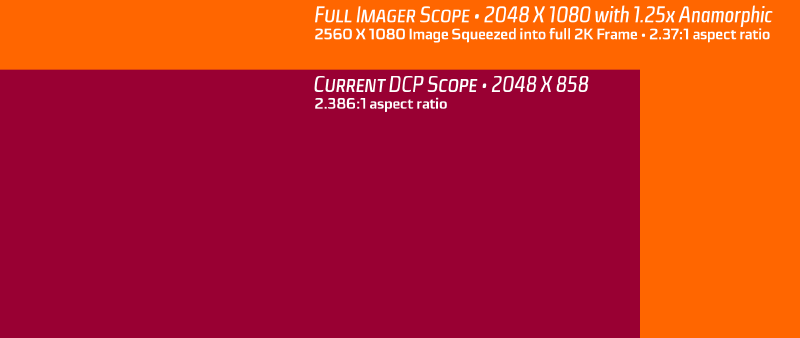
As Bobby notes, using an anamorphic with current content does not buy you any resolution. However it does buy you 23% more light (with the other 3% loss in the glass). Ideally it would have be a 1.26x anamorphic but I'm sure if tested a 26% stretch would have shown significantly more scaling artifacts than 25% hence it is just under ideal. That 23%, however, can normally mean a lamp size difference to hit your light on "Scope." Zooming the lens just wastes the light. If you read other threads, you'll find discussions where people have taken to setting scope's light level in the 11-12fL range and the Flat's light level in the 16-17fL range so the lamp is not ping-ponged between near minimum and near maximum level trying to balance both. With an anamorphic, that range is cut in half. Depending on the screen size, projector and lamp, you can have both target the standard 14fL or reduce the spread to something like 15fL and 13fL without stressing the lamp. In larger lamp situations, dropping the lamp size can really add up (particularly the 4500-watt and larger lamps). I suspect even with lasers it will provide a significant cost savings as a smaller laser system could be used. The scope format being the determining factor on how much projector one needs.
| IP: Logged
|
|
Daniel Schulz
Master Film Handler

Posts: 387
From: Los Angeles, CA USA
Registered: Sep 2003
|
posted 05-02-2015 09:53 AM

quote: Bobby Henderson
This anamorphic approach in d-cinema would make a big difference with image quality. But it takes both Hollywood studios creating DCPs with anamorphic enhanced content AND theaters outfitted with projectors using anamorphic 1.25x lenses to get the benefit.
If I could change anything about the DCI standards it would be this. I miss real widescreen. Unfortunately the loss of resolution happens relatively early post production - even if the image is captured at camera with an anamorphic lens, typically the work files for editing and color correction, and definitely the DI, are 2048 x 858.
There is a company called Folded Space (a division of Panamorph, who make anamorphic lenses for home theatre projectors), who have developed a technology to create anamorphic widescreen Blu Rays that are backwards compatible with non-anamorphic playback. Essentially they take the extra pixel data, place it in the space normally occupied by the black letter boxing bars, and then use the Java in the Blu Ray standard to hide those pixels. If you have an anamorphic system, the Blu Ray player reincorporates the extra pixels, creating a 1920x1080 anamorphic squeezed image, which yields a true widescreen image upon projection. Folded Space has been hoping to get this technology adopted in Blu Ray and the proposed UHD Blu Ray, but I see no technical reason it couldn't be used in Digital Cinema as well.
| IP: Logged
|
|
|
|
|
|
Gary Lightfoot
Film Handler
Posts: 20
From: Caterham, Surrey, UK
Registered: Apr 2015
|
posted 05-04-2015 06:32 AM
I've been using anamorphic lenses for over 10 years in my home theatre (Primsasonic and now ISCO), and although the source resolution does not change, scaling does produce a visibly better image than when zoomed from where I sit.
At home, we zoom 33% (rather than 25% for 2k), which is like moving your seating 33% closer, and pixels become more 'chunky' compared to a scaled image that is using more pixels which are smaller. The image looks more detailed and sharper despite the source res being no different than when zoomed. It all depends on how good the scaling is, and these days it's usually very good - no visible artefacts unless you use a test pattern. Much of this depends on how close you sit of course, and that is an important factor, more so than physical screen size.
I've been watching folded space (John Schuerman) over on avsforum but somehow I don't think it's going to happen unfortunately. ![[Frown]](frown.gif) It looks like 4k is going to be installed (and then 8k) before folded space gets used. At home, constant image height is a niche within a niche (of people with projectors), and if the commercial market is shying away from ananmorphics I can't see them wanting to go for folded space over a more marketable 4k, especially where the 4k zoomed pixels are going to be smaller than the pixels of a 2k image using anamorphics. IMHO. It looks like 4k is going to be installed (and then 8k) before folded space gets used. At home, constant image height is a niche within a niche (of people with projectors), and if the commercial market is shying away from ananmorphics I can't see them wanting to go for folded space over a more marketable 4k, especially where the 4k zoomed pixels are going to be smaller than the pixels of a 2k image using anamorphics. IMHO.
Zooming doesn't always lose you a huge amount of light with home cinema projectors, but it depends where in the throw the pj is - when you zoom the prime lens to make the image larger, due to the way the lens elements re-arrange, the F-stop changes and you often find that as you zoom larger, you get more lumens and less on/off contrast. When you zoom smaller the opposite happens. In some cases the difference between zooming and using an A lens can be small and inconsequential. I'm guessing that with commercial installs, the set up and choice of prime lens means that is never the case.
I'm a huge fan of constant image height and hate the way modern multiplexes are just like big tv now. Most cinema goers have no idea about constant width or constant height so don't know what they are missing. Looking at documents from people like SMPTE, THX, Dolby etc, they seem to actively promote constant height in preference over constant width (and no mention of other compromise formats like constant area), yet the commercial part of the industry is (obviously I guess) more concerned with the costs of things rather than the art of presentation. If the advantage of a $10k anamorphic lens is lost on 99.99% of the cinema going public, I can see why no one wants to spend that amount of money on one.
Would I be right in saying that due to the loss of people like yourselves in the industry, they now need projector operation etc to be so simple that an untrained guy like a multiplex manager or the guy who sells the tickets and popcorn can click a mouse and start a movie? If that's the case, I can see that zooming an image for scope or trying to implement an anamorphic lens would just be too tricky and lead to problems.
I'm purely a home cinema enthusiast but have popped over here to see what your guys take is on various aspects, and how things are done in the commercial space. Hope you don't mind me throwing in my own perspective and asking dumb questions.
Please be gentle with me. ![[Smile]](smile.gif)
Thanks
Gary
| IP: Logged
|
|
|
|
|
|
|
|
All times are Central (GMT -6:00)
|
This topic comprises 13 pages: 1 2 3 ... 7 8 9 10 11 12 13
|
Powered by Infopop Corporation
UBB.classicTM
6.3.1.2
The Film-Tech Forums are designed for various members related to the cinema industry to express their opinions, viewpoints and testimonials on various products, services and events based upon speculation, personal knowledge and factual information through use, therefore all views represented here allow no liability upon the publishers of this web site and the owners of said views assume no liability for any ill will resulting from these postings. The posts made here are for educational as well as entertainment purposes and as such anyone viewing this portion of the website must accept these views as statements of the author of that opinion
and agrees to release the authors from any and all liability.
|

 Home
Home







 Printer-friendly view of this topic