|
|
This topic comprises 3 pages: 1 2 3
|
|
Author
|
Topic: laser projection
|
|
|
|
|
|
|
|
|
|
|
|
|
|
|
|
|
|
|
Marcel Birgelen
Film God
Posts: 3357
From: Maastricht, Limburg, Netherlands
Registered: Feb 2012
|
 posted 12-26-2014 06:03 PM


quote: Carsten Kurz
Actually there are six tubes to/from the chiller. And yes, it does look very much like the Christie solution at first until you notice these six tubes can not be fibres.
Which makes sense too, because you really want to circulate your cooling liquid I guess ![[Wink]](wink.gif) . .
quote: Carsten Kurz
I assume the basic light output of these machines is about the same, around 60.000-70.000 lumens, but the Christie can output this luminous flux simultaneously from both projector heads, practically doubling it for 3D applications?
I've not yet seen a 3D movie in production on the Barco machine. I've seen 3D content on a demo setup, but the brightness didn't really blow me away. I will give the Kinepolis setup in Antwerpen or Brussels a try shortly, so I can do my own rather subjective comparisons.
The Christie Dual 3D setup is the first production setup which I've seen which will really deliver 3D at the brightness of 2D on a large screen.
Additionally, the wider color gamut pictures look really great, but not cinematic at all. Maybe it's the ideal platform for computer games on giant screens .
| IP: Logged
|
|
Carsten Kurz
Film God
Posts: 4340
From: Cologne, NRW, Germany
Registered: Aug 2009
|
posted 12-26-2014 07:24 PM
Is that screen size documented?
When I consider my own numbers from above - a common Barco DP4k-32B delivers 30.000+ lumens. The DP4k-60L delivers 60.000 lumens. The 6p/Dolby 3D efficiency is about the same as that of a RealD XL system, around 23-25%. That means, a single DP4k-60L lumenwise replaces a twin-DP4k-32B stack with RealD/silver screen (at three times the price - not including bulb cost).
But a dual DP4k-32B is not uncommon for large screen installations.
Yes - no silver screen necessary, no hot spot, better stereo separation, sllghtly higher overall contrast. But not really a breakthrough from a cinemagoer's perspective. The DP4k-60L ENABLES Dolby 3D for large screens, but it can not keep the '14fL Dolby 3D promise' for these screens, only for medium size screens.
While the Christie solution costs considerably more, I assume it would result in a significant increase in 3D brightness. Don't know if Barco is ready for stacked operation of two DP4k-60L. And the cost, wow...you can burn a lot of 7kW bulbs for that upcharge.
Really wondering what the IMAX solution looks like - it's designed to fill the largest IMAX screens. How many lumens would you need to accomplish this, and in 3D with 25% efficiency? And in how far will Barcos IMAX solution be different from their own general market DP4k-60L?
- Carsten
| IP: Logged
|
|
Marcel Birgelen
Film God
Posts: 3357
From: Maastricht, Limburg, Netherlands
Registered: Feb 2012
|
posted 12-27-2014 05:06 AM
quote: Carsten Kurz
Is that screen size documented?
My direct comparison would be JT Kerkrade against the Dolby Cinema setup in Eindhoven.
Auditorium 1 JT Kerkrade (XD PLF concept):
2 x Barco DP4K-32B
Circular polarized 3D using a silver screen
Roughly 24x10m ~ 240 sqm
Auditorium 6 JT Eindhoven (Dolby Cinema):
Christie 6P dual projector setup
Dolby 3D
Roughly 20x12m ~ 240 sqm
For the record, both screens feature Dolby Atmos.
Obviously, the screen in Kerkrade is a scope screen, so it loses some light if fully covered and has a smaller surface than the screen in Eindhoven for features presented in flat.
I’ve not seen the new Kinepolis setup using the single a DP4K-60L for 3D presentations.
The screen in Kerkrade is sufficiently bright for standard 2D presentations, but nothing to write home about. There is some hotspotting, but you need to look for it to see it. There are some reflections of exit lights on the screen, which are more troublesome.
For 3D presentations, the brightness is just acceptable and really not that great. It’s the best you can do with conventional Xenon bulbs or you need to add another two projectors to the setup, which will cause you quite some headaches, as Barco doesn’t currently offer a seamless convergence solution for their DCI gear.
Also, there’s always some noticeable crosstalk, especially in the ever-present subtitling.
The Dolby Cinema setup has already a few advantages built into the design of the auditorium. The dark, paneled walls, the plain white screen and the almost complete absence of other ambient light bouncing off the screen will create a larger contrast to begin with. So, the comparison might be an objective one, based on all factors, but still the difference for 3D is night and day, compared to the setup in Kerkrade. For 2D, it’s not really that obvious. The picture surely is bright, but nothing you couldn’t recreate on a somewhat smaller screen using a powerful projector like the DP4K-32B.
The Kinepolis screens in Brussels and Antwerpen are both about 23x10m, so a comparison would be based on roughly the same screen sizes.
Comparisons are obviously subjective, but in the end the perceptions of the average visitor is the thing that counts most.
| IP: Logged
|
|
|
|
|
|
|
|
|
|
All times are Central (GMT -6:00)
|
This topic comprises 3 pages: 1 2 3
|
Powered by Infopop Corporation
UBB.classicTM
6.3.1.2
The Film-Tech Forums are designed for various members related to the cinema industry to express their opinions, viewpoints and testimonials on various products, services and events based upon speculation, personal knowledge and factual information through use, therefore all views represented here allow no liability upon the publishers of this web site and the owners of said views assume no liability for any ill will resulting from these postings. The posts made here are for educational as well as entertainment purposes and as such anyone viewing this portion of the website must accept these views as statements of the author of that opinion
and agrees to release the authors from any and all liability.
|

 Home
Home



![[Cool]](cool.gif)
![[Razz]](tongue.gif) ), the Scotiabank now has it installed. There is an IMAX engineer at the facility doing tests during my screening. There is a lot of Dolby technology used for this system. Also, there is some Dolby advertising included with the IMAX branding.
), the Scotiabank now has it installed. There is an IMAX engineer at the facility doing tests during my screening. There is a lot of Dolby technology used for this system. Also, there is some Dolby advertising included with the IMAX branding.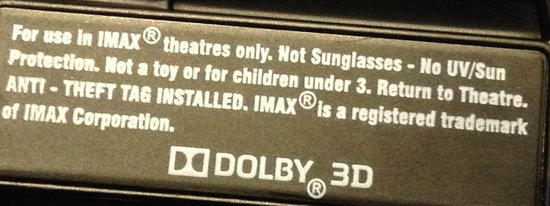

![[Smile]](smile.gif) .
.



 Printer-friendly view of this topic