Film-Tech Cinema Systems
Film-Tech Forum ARCHIVE


my profile | my password | search | faq & rules | forum home
  next oldest topic   next newest topic
» Film-Tech Forum ARCHIVE   » Operations   » Digital Cinema Forum   » Post Production Projectors (Page 2)

 
This topic comprises 2 pages: 1  2 
 
Author Topic: Post Production Projectors
Carsten Kurz
Film God

Posts: 4340
From: Cologne, NRW, Germany
Registered: Aug 2009


 - posted 04-21-2016 04:30 PM      Profile for Carsten Kurz   Email Carsten Kurz   Send New Private Message       Edit/Delete Post 
I was about to write that you don't need a real DCI projector for a post production application. You need a machine that supports P3 colors and proper calibration. However, if you are going for DCI content wrapping, it is advisable to have a DCI compliant server, and the Alchemy certainly is not a bad option (beefy yet low cost).

All ports are usable now, though I guess for a post production application, the HD-SDI ports will be first choice.

The Barco DP2K-6E with the Alchemy/ICMP is a very low cost option as well. It is also very silent, if that plays a role.

I think there are two different aspects that you may follow with such a purchase - you may want to get the best in 4k, contrast and color stability for grading in a grading/mastering suite.
Or you may buy the 'lowest denominator' in order to be sure what you grade to is actually displayed at a typical cinema. Some people suggest basic JBL speakers for the same reason for the final audio mastering, as that is what most cinemas have installed.

I know some mastering studios have both high-end monitors for production, and one or two typical consumer systems for verification.

- Carsten

 |  IP: Logged

Alan Gordon
Film Handler

Posts: 4
From: Brooklyn, NY, USA
Registered: Apr 2016


 - posted 04-21-2016 05:27 PM      Profile for Alan Gordon   Author's Homepage   Email Alan Gordon   Send New Private Message       Edit/Delete Post 
What variety are the SDI ports on the Alchemy board? I had assumed 3G SDI, which wouldn't get you 4k input (which is why the P projector comes with the quad 3G SDI...)

My Blackmagic output card has both 12G SDI (which can easily be converted to quad 3G SDI) As well as HDMI 2.0

Interesting note about the P and B having different light engines. I've been talking with a dealer about modifications that can be done to the 19B to bring the contrast a bit closer to that of the P. And I'm thinking that might be the best middle ground here as much as the gear nut in me would like to splurge on the P.

 |  IP: Logged

Dave Macaulay
Film God

Posts: 2321
From: Toronto, Canada
Registered: Apr 2001


 - posted 04-22-2016 06:39 AM      Profile for Dave Macaulay   Email Dave Macaulay   Send New Private Message       Edit/Delete Post 
The Alchemy ICMP dual SDI inputs are 3G, 2.970 Gb/s. Each will carry a 2k 4:4:4 image stream. It also supports the legacy 2D single or 3D dual SDI 4:2:2 and dual span 4:4:4 signals.
Ask your Barco dealer for document "Barco_InstallationManual_R5905722_06__ICMP-InstallationUpgrade-instructions-for-DC-projectors"
This has decent detail on what the inputs are expected to do. The different connections (SDI, DP, HDMI) each has it's own list of capabilities.
The ICMP is still somewhat new... firmware has been evolving. For example I don't think the SDI outputs do anything yet, and I haven't managed to use audio over DisplayPort.
The B and C projectors have the same backplane connectors for the same circuit boards: without seeing one "in the flesh" the P machine looks to be the same. If so you can install a TI ICP and any input card (quad SDI, Enigma dual SDI, IMB, IMS) or install an Alchemy where the ICP and input card would go.
All cinema projectors and cinema servers are designed for - and almost exclusively used for - cinema projection. Their feature sheets might suggest they will do exactly what you want, yet non-cinema features can be buggy or missing. Engineering teams have to prioritize issues that impact cinema customers... there is no shortage of such issues.
With any expensive equipment where you want to step outside of the primary intended use... talk to people who are using one for something similar to what you hope to do.
Don't jump in with the alligators because a salesman says the water's safe.

 |  IP: Logged

Daniel Morez
Film Handler

Posts: 21
From: Hollywood, CA, USA
Registered: Jun 2010


 - posted 05-26-2016 07:48 PM      Profile for Daniel Morez   Email Daniel Morez   Send New Private Message       Edit/Delete Post 
Below are a couple examples of what Ive found differentiates a Barco Post Production projector vs standard cinema projectors. As mentioned its much more than just improved contrast. Hand selected and matched optical components etc, etc. Its always vary obvious to me what this results in when working on a P unit.

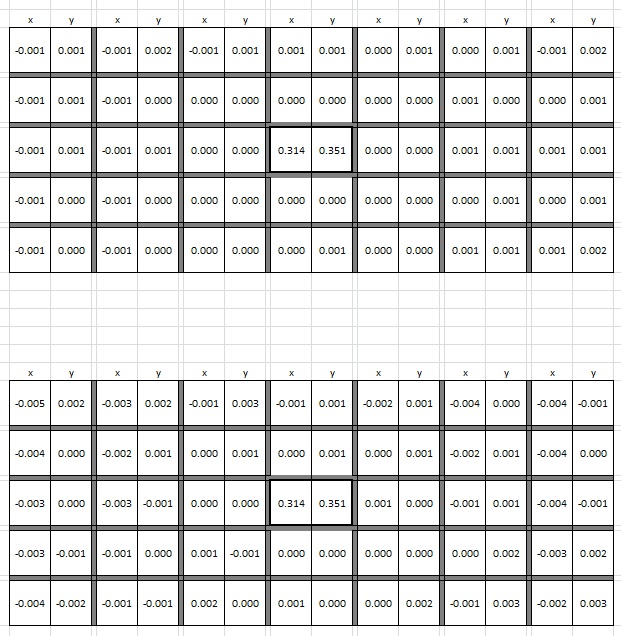
CIE xy color uniformity relative to center screen shown below. The upper measure grid is from a Barco P. The lower is a similar series non P model tuned up as best as possible.
 -

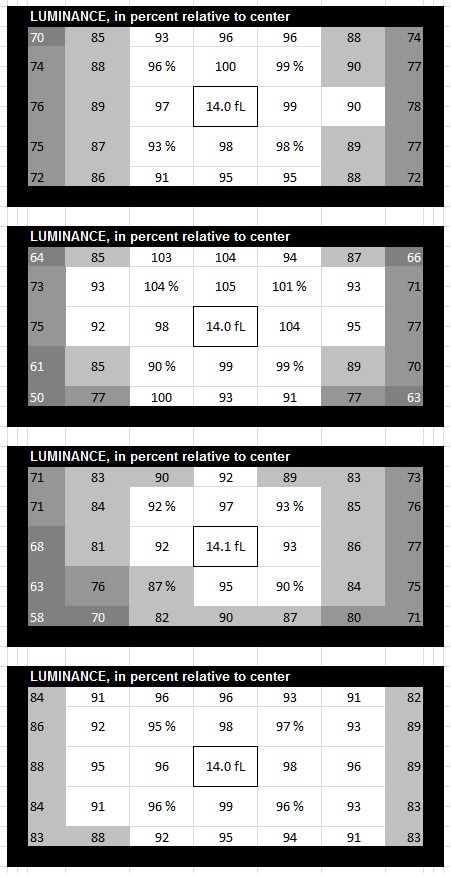
Below are multiple Luminance uniformity examples of non P cinema projectors vs a P unit.
 -

Another less often discussed factor is the Extended Gamut capability that comes with the P models. While Cinema projectors are supposed to all be able to reproduce the entire DCI-P3 color gamut, the reality is the good majority of standard gamut projectors will miss small portions of the gamut towards maximum saturations. With an available Gamut that goes beyond P3 the theory is you then just need to limit the gamut down to exactly cover P3. Just like we commonly do with Rec709 which is a smaller gamut that resides within the larger P3 gamut. This is actually the primary reason why the P Lumens rating is so much lower than a standard 23B. Light path contrast enhancements have a part but are not as significant compared to the spectral modifications needed to extend the gamut.


The above uniformity comparisons follow a custom 35 point (5x7) measurement of the entire 2K image area (DCI-P3 white field, includes perimeter edges of active area). Each point measured with spectroradiometer placed in the "hero" point of the room to factor reflection incidence. Done in the same DI suite successively, ie when measured the projectors were placed in the same position and alignment relative to the screen. Room equipped with a non-perf SnoMatte 100 unity gain white screen.

Just to state, as far as uniformity goes, I'm not saying only a P can achieve these or similar levels of uniformity. A lot can be done with methodical tuning and swapping/upgrading optical components. The thing with the P is that its just waaaaay better out of the box compared to any other projector I have had the chance to evaluate.

 |  IP: Logged

Marco Giustini
Film God

Posts: 2713
From: Reading, UK
Registered: Nov 2007


 - posted 05-27-2016 03:18 AM      Profile for Marco Giustini   Email Marco Giustini   Send New Private Message       Edit/Delete Post 
Thanks, that's quite interesting.

Another point is that if your P machine exceeds the Post Production tolerances and cannot be adjusted on site, Barco will take responsibility and replace the required parts to bring it back to what it should be. So if you measure +0.003x on a corner, you can claim a warranty repair.

It all depends whether you need that accuracy or not but the P machine is indeed very accurate.

 |  IP: Logged

Steve Guttag
We forgot the crackers Gromit!!!

Posts: 12814
From: Annapolis, MD
Registered: Dec 1999


 - posted 05-27-2016 11:31 AM      Profile for Steve Guttag   Email Steve Guttag   Send New Private Message       Edit/Delete Post 
Bravo! Very good post! [beer]

 |  IP: Logged

Alan Gouger
Jedi Master Film Handler

Posts: 501
From: Bradenton, FL, USA
Registered: Jul 2000


 - posted 11-23-2016 11:26 PM      Profile for Alan Gouger   Author's Homepage   Email Alan Gouger   Send New Private Message       Edit/Delete Post 
Regarding the expanded color space of the Barco 4k-P it exceeds P3 closer to rec2020. It uses a special Notch filter supplied by Kodak. The light path with filter does take a hit on light output.

Barco P gamut:
native red: x = 0.7; y = 0.3
native green: x = 0.2; y = 0.76
native blue: x = 0.145; y = 0.04

Rec2020
(R) 0.708, 0.292
(G) 0.170, 0.797
(B) 0.131, 0.046

 |  IP: Logged

Marco Giustini
Film God

Posts: 2713
From: Reading, UK
Registered: Nov 2007


 - posted 11-24-2016 08:52 AM      Profile for Marco Giustini   Email Marco Giustini   Send New Private Message       Edit/Delete Post 
very interesting, I thought the reduced light output was all used up to increase the contrast ratio.
Very interesting post indeed. Thanks!

 |  IP: Logged

Mark Gulbrandsen
Resident Trollmaster

Posts: 16657
From: Music City
Registered: Jun 99


 - posted 11-24-2016 09:13 AM      Profile for Mark Gulbrandsen   Email Mark Gulbrandsen   Send New Private Message       Edit/Delete Post 
Has anyone tried the Schneider series of D-Cinema lenses instead of the chinese built zooms? I am just curious if there is anything very positive to them...

Mark

 |  IP: Logged

Alan Gouger
Jedi Master Film Handler

Posts: 501
From: Bradenton, FL, USA
Registered: Jul 2000


 - posted 11-24-2016 09:47 AM      Profile for Alan Gouger   Author's Homepage   Email Alan Gouger   Send New Private Message       Edit/Delete Post 
quote: Mark Gulbrandsen
Has anyone tried the Schneider series of D-Cinema lenses instead of the chinese built zooms? I am just curious if there is anything very positive to them...
No experience but they are monstrous in size. I think they are all fixed, no zoom.

In-Vision 4K can be superior to the Minolta's if you get a good one ( the mechanics ). Ive had them work in one projector and not another.

 |  IP: Logged

Marco Giustini
Film God

Posts: 2713
From: Reading, UK
Registered: Nov 2007


 - posted 11-24-2016 11:10 AM      Profile for Marco Giustini   Email Marco Giustini   Send New Private Message       Edit/Delete Post 
interesting. I only found short-throw lenses though. Makes sense, why someone should install one of those lenses in a commercial cinema? You only require them on special occasions.

 |  IP: Logged

Mark Gulbrandsen
Resident Trollmaster

Posts: 16657
From: Music City
Registered: Jun 99


 - posted 11-24-2016 11:18 AM      Profile for Mark Gulbrandsen   Email Mark Gulbrandsen   Send New Private Message       Edit/Delete Post 
Yes, same issue here with the In-Vision stuff. I had one that went on an NC-3240 that looked absolutely awesome but the zoom motor was not set up properly on the lens. NC-3200 & 3240 have no lens learn function. But after several different tries at locating the null zoom point I got it to work and it's been fine for some times now. At another Drive In with an NC-3200 the first In-Vision lens would not work at all but the second one worked just fine and has been for a long time now. ALL of the .89" In-Vision DLP lenses drifted and all were returned for Minolta lenses. Yes, the Schneiders are big and you have to change lenses to change formats however, I suspect they beat the pants off any zoom.

Mark

 |  IP: Logged

Steve Guttag
We forgot the crackers Gromit!!!

Posts: 12814
From: Annapolis, MD
Registered: Dec 1999


 - posted 11-25-2016 10:29 AM      Profile for Steve Guttag   Email Steve Guttag   Send New Private Message       Edit/Delete Post 
Schneider, realizing they could not compete with the asian made lenses for DCinema and also realizing that for each style of projector (1.2/1.38, .98, .69) would require new designs of lenses, and also realizing that "zoom" lenses would never live up to their standards, opted to not jump into the DCinema lens business like they had with film projection.

So the lenses they DO make are short EFs for use in large screen applications. This is an area where their strengths would shine and lesser lenses would be shown to be not as good. Also, given that there would be a smaller percentage of lenses made in the short EFs, it is an area where high-volume doesn't help competitors.

Now me, personally, I wished that they had jumped in with variable focal length lenses (technically, a "zoom" should hold focus over its range). The quality I've experienced with DCinema lenses is all over the map. I'd say, on average, Minolta lenses are one's best bet but there is no guarantee. Yes, one can find examples of really good Invision and Fujinon lenses but if you had a pile of 10 Minoltas, 10 InVision and 10 Fujinon lens that all were the same range for the same projector, the odds you got a "good" lens would be FAR higher on the Minolta pile.

I believe InVision is the only lens company that is making 4K specific lenses, at the moment (of the variable EF, at least). The others just let their 2K lenses work on 4K projectors and noted the EF changes. There was no mention of if they over-designed the MTF of the lenses to work with 4K as well as 2K. The other thing a 4K lens should bring is a better shift range due to a larger inlet pupil.

 |  IP: Logged

Mark Gulbrandsen
Resident Trollmaster

Posts: 16657
From: Music City
Registered: Jun 99


 - posted 11-25-2016 10:38 AM      Profile for Mark Gulbrandsen   Email Mark Gulbrandsen   Send New Private Message       Edit/Delete Post 
Exactly... I remember when I did the Zion Canyon conversion we tried to get them to build us a WA lens since we had customers with pretty deep pockets on the project. But Schneider had literally just hired the optics guy away from T.I. at the time and he was just getting started. I actually had conversations with him several times about it. They quoted us something like 30K and a year turn around time which wouldn't have worked out. Dwight said the big issue with D-Cinema lenses was grinding the flourite elements involved. Apparently every now and then one of those will shatter and then the whole batch is ruined. Had we done that job a year later they would have a Schneider there. But the 15/70 system was getting pretty decrepit.

Mark

 |  IP: Logged


All times are Central (GMT -6:00)
This topic comprises 2 pages: 1  2 
 
   Close Topic    Move Topic    Delete Topic    next oldest topic   next newest topic
 - Printer-friendly view of this topic
Hop To:


Powered by Infopop Corporation
UBB.classicTM 6.3.1.2

The Film-Tech Forums are designed for various members related to the cinema industry to express their opinions, viewpoints and testimonials on various products, services and events based upon speculation, personal knowledge and factual information through use, therefore all views represented here allow no liability upon the publishers of this web site and the owners of said views assume no liability for any ill will resulting from these postings. The posts made here are for educational as well as entertainment purposes and as such anyone viewing this portion of the website must accept these views as statements of the author of that opinion and agrees to release the authors from any and all liability.

© 1999-2020 Film-Tech Cinema Systems, LLC. All rights reserved.