Film-Tech Cinema Systems
Film-Tech Forum ARCHIVE


my profile | my password | search | faq & rules | forum home
  next oldest topic   next newest topic
» Film-Tech Forum ARCHIVE   » Operations   » Digital Cinema Forum   » Equipment for adjusting A/V sync (Page 2)

 
This topic comprises 2 pages: 1  2 
 
Author Topic: Equipment for adjusting A/V sync
Kenneth Wuepper
Phenomenal Film Handler

Posts: 1026
From: Saginaw, MI, USA
Registered: Feb 2002


 - posted 01-02-2017 01:08 PM      Profile for Kenneth Wuepper   Email Kenneth Wuepper   Send New Private Message       Edit/Delete Post 
The leaders of most films had both numbers in a frame as well as a diamond in another frame.

A letter from the film company supplying "The Godfather" version #1 stated that the projector was to be loaded with the number frame in the gate in front of the lens and the corresponding diamond was to be at the light slit of the sound reader.

These leaders were printed with the standard offset being the distance from the number frame to the corresponding diamond.

The sound was very hard to understand on that film as Marlin Brando spoke very softly. (There was a theme song for that film also. The title was "Speak Softly Love")

 |  IP: Logged

Mark Gulbrandsen
Resident Trollmaster

Posts: 16657
From: Music City
Registered: Jun 99


 - posted 01-02-2017 01:51 PM      Profile for Mark Gulbrandsen   Email Mark Gulbrandsen   Send New Private Message       Edit/Delete Post 
I used to have a Tech print of that and #2, and I don't remember there being any intelligibility issues with it or #2.

Mark

 |  IP: Logged

Kenneth Wuepper
Phenomenal Film Handler

Posts: 1026
From: Saginaw, MI, USA
Registered: Feb 2002


 - posted 01-02-2017 03:08 PM      Profile for Kenneth Wuepper   Email Kenneth Wuepper   Send New Private Message       Edit/Delete Post 
Mark,

Does your print of #1 have the lab test inserted into the opening credits? There should be a splice there is it was removed.

I got a call from Hollywood to take the film out of the projector and remove the "watermelon girl" strip as someone at the lab thought it was just in a blank spot in the leader.

 |  IP: Logged

Jim Cassedy
Phenomenal Film Handler

Posts: 1661
From: San Francisco, CA
Registered: Dec 2006


 - posted 01-02-2017 04:54 PM      Profile for Jim Cassedy   Email Jim Cassedy   Send New Private Message       Edit/Delete Post 
quote: Scott Norwood
Surely, one would need to adjust sync differently at Radio City
than in a small screening room

True- - fortunately, in the case I mentioned in my post, I'm only dealing
with a room that seats 80 people, so it isn't large enough for there to be
any noticeable sound delay from the front to the rear. But if a DCP's sync
is "off" it's noticeable everywhere in the room. I usually stand just short
of the center of the room when I need to check or adjust the sync. Oddly
enough, due to some quirk in the way the system is wired, changing the
audio delay in the auditorium to anything other than the 'normal' setting,
doesn't change the delay to the booth monitor speakers. So even if I 'fix'
sync in the auditorium, it still looks out of sync in the booth, which is
very annoying to me if I'm trying to watch the flick from there.
Thankfully, it's a situation that doesn't happen too often.

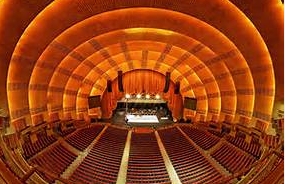
As for Radio City- - I grew up in NY, so I've been there many times.
Great theater, but to me, the auditorium architecture always made me
feel like I was watching a show while sitting inside a giant armadillo.
 -

 |  IP: Logged

Kristo Nalo
Film Handler

Posts: 24
From: Skopje, MK, MK, Macedonia
Registered: Nov 2016


 - posted 01-03-2017 06:34 AM      Profile for Kristo Nalo   Email Kristo Nalo   Send New Private Message       Edit/Delete Post 
I don't have any experience about that before. Hope someone can give you a good advice.

 |  IP: Logged

Mattias Mattsson
Film Handler

Posts: 90
From: Göteborg, Sweden
Registered: May 2007


 - posted 01-03-2017 03:55 PM      Profile for Mattias Mattsson   Email Mattias Mattsson   Send New Private Message       Edit/Delete Post 
Thanks all for your insights!

The Sync-One2 seems really promising but I don't find any sync test DCP:s on their site. Pete, do you know if they provide any for use with their meter?

 |  IP: Logged

Carsten Kurz
Film God

Posts: 4340
From: Cologne, NRW, Germany
Registered: Aug 2009


 - posted 01-03-2017 04:45 PM      Profile for Carsten Kurz   Email Carsten Kurz   Send New Private Message       Edit/Delete Post 
Hi Mattias,

you need to create your own Test-DCPs from these files:

http://www.sync-one2.co.uk/support/test-files/

Simple procedure, did you ever try DCP-o-matic?

- Carsten

 |  IP: Logged

Pete Naples
Phenomenal Film Handler

Posts: 1565
From: Dunfermline, Scotland
Registered: Feb 2001


 - posted 01-04-2017 02:47 AM      Profile for Pete Naples   Email Pete Naples   Send New Private Message       Edit/Delete Post 
Mattias,

Carsten has it covered, you can self convert, or use one of the many readily available DCPs. The syncone2 only needs to see a flash and hear a blip.

That said, the designer is keen to have DCPa available, he has an update to the test file section scheduled soon, so they may appear then.

I am fortunate in that I have a Clipster near me where I can get the odd small favour DCP Jon done, I got the test files converted there.

 |  IP: Logged

Steve Guttag
We forgot the crackers Gromit!!!

Posts: 12814
From: Annapolis, MD
Registered: Dec 1999


 - posted 01-04-2017 05:59 AM      Profile for Steve Guttag   Email Steve Guttag   Send New Private Message       Edit/Delete Post 
I've been quite happy with the DCP created here:

http://www.film-tech.com/cgi-bin/ubb/ultimatebb.cgi?ubb=get_topic;f=16;t=001037#000009

It should work with any of the systems that look for a flash and the "crack" of the sound.

It would seem to me that the cell phone based systems could be reasonably easily calibrated by merely making your own test by using a clapper or dropping a book on a table and then measuring that sync and therefore have your phone's offset. You only really need to be accurate enough for the frame resolution you are working with. In A/V systems, I rarely offer lip sync adjustments in msec. Instead I tend to move in frame sized hunks. If there is a lip sync problem, you want to move quickly to the point where it appears correct. As others have noted, depending on the workflow of the material, the sync could vary throughout the performance.

Even back in 2003, this is a screen shot of the "home" screen on one of the AFI's portal touchpanels

http://www.film-tech.com/warehouse/picview.php?id=4770&category=1.

While looking out of the port, the projectionist can move between 0 and 4 frames of delay, as needed. In truth, the delay was a fixed amount per frame (it didn't know if you were running 24fps or 60fps) however, within seconds the operator could resolve such an issue because you do not need precision as a little too much will always appear better than too little.

 |  IP: Logged

Jeffry L. Johnson
Jedi Master Film Handler

Posts: 809
From: Cleveland, Ohio, USA
Registered: Apr 2000


 - posted 01-12-2017 01:27 PM      Profile for Jeffry L. Johnson   Author's Homepage   Email Jeffry L. Johnson   Send New Private Message       Edit/Delete Post 
SMPTE 40

3 Longitudinal picture-audio displacement

3.1 The audio record on the film shall be displaced
longitudinally from the center of the corresponding
picture by a distance of 21 frames ±
1/2 frame in the direction of film travel during
normal projection.

3.2 Although picture and audio are correctly synchronized
with a displacement of 21 frames ± 1/2
frame on the film, normal playback of motion
pictures occurs in theaters where the relatively
slow speed of sound means that the audio
should precede the picture at the screen if subjectively
correct synchronism is to be achieved
in the middle of the theater (see annex A).

Annex A (informative)
Explanatory notes

In the average theater, it is necessary to emit the sound
pulses before the corresponding picture frame is positioned
in the aperture. Since sound travels approximately 1100 ft
per second or about 50 ft per frame during the normal
projection rate of 24 frames per second, the projectionist
can place the sound and picture in synchronization in the
theater where he wishes by varying the length of the threading
path in the projector.

For example, if the positioning of frame 21 at the scanning
point brings the corresponding picture and sound to the
screen and the speaker at the same instant, then positioning
frame 20 at the scanning point would give synchronism at
about 50 ft from the screen.

 |  IP: Logged


All times are Central (GMT -6:00)
This topic comprises 2 pages: 1  2 
 
   Close Topic    Move Topic    Delete Topic    next oldest topic   next newest topic
 - Printer-friendly view of this topic
Hop To:


Powered by Infopop Corporation
UBB.classicTM 6.3.1.2

The Film-Tech Forums are designed for various members related to the cinema industry to express their opinions, viewpoints and testimonials on various products, services and events based upon speculation, personal knowledge and factual information through use, therefore all views represented here allow no liability upon the publishers of this web site and the owners of said views assume no liability for any ill will resulting from these postings. The posts made here are for educational as well as entertainment purposes and as such anyone viewing this portion of the website must accept these views as statements of the author of that opinion and agrees to release the authors from any and all liability.

© 1999-2020 Film-Tech Cinema Systems, LLC. All rights reserved.