|
|
This topic comprises 3 pages: 1 2 3
|
|
Author
|
Topic: Barco 32B color Alignment Issue
|
Leo Enticknap
Film God

Posts: 7474
From: Loma Linda, CA
Registered: Jul 2000
|
 posted 12-23-2018 01:41 PM


quote: Ioannis Syrogiannis
"it can as well be a glass between the screen and my eyes" is not the projection port glass, but the glass of a window through which I see the screen. Often enough, that is not one and the same. That is the reason I made that rather peculiar choice of words, instead of mentioning the projection port. The same reason that I got to mention my eye glasses just after.
So to be clear, you are suggesting that if a tech is wearing an eyesight correction device (eyeglasses/spectacles or contact lenses), that will mess with his or her perception of projected image enough to make it impossible to do an accurate convergence adjustment?
If so, you could be right, but there are a lot of techs out there who do not have good enough eyesight not to need a corrective device, especially middle-aged and older ones. Most people's eyesight declines significantly in their 40s and early 50s, and then tends to stabilize in their mid to late 50s. I'm in my late 40s and have needed three new glasses prescriptions in the last five years.
Also, and not meaning to start a political thread, but most service techs are men, and as a general rule, men tend to suffer from declining eyesight in middle age more than women do.
Unless you're fine with firing all the techs who have less than perfect eyesight, this also emphasizes the importance of two pairs of eyes (though only one of them has to belong to a trained tech). The same applies to adjusting focus uniformity (Scheimpflug), because again, that adjustment can only be made standing next to the projector.
| IP: Logged
|
|
Ioannis Syrogiannis
Expert Film Handler
Posts: 147
From: Reykjavík, Iceland
Registered: Jun 2005
|
posted 12-23-2018 03:54 PM
Leo, I am getting the impression that what we are talking about, here, is not the subject in hand.
I do make an effort to find where in my writings I haven't been clear. Unfortunately, maybe because of the limited power of observation one have on their own texts and words that call for text editors and their likes, I can't quite spot it.
Is there something I wrote that offended you? If that is the case, I am sorry. I very much value your opinion, your experience and your input in the forum and consider you a better technician than I am.
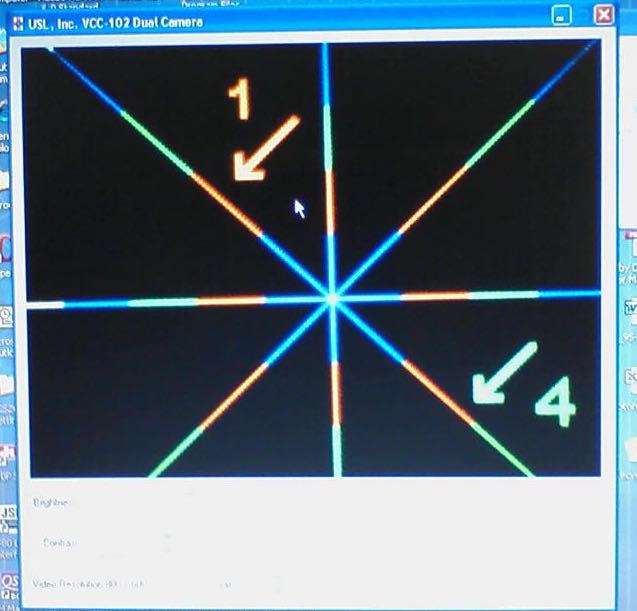
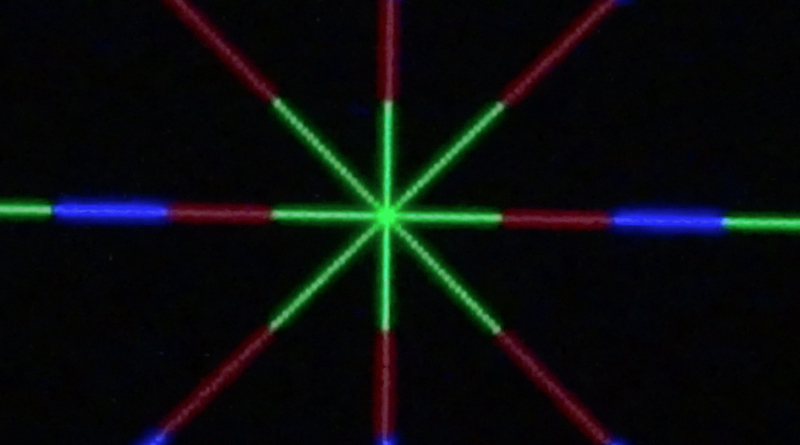
If not, and what you are suggesting is out of some kind of misunderstanding of what I write, I will just write that I myself have seen that on my eye-glasses and on a convergence test pattern (where I could make the observation) I was not seeing the blue line exactly where I was seeing it when I was not wearing them.
I am one of them technicians that are in need of a corrective device, and the fact gave me the opportunity to make the observation. For that reason, as I already mentioned, I always prefer, either to use help from someone in the auditorium, or using a proper camera *if* I have one available and *if* I can avoid the glass between the camera and the screen. The fact that I came to observe issues with the monoculars *I* came upon in color sharpness, made me share my disinclination towards using them.
So, I can't really see from where on what I write the fact can be deduced that I might be fine with firing all the techs that have less than perfect eyesight.
The fact that one stands next to the projector using eye glasses, doesn't affect their ability to adjust focus uniformity or focus, since the focus test pattern (that is usually needed for the Scheimpflug adjustment as well) is using one of the three colors only and therefor doesn't pose problems deriving from DMD convergence.
I sincerely hope that I made my self clear now and that hereby we both agree that I am not in any way biassed against technicians that have less that perfect eyesight or hearing.
| IP: Logged
|
|
Leo Enticknap
Film God
Posts: 7474
From: Loma Linda, CA
Registered: Jul 2000
|
posted 12-23-2018 04:25 PM
Don't worry, I'm not offended at all, just exploring the implications of the perfectly valid point you made (that eyeglasses and contact lenses may be messing with our ability to judge convergence in the same way that a port glass in the light path can).
My point in response to that is projection techs are a demographic that is more likely than average to be affected by poor eyesight, because they tend to be older (having first worked as a projectionist, or, increasingly since the transition to digital, in other technology-related professions), and male.
And my suggested workaround for this is in agreement with you, too: ideally, a second, and healthier, pair of eyes on the job, to cross-check the adjustments being made.
For lens and screen files, none of this matters, because you can stand right next to the screen and make the adjustments by wifi. But convergence and focus uniformity can only be adjusted by operating mechanical controls on the projector itself, hence the problem.
| IP: Logged
|
|
Marcel Birgelen
Film God
Posts: 3357
From: Maastricht, Limburg, Netherlands
Registered: Feb 2012
|
posted 12-23-2018 05:07 PM
quote: Dave Macaulay
CRT convergence is not comparable to DMD convergence. The DMD is static, the pixels can not move relative to each other.
Yeah, sure, the point was, it was one of those things you didn't need to do physically on the projector, you could walk close up to the screen and adjust it from there. (although focus and Scheimpflug were a different issue...)
It's a pity color convergence on 3DLP machines has never been motorized. Even some of the top 3LCD machines offer "motorized" convergence options, by putting actuators on the LCD panels.
quote: Dave Macaulay
A CRT image is entirely flexible, the beam deflection system can direct and distort the image freely, limited only by the complexity of the deflection drive electronics.
Well, those deflection systems had their inherent quirks and it took a while per model, to get a good feel at the best approach.
Maybe, one day we might get laser scanning systems to compete with laser-light spread over DMDs. ![[Wink]](wink.gif)
quote: Leo Enticknap
Don't worry, I'm not offended at all, just exploring the implications of the perfectly valid point you made (that eyeglasses and contact lenses may be messing with our ability to judge convergence in the same way that a port glass in the light path can).
You wear glasses made out of cheap window glass? ![[Razz]](tongue.gif)
Surely, someone wearing a set of perfectly good glasses, which compensate for 99% of all chromatic aberration, can do the manual color convergence on a typical DCI machine.
Let's not overdo it. We're not vertically landing rockets on a floating platform in the ocean...
It needs to be unnoticeable from the first row of the theater on forward. It will never be micrometer-perfect, heck, I congratulate you if you get it millimeter-perfect. And over time, it will also start to drift.
I think the biggest gotcha is to do the calibration on a cold machine, only to see that it has shifted, once it's at its operating temperature.
| IP: Logged
|
|
|
|
|
|
|
|
|
|
|
|
|
|
|
|
|
|
|
|
|
|
|
|
|
|
All times are Central (GMT -6:00)
|
This topic comprises 3 pages: 1 2 3
|
Powered by Infopop Corporation
UBB.classicTM
6.3.1.2
The Film-Tech Forums are designed for various members related to the cinema industry to express their opinions, viewpoints and testimonials on various products, services and events based upon speculation, personal knowledge and factual information through use, therefore all views represented here allow no liability upon the publishers of this web site and the owners of said views assume no liability for any ill will resulting from these postings. The posts made here are for educational as well as entertainment purposes and as such anyone viewing this portion of the website must accept these views as statements of the author of that opinion
and agrees to release the authors from any and all liability.
|

 Home
Home




![[Frown]](frown.gif)


 Printer-friendly view of this topic