|
|
This topic comprises 2 pages: 1 2
|
|
Author
|
Topic: Ground Loops With Ultra Stereo J-200
|
Steve Guttag
We forgot the crackers Gromit!!!

Posts: 12814
From: Annapolis, MD
Registered: Dec 1999
|
 posted 02-03-2019 01:57 PM


If you recall, there were three series in the analog life... the 5/95, the very short lived 105/195 and the 205/295. The second and third digit defined what its capabilities were. It is the same frame in each case. The only differences were what cards were stuffed in. One could add a JSYN-05 to a processor to get Synth stereo too. However, most used that slot for their "pink card" for testing.
There was a VERY VERY close variant to the JS-200 series the JSX-1000A for THX people and, officially, only approved for Dolby-A noise reduction though there was a JSX-1000S that had the SR module too.
I saw the JS series in mono, Center-Surround, the very goofy Left-Surround, Center, Right-Surround (Left was played out of Left-Surround and likewise on Right to Right-Surround). as well as the more popular JS-280, which was a full stereo unit. The lesser decoders were a simple L-R for surround rather than actual audio steering.
| IP: Logged
|
|
|
|
|
|
|
|
|
|
Carsten Kurz
Film God
Posts: 4340
From: Cologne, NRW, Germany
Registered: Aug 2009
|
posted 02-07-2019 05:41 PM
Trevor - Doremis have serial out, but that is a control interface (typically, a 9pin, DSUB, computer type connector). That could be used to issue commands towards the JS200 (switch formats). No idea wether a JS200 has a serial interface, I am not familiar with that processor.
Now, the audio needs either an analog multichannel, or a digital (AES/EBU) interface, usually on a larger connector (typically 25pin DSUB). Maybe you could show us some pictures of the back of the Doremi?
In many digital installations which reuse film age processors, a digital to analog converter was placed between server and processor - one common type is the Doremi AUD-D2A (see a picture here: https://www.dolby.com/us/en/professional/cinema/products/aud-d2a.html ). Another common type was the USL ECI-60, or the Dolby DMA8(+).
However, I think some older Doremis also offered a server-internal 8ch analog output card, so, it may be that your installation can output analog audio from the server directly. I don't know if there is any technical reference available about this analog audio card.
- Carsten
| IP: Logged
|
|
|
|
Carsten Kurz
Film God
Posts: 4340
From: Cologne, NRW, Germany
Registered: Aug 2009
|
posted 02-08-2019 03:17 AM
Yes, that's one of the old Doremis with a rev.B Dolphin (4 BNC), GPIO on DB25, AES AND analog out on DB25. I can imagine that you get ground loop problems using this analog out. I guess I don't have a pinout description for the old analog out card that could help with that. If I remember right, there were balanced and unbalanced out versions of that audio card.
If we can't figure out a different wiring solving the issue, I would suggest a set of isolation transformers or 'DI boxes'. You can also find them rack mounted in 8ch configurations, although these are usually more expensive than a set of 6 single channel or 3 stereo DI boxes. There's a bit of rewiring involved, as these typically use XLR connectors at least on one side.
edit: I found the analog pinout in the Doremi audio wiring document. There is also a suggested wiring guide towards some common audio processors in that document. Not towards a JS-200, but some towards e.g. the JSD80 or DTS6AD may help.
I would NOT connect DCP2000 chassis ground towards the JS-200. Also, do not connect cable shield/connector to audio ground. You may connect cable shield only on one side of the cable.
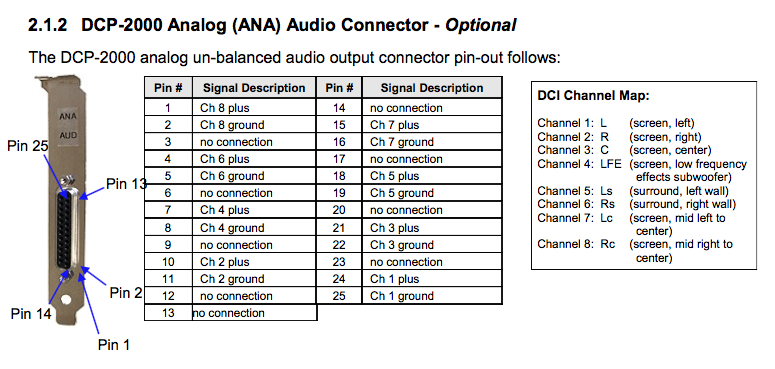
Full document: http://www.manualsdir.com/manuals/751530/doremi-dcp-2000.html?page=9
- Carsten
| IP: Logged
|
|
Tony Bandiera Jr
Film God

Posts: 3067
From: Moreland Idaho
Registered: Apr 2004
|
posted 02-08-2019 09:57 AM
quote: Steve Guttag
If you recall, there were three series in the analog life... the 5/95, the very short lived 105/195 and the 205/295. The second and third digit defined what its capabilities were. It is the same frame in each case. The only differences were what cards were stuffed in. One could add a JSYN-05 to a processor to get Synth stereo too. However, most used that slot for their "pink card" for testing.
There was also the very first Ultra*Stereo analog processor, the one with the taller cards and the full plexi faceplate, the series numbers escape me at the moment.
I had one of those, loved the look of it but compared to the later JS Series it was somewhat lacking in performance. (Not in a bad way really, just the NR seemed a bit off and it had higher noise floor.) I also recall it took me a while to scare up a format card with remote fader ability.
One flaw that IIRC all of them had, was that it was possible to force the Surround decoder card into the SYN slot, which always fried a few resistors on the backplane and sometimes the Surround decoder card. (On second thought, it might have been the other way around, I think this location only had center-surround, so it would be the SYN card into the surround slot.)
I had a theatre I serviced with a notoriously sleazy owner who had that problem constantly at one location, due to a popcorn kid who fancied himself a tech (or fancied me, I was young and pretty then). ![[Big Grin]](biggrin.gif)
The owner was one of those guys who, if you fixed the rectifier on lamp #1, blamed you for theatre #4 losing sound the next day. He quickly became a cash-only, 4 hour minimum UP FRONT customer. He only did it because I was the only one dumb enough to show up.
He had bought a really bad location (4 screens, with Cinecitas (or as I called them, Sorry-to-see-yas), CFS consoles, and the Ultra*Stereo processors). The late Conrad Button had a field day riling that guy up.
Back to the main topic:
Trevor, you really need to check out the Rane document that Steve linked to on the first page.
It offers detailed explanations about balanced vs. unbalanced, and has several options (with illustrations) on how to make up cables with balanced to unbalanced connections.
The balanced connection (usually shown as the XLR connector on the diagrams, pin 2 is +, pin 3 is - ) would be on the server side, and the unbalanced would be the JS 200 side.
They also show the capacitive shield coupling.
| IP: Logged
|
|
|
|
|
|
Marcel Birgelen
Film God
Posts: 3357
From: Maastricht, Limburg, Netherlands
Registered: Feb 2012
|
posted 02-08-2019 08:21 PM
quote: Trevor Meusx
Does the audio ground on the amps link to the chassis?
That's usually an important safety requirement. So, the answer should be: Yes ![[Wink]](wink.gif)
A ground loop essentially occurs when you have two grounds in your system. There will be a difference in potential between those grounds and even if it's just a few volts, there will be a current between those systems over the ground loop you created. It's this current that introduces the hum on your system.
A ground loop can also occur if equipment is connected to the same ground, but with one of the devices having a problem with the grounding, introducing some level of resistance. In those cases, it can help to give those devices a new ground, by connecting the chassis directly to the ground.
If you cannot connect all devices to the same ground, I strongly advice a transformer, like I mentioned before. That will not only get rid of hums produced by ground loops, but will also make your setup safer, since it will introduce a Galvanic isolation between both systems.
| IP: Logged
|
|
|
|
|
|
|
|
All times are Central (GMT -6:00)
|
This topic comprises 2 pages: 1 2
|
Powered by Infopop Corporation
UBB.classicTM
6.3.1.2
The Film-Tech Forums are designed for various members related to the cinema industry to express their opinions, viewpoints and testimonials on various products, services and events based upon speculation, personal knowledge and factual information through use, therefore all views represented here allow no liability upon the publishers of this web site and the owners of said views assume no liability for any ill will resulting from these postings. The posts made here are for educational as well as entertainment purposes and as such anyone viewing this portion of the website must accept these views as statements of the author of that opinion
and agrees to release the authors from any and all liability.
|

 Home
Home









 Printer-friendly view of this topic