|
|
This topic comprises 3 pages: 1 2 3
|
|
Author
|
Topic: Deja Vu >>> OFF TOPIC
|
Bobby Henderson
"Ask me about Trajan."

Posts: 10973
From: Lawton, OK, USA
Registered: Apr 2001
|
 posted 12-18-2006 06:12 PM


quote: Mike Schindler
Again, this is all about preconceptions. Why does film have to be a stroytelling medium? Wouldn't busting out of that convention go a long way towards making new and different movies instead of the same old shit over and over again? As far as abstract art goes, I think that classical music has proven that it can have a large audience and communicate effectively.
Music, overall, is also a bad thing to use as a comparison to movies on what people find entertaining. People listen to music on a different, more subconscious level. It's often used as background for other activities (work, exercise, parties, etc.). Music is more portable and enjoyed in more solitary ways. People only seem to gather in crowds to listen to music when it is performed live.
On the topic of classical music, most music stores have very little of it. Sometimes the only classical sounding music you're going to find is in the form of motion picture score CDs.
Why does film have to be a storytelling medium? That's what the public wants most.
Experimental film is nothing new. Lots of different things have been tried, even back in the earliest days of film. The more artsy, non-conventional methods had limited appeal and drew only small crowds. Some true art films are still made and still draw only limited levels of interest.
A good story driven by well defined characters involves an audience far greater than any sort of abstract motion art piece. That sort of convention has the hook of getting the audience personally involved in the experience -but only if it is well executed.
quote: Mike Schindler
And that's exactly why most movies suck.
The influence of money does indeed make a lot of movies suck. However, the movie business is still a business before anything else.
Movies cost an incredible amount of money to produce, market and distribute. The act of using all that borrowed money to do something abstract and unconventional is highly risky, especially when it probably won't connect with very many audience members at all.
And Domino largely didn't connect with audiences and it bombed terribly with critics. The movie finished with a dismal 17% on Rotten Tomatoes tomato-meter (116 negative reviews out of 140 counted).
I also don't find much of anything innovative with Domino (or Deja Vu). It's a bunch of hyper-edited, over processed stuff that plays like a 128 minute Japanese car commercial on crack. The Rock was enough of a statement in that kind of movie making, and even that one is pretty silly to watch on repeat viewings.
I think that form of over-stylized film making has run low on its appeal and its time for a change. It's time for film makers to stop copying slo mo character pose camera shots and edit moves from John Woo movies. It's time to stick the camera on a tripod or dolly and stop shaking the living hell out of it.
This over-stylized kind of movie making has reached the same silly phase as hair band metal did before it died out suddenly in 1990.
If I'm going to loosely throw around the word "art" when describing a movie meant for mainstream consumption, I'd rather put the label on something more challenging like Memento from Christopher Nolan. Now that's a movie I'd call "unconventional."
| IP: Logged
|
|
|
|
|
|
Mike Schindler
Phenomenal Film Handler

Posts: 1039
From: Oak Park, IL, USA
Registered: Jun 2002
|
posted 12-18-2006 07:33 PM
quote: Mike Blakesley
This should go down in the list as one of the dumbest things ever said in the history of Film-Tech (if not the planet Earth).
Thank you for the kind words, Mike. You're a class act.
For the sake of argument, let's assume that the AFI Top 100 list is indicative of what the general educated film community considers to be the best the medium has to offer. Let's also assume that those same people consider story to be the spine upon which any good movie is built. Six of the top ten movies are based on books, and of those, four are closer to three hours than two. In addition to this, how many times have you heard someone utter the phrase, "The book is always better than the movie"? Why do you think TV is better than movies these days? Because you have about 17 hours a year to tell a story in that medium. Why do you think people like Tarantino, Lucas, Soderbergh, Peter Jackson, and even the fracking James Bond writers are choosing to break their stories up into multiple parts? Because you can't do shit in two hours.
Now, I'm not saying that movies are bad. Obviously, there are well-written movies. But when compared to the other long-form media, forget it. Film doesn't come close. Movies are like candy. They taste really good, but lack substance. TV is where the stories are. Give me STUDIO 60 over DEJA VU any day of the week. I stand by my statement 100%.
[ 12-19-2006, 01:09 AM: Message edited by: Mike Schindler ]
| IP: Logged
|
|
Bobby Henderson
"Ask me about Trajan."
Posts: 10973
From: Lawton, OK, USA
Registered: Apr 2001
|
posted 12-18-2006 10:03 PM
quote: Mike Schindler
In addition to this, how many times have you heard someone utter the phrase, "The book is always better than the movie"? Why do you think TV is better than movies these days? Because you have about 17 hours a year to tell a story in that medium. Why do you think people like Tarantino, Lucas, Soderbergh, Peter Jackson, and even the fracking James Bond writers are choosing to break their stories up into multiple parts? Because you can't do shit in two hours.
That's a bunch of baloney. I've seen great movies clock in at under 90 minutes.
Further, you're making more apples to oranges comparisons by bringing up books and TV. Even with that, you're still undermining your argument that Domino is somehow a "masterpiece" and that movies need to abandon the conventional practice of story telling.
The truth is most books and TV shows are written in the form of stories as well. Of course you have exceptions in that regard with text books and "reality TV" shows. Still, those items are put together in a logical narrative where the reader or viewer can anticipate getting from point A to point Z.
quote: Mike Schindler
But when compared to the other long-form media, forget it. Film doesn't come close. Movies are like candy. They taste really good, but lack substance.
And Domino has substance?
If you have such a lack of respect for the movie making medium why bother posting in a forum called "Film-Tech?"
| IP: Logged
|
|
|
|
Mike Blakesley
Film God

Posts: 12767
From: Forsyth, Montana
Registered: Jun 99
|
posted 12-18-2006 11:09 PM

quote: Mike Schindler
Movies are like candy. They taste really good, but lack substance. TV is where the stories are.
Well, now you're topping yourself.
First of all, a good story is a good story, no matter where or how it's presented. Some stories are longer than others. Some stories are only a few lines. One of my favorite stories is a 1956 item called "Contents of the Dead Man's Pockets," which is about a ten-minute read. (It wouldn't make a good movie, it's too short.)
Second - you must be a very young person to be able to dismiss movies in such a blanket way. Movies have been entertaining people, and satisfying them, for over 100 years. Some of the most acclaimed pieces of American art are movies. The ratio of crap on TV versus the good stuff is FAR higher than it is with movies, I'll guarantee you that. TV has only recently evolved into an occasional sophisticated storytelling medium. Before the 1980s when VHS came along, quite a few of the "special events" on TV were....movies.
| IP: Logged
|
|
|
|
Mike Schindler
Phenomenal Film Handler
Posts: 1039
From: Oak Park, IL, USA
Registered: Jun 2002
|
posted 12-19-2006 02:15 AM
OK. To start, I made a major typo in my last post. I left the word "not" out of the sentence, "Now, I'm not saying movies are bad." That was a big mistake, and I fixed it. Sorry about that. Also, I may not have been clear in previous posts, but I don't think a story has to be long in order to be good. What I meant was that longer stories tend to be better. Even that's a generalization which I think is true most of the time, but of course not always. Anyway, moving on to some of the points which were brought up...
quote: Bobby Henderson
That's a bunch of baloney. I've seen great movies clock in at under 90 minutes.
Me too! I'm not saying that it can't be done. I'm saying that movies are limited in the stories that they can tell. Other media aren't. However, there are other things that can be accomplished on film that can't be in, say, books. So why not focus on those things which make film unique?
quote: Bobby Henderson
Further, you're making more apples to oranges comparisons by bringing up books and TV.
I don't think the comparison is apples to oranges. Every story which can be told in film can be also be told in those other two media. The opposite is not true.
quote: Bobby Henderson
Even with that, you're still undermining your argument that Domino is somehow a "masterpiece" and that movies need to abandon the conventional practice of story telling.
How so?
quote: Bobby Henderson
The truth is most books and TV shows are written in the form of stories as well. Of course you have exceptions in that regard with text books and "reality TV" shows. Still, those items are put together in a logical narrative where the reader or viewer can anticipate getting from point A to point Z.
I'm not proposing that books and TV stop telling stories. I'm saying that they do that really well. I'm not proposing that movies stop either. What I am proposing is that movies branch out into other forms which play to the medium's strengths, just like books and TV have.
quote: Bobby Henderson
And Domino has substance?
No, it tastes good. But don't take that as an absolute (only a Sith deals in absolutes).
quote: Bobby Henderson
If you have such a lack of respect for the movie making medium why bother posting in a forum called "Film-Tech?"
I have a lot of respect for it. I love movies. Maybe not for the same reasons as you, but I don't really think that that's a problem. All I'm saying is that I want movies to be better than they already are. Is there really anything wrong with that?
quote: Mike Blakesley
First of all, a good story is a good story, no matter where or how it's presented. Some stories are longer than others. Some stories are only a few lines. One of my favorite stories is a 1956 item called "Contents of the Dead Man's Pockets," which is about a ten-minute read. (It wouldn't make a good movie, it's too short.)
That's exactly what I'm trying to say. If you can tell a story in two hours, fantastic. If you can tell a story in ten minutes, even better. But like you said, ten minutes doesn't work for movies. The same thing's true if a story is ten hours. But literature can accomodate all three of those lengths, which is why it's a better medium for telling stories.
quote: Mike Blakesley
Second - you must be a very young person to be able to dismiss movies in such a blanket way. Movies have been entertaining people, and satisfying them, for over 100 years. Some of the most acclaimed pieces of American art are movies. The ratio of crap on TV versus the good stuff is FAR higher than it is with movies, I'll guarantee you that. TV has only recently evolved into an occasional sophisticated storytelling medium. Before the 1980s when VHS came along, quite a few of the "special events" on TV were....movies.
I'm not dismissing movies at all. I think they have a lot to offer, and they've been entertaining and satisfying me for over 26 years. I would totally agree that my favorite pieces of American art are movies. And you're right that there's a much higher percentage of crap on TV than there is at the local multiplex. But I would argue that at this point in time, the best that TV has to offer is better than the best that movies have to offer. I would agree with you that TV's worth has only come about recently. That has everything to do with VHS, because producers no longer have to worry about people missing parts of the story. And the reason why special events on TV were movies is quite simply because movies were better than TV.
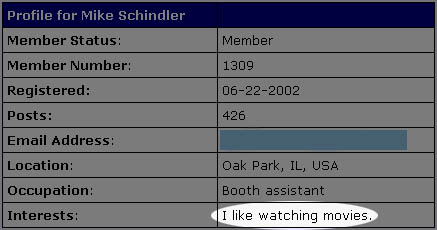
Adam, thank you for pointing out to people that I like watching movies. I don't know where the perception that I don't came from, but I find it kinda weird. So I'm more interested in form than content. Big damn deal. That's what I get off on. When a really good story comes along, that's fantastic. I'm totally into it. Did you guys see CLERKS II? It's awesome! But most movies have more in common with DEJA VU. And in the words of William Shatner, I can't get behind that.
| IP: Logged
|
|
|
|
Bobby Henderson
"Ask me about Trajan."
Posts: 10973
From: Lawton, OK, USA
Registered: Apr 2001
|
posted 12-19-2006 10:24 AM
quote: Mike Schindler
I'm saying that movies are limited in the stories that they can tell. Other media aren't. However, there are other things that can be accomplished on film that can't be in, say, books. So why not focus on those things which make film unique?
That's a contradictory statement.
Further, attempts to compare one story telling medium to another absolutely is an apples or oranges comparison.
quote: Mike Schindler
If you can tell a story in two hours, fantastic. If you can tell a story in ten minutes, even better. But like you said, ten minutes doesn't work for movies. The same thing's true if a story is ten hours. But literature can accomodate all three of those lengths, which is why it's a better medium for telling stories.
On a fundamental level, I'm going to reject any statement that claims one medium of story telling is better than another. Such statements are close-minded.
BTW, there are movies that run only 5 or 10 minutes. They're called "short films." There's even an Oscar category for them.
Books have their strengths. One of the greatest is showing internal monologue of the characters. Some novels are written entirely in the character's first person point of view. However, books are not without weaknesses either. They are not superior to movies or anything else, just different.
You can't read a 400 page novel and properly absorb its details in one two hour sitting like you can with a movie. The reader has to invest a lot more time to get through a book. Most people don't read books because the process seems like a lot of work to them. Or it just seems boring. The reading process is something you do alone, typically in a quiet, isolated environment. You have to visually flesh out the details using your imagination. The author tries to guide you in that, but ultimately every reader sees the story in a different way. That's not necessarily a good thing.
Movies have the strength of bringing a story to literal, visual life. Everyone in the audience sees the same thing. When the movie works well, the audience shares the same emotional experience. When an audience reacts the same way to the same event on screen it adds another dimension turning it into a participatory experience.
Since you metioned "the book is always better than the movie" cliché earlier, I'll top that with another. Whenever someone reads a new book that turns out to be really good, their reaction is often followed with the statement, "that would make a really good movie."
quote: Mike Schindler
All I'm saying is that I want movies to be better than they already are. Is there really anything wrong with that?
There's nothing wrong with that statement at face value. The direction where you are taking it is where I have to disagree. I disagree with that statement you attribute to director John McTiernan where he claims movies are limited by story telling conventions and need to branch off elsewhere.
I really disagree with it strongly based on the context that it is somehow meant to defend the film making style of Domino and lots of other recent "all style no substance" movies.
Very often the over-the-top camera moves and hyper editing we've already seen in countless other movies is just there to mask a very weak story line and paper thin characters. I suppose the directors think if they make the audience feel like they're having an epileptic seizure it will hide the fact they're actually watching a shitty movie.
The "mannerism" period of art in the 16th century is a good analogy to mention.
Mannerism worked against the balance of paintings made earlier in the Renaissance. Proportions of figures were exaggerated, sometimes to extremes in attempts to make the figures appear more beautiful or heroic. In the end, that school of painting/drawing style was rejected. Viewers were put off at a distance by such paintings. They couldn't relate to them at all. Some good ideas came from the mannerist movement, and those ideas lived on in the more emotional yet more realistically drawn works of art in the Baroque period.
Film makers like Tony Scott, Michael Bay, Jerry Bruckheimer and several others are the movie industry's current crop of "mannerists." Everything tends to be seen from extreme camera angles masked with pretty gradient filters with the finished shots hyper edited to oblivion. Most of the people in those movies are model pretty. On top of that, such film makers play very loosely with what is even physically possible or plausible in reality, often crossing the line into just plain bullshit territory. In the end, that lack of grounded realism, lack of character and lack of tripod just pushes audiences away from being able to get involved with the story.
Look at the recent success of Casino Royale. It's the best James Bond movie made in 30 years. A major key to its success was a "back to the basics" approach. Just try to do a credible job adapting the novel. That seemed to be enough. The movie ended up with an incredible Rotten Tomatoes score of 95%.
| IP: Logged
|
|
|
|
Mike Schindler
Phenomenal Film Handler
Posts: 1039
From: Oak Park, IL, USA
Registered: Jun 2002
|
posted 12-19-2006 12:23 PM
quote: Bobby Henderson
That's a contradictory statement.
No, it's not. The things that I was thinking of that film can do have nothing to do with telling stories. But you make some good points as to how some stories can be more effectively told as movies. So if movies are going to be stuck in their current rut of storytelling, why not at least tell stories that only they can? I would argue that that is not currently the case, with films like CASINO ROYALE as evidence.
quote: Bobby Henderson
I disagree with that statement you attribute to director John McTiernan where he claims movies are limited by story telling conventions and need to branch off elsewhere.
But really, why shouldn't they? The worst that can happen is some bad movies get made. What I think would ultimately happen is filmmakers would learn something new about the medium, and bring that back to the more conventional movies, making them better. As long as good movies like CASINO ROYALE and CLERKS II continue to be made, where's the problem with someone like Tony Scott trying something different. Does the world really need DEJA VU? It feels like I've seen that movie a million times before. ![[Wink]](wink.gif) Why doesn't he try something different instead? Why doesn't he try something different instead?
Your Mannerism argument is interesting. While I don't agree with you on how it applies to today's movies, you mention how despite its failure, the elements that work were adopted by later artists. If that is the end result of McTiernan's theory in practice, then I would consider it to be a success and worthwhile.
quote: Mark J. Marshall
I'm waiting for someone with epilepsy to have an actual seizure in our theater from watching all of the flashing and strobing on the screen.
That actually happened with an episode of POKEMON in Japan. If you look at the clip, it seems pretty tame, but I guess that particular pattern of flashing colors is enough to trigger it.
[ 12-19-2006, 01:27 PM: Message edited by: Mike Schindler ]
| IP: Logged
|
|
Bobby Henderson
"Ask me about Trajan."
Posts: 10973
From: Lawton, OK, USA
Registered: Apr 2001
|
posted 12-19-2006 03:24 PM
quote: Mike Schindler
As long as good movies like CASINO ROYALE and CLERKS II continue to be made, where's the problem with someone like Tony Scott trying something different.
That's the problem. He isn't doing anything different. He, like so many other guys making action movies these days, is merely using the old Michael Bay/John Woo overblown style to try to hide the weaknesses in the story. They believe if they make the camera shot look cool that will be enough to keep the audience going along with the story. More explosions! More cars flipping through the air! Tits! I need tits on the set! Now!!!
At the core, it's bullshit film making. There's nothing new being shown. It's all just technique being used as shtick to string together a series of action set pieces and embellish further upon them.
Those rapid editing sequences with white flashes of over-exposed film date back to 1980's music videos. The wide landscape shots using dark gradient filters and circular polarizer filters to amplify the light to dark shift in the sky has been seen in hundreds of car commercials (and music videos). Animated type on the screen is nothing new either. There's lot of other very obvious camera and editing technique being used to pretty-up action movies.
The trick is that sort of thing needs to be used sparingly and in a subtle manner. Tony Scott (and others) seem to prefer pounding viewers in the face with it like a baseball bat. Further, such techniques should be only be used when it serves some purpose to the story. In many of these recent action movies these flashy techniques are just thrown anywhere.
quote: Mike Schindler
While I don't agree with you on how it applies to today's movies, you mention how despite its failure, the elements that work were adopted by later artists. If that is the end result of McTiernan's theory in practice, then I would consider it to be a success and worthwhile.
No. McTiernan's theory is to go even further with this all style no substance baloney and drop the framework of the story altogether. I don't agree with that -at least not in the context of people paying $7 to $12 per ticket to watch it in a conventional movie theater.
The failure in mannerism is it totally put off the human element. People couldn't relate to what they were seeing. The same is true for these manneristic action movies. The characters are idealized beyond what is realistic for any actual human being. Viewers don't relate to them. Further, those characters are often put into situations that are implausible and do things that are physically impossible. The events in the movies are embellished to death with odd camera angles and edit schemes as severe as any spastic movie video or car commercial. These manneristic action movies don't care about suspension of disbelief. Gunshot through the skull? Our star can survive it! Fall from 10000 feet? Our star can survive it!
It's almost like these kinds of movies are trying to one-up various music videos or the experience one gets from playing a violent video game. There's no point to it. The blatant overuse of technique in these movies makes me think of that phrase from Shakespeare's Macbeth ..."it is a tale, told by an idiot, full of sound and fury, signifying nothing."
| IP: Logged
|
|
Mike Schindler
Phenomenal Film Handler
Posts: 1039
From: Oak Park, IL, USA
Registered: Jun 2002
|
posted 12-19-2006 05:09 PM
quote:
That's the problem. He isn't doing anything different. He, like so many other guys making action movies these days, is merely using the old Michael Bay/John Woo overblown style to try to hide the weaknesses in the story. They believe if they make the camera shot look cool that will be enough to keep the audience going along with the story. More explosions! More cars flipping through the air! Tits! I need tits on the set! Now!!!
Personally I've never seen anything like DOMINO. At least, not to that extent. Bay, Woo, and Scott all have very distinct styles, and I see very little of them in each other.
I somewhat agree with you in regards to Bay and Woo. But I don't think they're trying to hide a bad story. It's more of a case of the story being a means to do all of the cool shit that they want to do. They've pretty much both come out and said that. And I don't really see that as being a problem. Because really, who doesn't like flipping cars and explosions? If there is a problem with these movies, it's that the story often gets in the way of what the filmmakers really want to do. But they use a story to make their movie fit into that formal box that all mainstream movies have to fit in.
As far as Tony Scott is concerned, particularly with DOMINO, I don't think that's the case. He did want to tell a story, and this is the best way he knew how. In my opinion, there isn't really anything gratuitous in that movie.
But getting back to what you call "bullshit filmmaking," yeah, I can't really argue with the points you're making. If you don't like it, you don't like it. I do, but that's just me. When I go to see a movie, I'm usually not looking for substance, because I know I'm just setting myself up for disappointment. When I get it, it's like a bonus. But as I've said before, I generally go to see movies for the bling. Because that's what movies are really good at. TV is where I usually go to give my brain a workout. Shows like BATTLESTAR GALACTICA give me a lot more to chew on intellectually than 99% of the movies out there.
quote: Bobby Henderson
No. McTiernan's theory is to go even further with this all style no substance baloney and drop the framework of the story altogether. I don't agree with that -at least not in the context of people paying $7 to $12 per ticket to watch it in a conventional movie theater.
I think the idea is that by dropping the framework of story we'll free ourselves up to finding an even greater level of substance somewhere down the line. The thing that excites me about movies like DOMINO is that I can see people kinda starting to figure out how to do that. That's cool. As far as the venue is concerned, I don't get it. What do you mean?
quote:
The failure in mannerism is it totally put off the human element. People couldn't relate to what they were seeing. The same is true for these manneristic action movies. The characters are idealized beyond what is realistic for any actual human being. Viewers don't relate to them. Further, those characters are often put into situations that are implausible and do things that are physically impossible. The events in the movies are embellished to death with odd camera angles and edit schemes as severe as any spastic movie video or car commercial. These manneristic action movies don't care about suspension of disbelief. Gunshot through the skull? Our star can survive it! Fall from 10000 feet? Our star can survive it!
I don't think this is a problem based on the fact that the type of movie you're describing generally has a really large audience.
| IP: Logged
|
|
|
|
All times are Central (GMT -6:00)
|
This topic comprises 3 pages: 1 2 3
|
Powered by Infopop Corporation
UBB.classicTM
6.3.1.2
The Film-Tech Forums are designed for various members related to the cinema industry to express their opinions, viewpoints and testimonials on various products, services and events based upon speculation, personal knowledge and factual information through use, therefore all views represented here allow no liability upon the publishers of this web site and the owners of said views assume no liability for any ill will resulting from these postings. The posts made here are for educational as well as entertainment purposes and as such anyone viewing this portion of the website must accept these views as statements of the author of that opinion
and agrees to release the authors from any and all liability.
|

 Home
Home





![[thumbsup]](graemlins/thumbsup.gif)


 Printer-friendly view of this topic