Film-Tech Cinema Systems
Film-Tech Forum ARCHIVE


my profile | my password | search | faq & rules | forum home
  next oldest topic   next newest topic
» Film-Tech Forum ARCHIVE   » Operations   » Ground Level   » Filmguard in So. Cal? (Page 2)

 
This topic comprises 4 pages: 1  2  3  4 
 
Author Topic: Filmguard in So. Cal?
Joe Redifer
You need a beating today

Posts: 12859
From: Denver, Colorado
Registered: May 99


 - posted 07-20-2002 04:18 PM      Profile for Joe Redifer   Author's Homepage   Email Joe Redifer   Send New Private Message       Edit/Delete Post 
Brad- I saw that issue, but the scan quality is so bad that I can barely even make out the shape of the object. Anyone have any pics that show detail?

 |  IP: Logged

Jim Leko
Film Handler

Posts: 90
From: Redondo Beach, CA, USA
Registered: May 2002


 - posted 07-21-2002 04:17 AM      Profile for Jim Leko   Email Jim Leko   Send New Private Message       Edit/Delete Post 
So, back to my original question... is there anybody in the Southern California area using Filmguard?

 |  IP: Logged

John Pytlak
Film God

Posts: 9987
From: Rochester, NY 14650-1922
Registered: Jan 2000


 - posted 07-22-2002 09:25 AM      Profile for John Pytlak   Author's Homepage   Email John Pytlak   Send New Private Message       Edit/Delete Post 
The March 1980 issue of Kodak's "Film Notes for Reel People" (publication H-50-10) had photos of the Christie FC-1 cleaner, United Artists Film Cleaner (Joe Kelly's unit), and the 3M Masterwipe Film Cleaner, which all used dry woven webs as the cleaning media.

------------------
John P. Pytlak, Senior Technical Specialist
Worldwide Technical Services, Entertainment Imaging
Research Labs, Building 69, Room 7525A
Rochester, New York, 14650-1922 USA
Tel: +1 585 477 5325 Cell: +1 585 781 4036 Fax: +1 585 722 7243
e-mail: john.pytlak@kodak.com
Web site: http://www.kodak.com/go/motion

 |  IP: Logged

Steven Gorsky
Expert Film Handler

Posts: 146
From: Frederick, MD, USA
Registered: Sep 2000


 - posted 07-22-2002 09:59 AM      Profile for Steven Gorsky   Author's Homepage   Email Steven Gorsky   Send New Private Message       Edit/Delete Post 
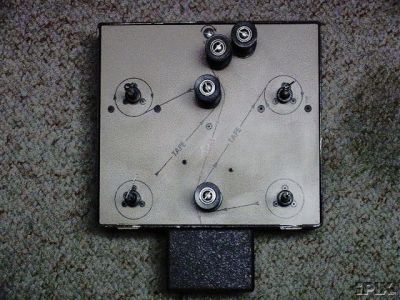
Here you go Joe:

These show up on eBay once in a while. There have been others with more pictures, but this is the only one that has been recently listed.

Steven Gorsky


 |  IP: Logged

John Pytlak
Film God

Posts: 9987
From: Rochester, NY 14650-1922
Registered: Jan 2000


 - posted 07-22-2002 10:02 AM      Profile for John Pytlak   Author's Homepage   Email John Pytlak   Send New Private Message       Edit/Delete Post 
Thanks Steven. That photo is of Joe Kelly's United Artists Film Cleaner. The woven cleaning media ("tape" in the diagram) was held on metal spools attached to the four spindles.

------------------
John P. Pytlak, Senior Technical Specialist
Worldwide Technical Services, Entertainment Imaging
Research Labs, Building 69, Room 7525A
Rochester, New York, 14650-1922 USA
Tel: +1 585 477 5325 Cell: +1 585 781 4036 Fax: +1 585 722 7243
e-mail: john.pytlak@kodak.com
Web site: http://www.kodak.com/go/motion


 |  IP: Logged

Steven Gorsky
Expert Film Handler

Posts: 146
From: Frederick, MD, USA
Registered: Sep 2000


 - posted 07-22-2002 10:04 AM      Profile for Steven Gorsky   Author's Homepage   Email Steven Gorsky   Send New Private Message       Edit/Delete Post 
I just realized Joe wanted to see the 3M cleaner not the UA one. If I come across a picture I'll add it.

Steven Gorsky

 |  IP: Logged

John Pytlak
Film God

Posts: 9987
From: Rochester, NY 14650-1922
Registered: Jan 2000


 - posted 07-22-2002 10:08 AM      Profile for John Pytlak   Author's Homepage   Email John Pytlak   Send New Private Message       Edit/Delete Post 
The 3M "Masterwipe" (Models 525 and 523) film cleaners were most widely used by photofinishers. 3M also used them on their early PhotoGard coating machines to clean the film before it was coated with PhotoGard.

------------------
John P. Pytlak, Senior Technical Specialist
Worldwide Technical Services, Entertainment Imaging
Research Labs, Building 69, Room 7525A
Rochester, New York, 14650-1922 USA
Tel: +1 585 477 5325 Cell: +1 585 781 4036 Fax: +1 585 722 7243
e-mail: john.pytlak@kodak.com
Web site: http://www.kodak.com/go/motion

 |  IP: Logged

Joe Redifer
You need a beating today

Posts: 12859
From: Denver, Colorado
Registered: May 99


 - posted 07-22-2002 11:49 AM      Profile for Joe Redifer   Author's Homepage   Email Joe Redifer   Send New Private Message       Edit/Delete Post 
I wonder if the people who named "Photogard" realize that they spelled "guard" wrong?

 |  IP: Logged

John Pytlak
Film God

Posts: 9987
From: Rochester, NY 14650-1922
Registered: Jan 2000


 - posted 07-22-2002 12:07 PM      Profile for John Pytlak   Author's Homepage   Email John Pytlak   Send New Private Message       Edit/Delete Post 
Ask the folks at 3M:
http://www.3m.com/market/consumer/photogard/overview.html

------------------
John P. Pytlak, Senior Technical Specialist
Worldwide Technical Services, Entertainment Imaging
Research Labs, Building 69, Room 7525A
Rochester, New York, 14650-1922 USA
Tel: +1 585 477 5325 Cell: +1 585 781 4036 Fax: +1 585 722 7243
e-mail: john.pytlak@kodak.com
Web site: http://www.kodak.com/go/motion

 |  IP: Logged

Darren Briggs
Master Film Handler

Posts: 371
From: York, UK
Registered: Dec 2001


 - posted 07-23-2002 06:33 AM      Profile for Darren Briggs   Author's Homepage   Email Darren Briggs   Send New Private Message       Edit/Delete Post 
PTR do work very well.
I run every show through them ever since Oceans Eleven. There is a noticable difference in the amount of dust left in the projector and the films look like they did on day one.
I think film guard is a good product and i do have a bottle for use on old prints which are not showing in the main screen with the PTR assy.

PTR's rock in my opinion, and are cheaper too!

Darren

 |  IP: Logged

William T. Parr
Jedi Master Film Handler

Posts: 823
From: Cedar Park, TX
Registered: Nov 2000


 - posted 07-23-2002 08:33 AM      Profile for William T. Parr   Email William T. Parr   Send New Private Message       Edit/Delete Post 
I did not have a particularly wonderful expiereince with PTR's at the Century 16 in Corpus, which is the only place I have had the chance to use them. But in the PTR's defense I can not be compltely Objective about hem either. My big problem I had in using them was it was a brand new building which meant that while I was trying to train booth staff and even on opening day, they were still cutting and hanging sheetrock in my booth. which meant that I had dust everywhere. I could have the staff wipe down all the surfaces in the booth and 30 minutes later it was all covered in dust again. This lead to the PTR's Being completly full about 1/3 of the way throughthe show. I never was able to completley clean a print in one shot using them. I do understand from talking with the person who became booth manager after I left that once the dust settled the PTR's became great to use. I use Film Gaurd in my current booth running it with a borrowed dry web media cleaner, and I love the stuff. Speaking of which I need to order some more today.


 |  IP: Logged

Scott Norwood
Film God

Posts: 8146
From: Boston, MA. USA (1774.21 miles northeast of Dallas)
Registered: Jun 99


 - posted 07-23-2002 08:46 AM      Profile for Scott Norwood   Author's Homepage   Email Scott Norwood   Send New Private Message       Edit/Delete Post 
PTRs are good at picking up occasional dust on new or well-handled used prints. They don't do much for me on really beat-up old prints, however. They also don't work well when they get old and lose their stickiness.

Filmguard works better, however, as it does more than just remove dust from film--it also helps to hide scratches and appears to have some qualities that relax slightly warped prints. Unlike PTRs, it is also effective on very dirty or otherwise mishandled prints.

 |  IP: Logged

John Pytlak
Film God

Posts: 9987
From: Rochester, NY 14650-1922
Registered: Jan 2000


 - posted 07-23-2002 10:20 AM      Profile for John Pytlak   Author's Homepage   Email John Pytlak   Send New Private Message       Edit/Delete Post 
William Parr said: "My big problem I had in using them was it was a brand new building which meant that while I was trying to train booth staff and even on opening day, they were still cutting and hanging sheetrock in my booth. which meant that I had dust everywhere. I could have the staff wipe down all the surfaces in the booth and 30 minutes later it was all covered in dust again. This lead to the PTR's Being completly full about 1/3 of the way throughthe show. I never was able to completley clean a print in one shot using them. I do understand from talking with the person who became booth manager after I left that once the dust settled the PTR's became great to use."

Your experience supports Kodak's initial testing of PTRs. Even when filled with abrasive dirt, PTRs have very low risk of scratching film. We actually tested this by scraping sandpaper grit onto the surface of PTRs and then cleaning camera negative film. Even after multiple passes over the dirt-laden surface of the PTR, the negative was unscratched because of the rolling contact and soft urethane PTR material. When the PTR surface is completely covered with dirt, it loses cleaning effectiveness, but will not damage film.

I have seen cases where dry media cleaners have scratched prints from head to tail when abrasive construction dirt was picked up from the print, literally turning the woven media into a piece of sandpaper.

For film cleaning "there are different horses for different courses". PTRs are ideally suited to situations where you do not want to apply chemicals or solvents to the film, and the dirt levels do not exceed the capacity of the PTRs between routine cleanings. With simple washing after each show (either in water or with "see-saw" of adhesive tape), they can clean millions of feet of film. PTRs are a simple and effective FILM CLEANER, they are not a FILM TREATMENT that changes the properties of the film itself.

------------------
John P. Pytlak, Senior Technical Specialist
Worldwide Technical Services, Entertainment Imaging
Research Labs, Building 69, Room 7525A
Rochester, New York, 14650-1922 USA
Tel: +1 585 477 5325 Cell: +1 585 781 4036 Fax: +1 585 722 7243
e-mail: john.pytlak@kodak.com
Web site: http://www.kodak.com/go/motion


 |  IP: Logged

Brad Miller
Administrator

Posts: 17775
From: Plano, TX (36.2 miles NW of Rockwall)
Registered: May 99


 - posted 07-23-2002 02:39 PM      Profile for Brad Miller   Author's Homepage   Email Brad Miller       Edit/Delete Post 
It all boils down to effectiveness. The next time someone armed with FilmGuard, a media cleaner and a set of PTRs opens a new theater that has construction dirt everywhere, pick two identical prints (same lab, same film stock, preferably same movie title) and run PTRs on one and FilmGuard on the other. The PTR print will be a joke within a day or two with all of the dirt. The FilmGuard print will still be sparkling months down the road. PTRs only have a chance if the booth environment is kept in sterile condition, which is rarely the case in a commercial booth.

Or you can consider it this way, every time you run PTRs part of the stickiness is wearing off. As such, every time you clean a print with PTRs the PTRs become less and less effective over the useful life of a print. With a media cleaner and FilmGuard, you get the "brand new" effect over and over and whether the test is done in a white glove type of environment or in a torture test (aka: construction dirt areas) FilmGuard is the clear winner everytime whether you are working in a flawlessly clean environment, or projecting with construction dirt.


 |  IP: Logged

John Pytlak
Film God

Posts: 9987
From: Rochester, NY 14650-1922
Registered: Jan 2000


 - posted 07-23-2002 03:34 PM      Profile for John Pytlak   Author's Homepage   Email John Pytlak   Send New Private Message       Edit/Delete Post 
"Different horses for different courses".

BTW, the PTR "stickiness" is not from an adhesive or additive. It comes from the surface finish of the polyurethane that was chosen. Any loss of effectiveness with age is due to surface contamination (that can be washed off), physical wear, or improper storage (e.g., excessive temperature).

A quick way to test the effectiveness is to roll the PTR over a smooth dusty surface (e.g., the dusty top of a filing cabinet) and observe whether 95% of the dust particles are picked up.

------------------
John P. Pytlak, Senior Technical Specialist
Worldwide Technical Services, Entertainment Imaging
Research Labs, Building 69, Room 7525A
Rochester, New York, 14650-1922 USA
Tel: +1 585 477 5325 Cell: +1 585 781 4036 Fax: +1 585 722 7243
e-mail: john.pytlak@kodak.com
Web site: http://www.kodak.com/go/motion


 |  IP: Logged


All times are Central (GMT -6:00)
This topic comprises 4 pages: 1  2  3  4 
 
   Close Topic    Move Topic    Delete Topic    next oldest topic   next newest topic
 - Printer-friendly view of this topic
Hop To:


Powered by Infopop Corporation
UBB.classicTM 6.3.1.2

The Film-Tech Forums are designed for various members related to the cinema industry to express their opinions, viewpoints and testimonials on various products, services and events based upon speculation, personal knowledge and factual information through use, therefore all views represented here allow no liability upon the publishers of this web site and the owners of said views assume no liability for any ill will resulting from these postings. The posts made here are for educational as well as entertainment purposes and as such anyone viewing this portion of the website must accept these views as statements of the author of that opinion and agrees to release the authors from any and all liability.

© 1999-2020 Film-Tech Cinema Systems, LLC. All rights reserved.