Film-Tech Cinema Systems
Film-Tech Forum ARCHIVE


my profile | my password | search | faq & rules | forum home
  next oldest topic   next newest topic
» Film-Tech Forum ARCHIVE   » Operations   » Ground Level   » Switch from common width to common height - trend or aberation? (Page 6)

 
This topic comprises 7 pages: 1  2  3  4  5  6  7 
 
Author Topic: Switch from common width to common height - trend or aberation?
David Zylstra
Master Film Handler

Posts: 432
From: Novi, MI, USA
Registered: Mar 2007


 - posted 08-20-2007 09:06 PM      Profile for David Zylstra   Email David Zylstra   Send New Private Message       Edit/Delete Post 
quote: Paul Konen
David, the thing with D-Cinema and fixed height is having to have the extra anamorph swing into position for scope movies. As far as using a larger lamp, I don't think that is the case. I use the same lamp for scope or flat. That would be silly to change it out for each format. Uggh.

Not a lot of 2K installs are using anamorphics (AccessIT is only using them for the largest of fixed height screens - their single lens solution scales flat down to fit the scope pixel height on fixed height screens) - under some interpretations anamorphics violate DCI since it requires the image to be scaled vertically 1.25X, but DCI says you can only scale 2X . . . . . the section on lenses and scaling is wide open to several interpretations.

When you do the math for screen luminance there is about a 2-3FL difference between flat and scope using an anamorphic lens (i.e. scope is about 2-3 FL lower than flat) . . . . when you do the same math using the proposed magnifier scope lens the difference is more like 5FL lower for scope . . . . . If a screen uses the magnifier for scope you need to lamp it to provide the correct luminance for scope and then either overlight flat or turn the power down (the Christie has "lamp per channel" so you can set the power level separately for each format).

I'd be interested to know if anyone has TDC units and if they installed anamorphics on all screens or just the larger ones.

 |  IP: Logged

Evans A Criswell
Phenomenal Film Handler

Posts: 1579
From: Huntsville, AL, USA
Registered: Mar 2000


 - posted 09-10-2007 03:22 PM      Profile for Evans A Criswell   Author's Homepage   Email Evans A Criswell   Send New Private Message       Edit/Delete Post 
quote: Thomas Pitt
I also had an idea: how about adjusting the projector so the top and bottom of the scope image match the top and bottom of the 'flat' screen? You would, of course, lose some of the image off the left and right, but I haven't seen many scope features that have anything important on the extremes!
In effect you're pan-scanning the scope ratio image to flat ratio (and using the whole fixed-width screen), although you can't pan the image left and right easily.
I don't think this would work very well in practice though - any thoughts?

R. C. Cobb would have loved you. That was the Cobb Theatres way of doing things in all but their largest auditoriums in the 1980s and 1990s. Cropping 2.39:1 to 1.85:1 was their standard practice. Regal finally fixed the total 18 auditoriums between the Hollywood 18 and the Madison Square 12 back in 2003 by installing top and bottom masking.

 |  IP: Logged

Monte L Fullmer
Film God

Posts: 8367
From: Nampa, Idaho, USA
Registered: Nov 2004


 - posted 09-10-2007 03:49 PM      Profile for Monte L Fullmer   Email Monte L Fullmer   Send New Private Message       Edit/Delete Post 
quote: Sam Graham
I've always wondered why they only ran one screen with three on the lot...

(sorry on this post being so late to reply on...) Right after the place reopened up in 1991, the left screen was the initial one that began operation - using a Century/ORC 4000 setup with an EPRAD MiniMut for film transport. The center screen setup wasn't fully going yet...I think that it was in the late 90's that the operation was moved over to the present main screen.

The MiniMut was then used for film transport for the center screen until 2003 when the present platter and lamphouse setup was installed.

 -

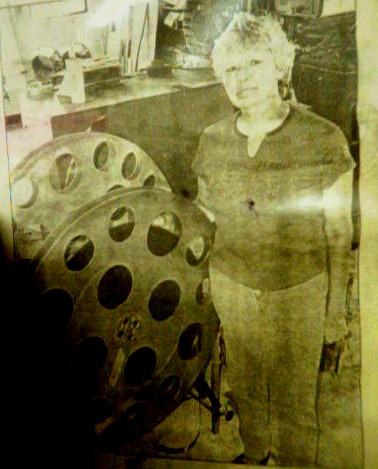
Pict of the present owner and the MiniMut transport unit.
-Monte

 |  IP: Logged

Cameron Glendinning
Jedi Master Film Handler

Posts: 845
From: West Ryde, Sydney, NSW Australia
Registered: Dec 2005


 - posted 09-10-2007 05:20 PM      Profile for Cameron Glendinning   Email Cameron Glendinning   Send New Private Message       Edit/Delete Post 
quote: David Zylstra
When you do the math for screen luminance there is about a 2-3FL difference between flat and scope using an anamorphic lens
Just Curious, how much of this difference could be dealt with within film grading? With DCI can gamma be played with to increase the brightness ect, or are these parameters set in stone?

In reference to Rons earlier comments re anamorphics now being used at home web page

 |  IP: Logged

Bill Enos
Film God

Posts: 2081
From: Richmond, Virginia, USA
Registered: Apr 2000


 - posted 09-12-2007 12:17 PM      Profile for Bill Enos   Email Bill Enos   Send New Private Message       Edit/Delete Post 
Post cleared---posted to wrong topic.

 |  IP: Logged

Dennis Benjamin
Phenomenal Film Handler

Posts: 1445
From: Denton, MD
Registered: Feb 2002


 - posted 09-21-2007 04:10 PM      Profile for Dennis Benjamin   Author's Homepage   Email Dennis Benjamin   Send New Private Message       Edit/Delete Post 
quote:
quote: Brian Guckian
--------------------------------------------------------------------------------
What's interesting is that only Steve Guttag has pointed out that 'Scope is meant to be WIDER (and bigger) than the "flat" ratios.
--------------------------------------------------------------------------------

That's because everyone thinks he's right.

He's not always right?

[Big Grin]

 |  IP: Logged

Thomas Pitt
Master Film Handler

Posts: 266
From: Leeds, West Yorkshire, UK
Registered: May 2007


 - posted 10-07-2007 04:05 PM      Profile for Thomas Pitt   Email Thomas Pitt   Send New Private Message       Edit/Delete Post 
Fixed-height screens with side masking have always been (in my opinion) better than fixed-width screens. With a fixed-width screen, it doesn't matter whether you have just top masking or top and bottom masking - the screen is still getting SMALLER when you switch over to scope.

I saw Halloween at Sheffield VUE last week; the screen was fixed-width with top and bottom masking. When it changed over to scope, I overheard someone behind me say "I swear, the screen's just got smaller!"

It's much better if the screen widens and gets bigger when the main movie starts (side masking). Again, when I saw Zodiac I was in an auditorium with side masking, and a few of the other people in the audience went 'Yeah!' when the screen opened up to full width [Wink]

If you've ever seen This Is Cinerama, after the introduction the tiny 4:3 image in the centre of the screen suddenly changes into a very wide 3-projector image of a rollercoaster ride. You can imagine how it must have awed audiences who were used to seeing all movies in the tiny 4:3 screen format! Fixed height is like that too; making the image bigger for the main movie.

Regarding D-Cinema and fixed height screens, surely it would be better to align the projector so that it fills the full scope area of the screen. For flat features, simply pillarbox the image digitally and have the projector showing black borders (which would be on the masking, so less obvious). Is this what David was trying to say?

The Leeds Light has a single digital projector, but they have fixed-width screens there. The digital projector is set to fill the full flat screen. For scope digital features, the image is scaled down slightly and only projected onto the bottom area of the screen - leaving a large black bar on the top. This, coupled with the top masking, makes the projector do a scope aspect ratio image without having to use an extra anamorphic lens.
I'm still unsure whether most moviegoers would notice that images have been scaled up or down when using a digital projector, though. It's not as if you're sitting right in front of a computer LCD screen, where upscaling is obvious!

 |  IP: Logged

Edwin Graf Diemer
Film Handler

Posts: 47
From: Red Bank, NJ, USA
Registered: Jul 2000


 - posted 10-07-2007 09:10 PM      Profile for Edwin Graf Diemer   Email Edwin Graf Diemer   Send New Private Message       Edit/Delete Post 
Pravin wrote:
"Also , why not use the fixed width auditorium to show mostly flat movies and show 2.35:1 movies only as a last ditch scheduling fix. This way, at least the ratio is not compromised when they are forced to show a scope movie."

I remember doing that when I was a projectionist at the Eric Concordville 4 (PA). It was a single-screen house that was built in the late 60's, twinned in 1976, and had 2 screens added in a early 80's addition. Sameric was very big on screen curtains (with a big "E" on them), which was neat, and all was retained when UA bought the chain. (It was something having to remove those letters from the curtains!) Anyway, when the original auditorium was twinned, a bowling alley theater of about 330 seats resulted at the left, while 737-seat auditorium #2 was at the right. The smaller house was the only one in the complex to have a fixed-width screen, and 'scope presentations looked so miserable there that we only showed "flat" prints on that screen. At least the image was a bit larger! Like many of you probably had to do, the side masking was moved by yanking a rope at the side.

 |  IP: Logged

David Zylstra
Master Film Handler

Posts: 432
From: Novi, MI, USA
Registered: Mar 2007


 - posted 10-07-2007 09:43 PM      Profile for David Zylstra   Email David Zylstra   Send New Private Message       Edit/Delete Post 
quote: Thomas Pitt
Regarding D-Cinema and fixed height screens, surely it would be better to align the projector so that it fills the full scope area of the screen. For flat features, simply pillarbox the image digitally and have the projector showing black borders (which would be on the masking, so less obvious). Is this what David was trying to say?

This is exactly what happens in real life . . . . . . but Digital flat and scope has the reverse of film - i.e. with 35mm scope is the brighter of the 2 pictures, but with digital flat is brighter than scope when you use 2 lenses (less so if you us an anamorphic for scope); the current single lens solution that scales flat to fit the scope picture height actually has the same luminance on both formats.

 |  IP: Logged

Monte L Fullmer
Film God

Posts: 8367
From: Nampa, Idaho, USA
Registered: Nov 2004


 - posted 10-08-2007 03:32 AM      Profile for Monte L Fullmer   Email Monte L Fullmer   Send New Private Message       Edit/Delete Post 
quote: Edwin Graf Diemer
The smaller house was the only one in the complex to have a fixed-width screen, and 'scope presentations looked so miserable there that we only showed "flat" prints on that screen. At least the image was a bit larger! Like many of you probably had to do...
..  -
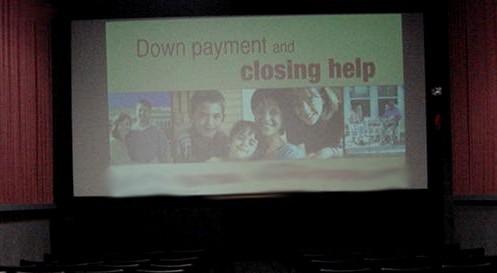
this is a house with a 9x18 ft. screen - simple common width screen (image from a preshow display..). Sad thing is that FLAT is projected at 2.00:1 along with the cropped 2.00:1 for scope vas well.

 |  IP: Logged

Tristan Lane
Master Film Handler

Posts: 444
From: Nampa, Idaho
Registered: Feb 2002


 - posted 10-08-2007 06:12 AM      Profile for Tristan Lane   Email Tristan Lane   Send New Private Message       Edit/Delete Post 
quote: David Zylstra
When you do the math for screen luminance there is about a 2-3FL difference between flat and scope using an anamorphic lens
When using a single lens, on common height screens, overall luminance should remain the same between formats. But an anamorphic should increase screen luminance, given the anamorphic lens isn't eating up all of the extra light produced by utilizing the entire chip.

I'm curious as to how you calculated the light loss. Are you claiming that the light is lost in the lens? That's the only reason I can see to have lower light

I don't recall seeing that much of a drop in light levels @ the screen in scope when the anamorphic was used. Were you able to test the math in the field?

quote: Thomas Pitt
it doesn't matter whether you have just top masking or top and bottom masking - the screen is still getting SMALLER when you switch over to scope.
If done correctly the Scope screen size wouldn't be any smaller than if it were set up as common height. Actually, you could probably net an additional foot on each side due to the lack of movable masking. Common height would just reduce your flat screen size.

I've never understood the thinking behind that. I know it seems a little more "grand" to have the Scope image appear larger than the flat image, but why not maximize the screen size for both formats?

Perhaps not moving the masking in front of an audience would keep people from thinking that the screen just got smaller.

 |  IP: Logged

David Zylstra
Master Film Handler

Posts: 432
From: Novi, MI, USA
Registered: Mar 2007


 - posted 10-08-2007 07:31 AM      Profile for David Zylstra   Email David Zylstra   Send New Private Message       Edit/Delete Post 
So far I have not been able to test in the field since Christie has been dragging their feet installing the anamorphics on our largest screens (we can barely reach 14FL with a new 6K lamp so we need the anamorphics). I have not assumed any light loss from the lens and the field measurements we have done on the single lens solution comes really close to the math.

The basic math for luminance is (Lumens X Gain)/Screen Area . . . . . running the math shows about a 2FL difference between flat and scope with anamorphic (I will be able to take field measurements in November - at least that's when Christie has promised to deliver the needed lenses).
There are a few things to make the above formula work for cinema - Since the approx lumens for the CP2000H lamphouse is based on using the full 1080X2048 (1.9 aspect ratio) chip you need to calculate a theoretical picture size for each format (i.e. if flat is 20 X 37 then when calculating FL you need to use 20 X 38).

 |  IP: Logged

Monte L Fullmer
Film God

Posts: 8367
From: Nampa, Idaho, USA
Registered: Nov 2004


 - posted 10-09-2007 02:07 AM      Profile for Monte L Fullmer   Email Monte L Fullmer   Send New Private Message       Edit/Delete Post 
quote: Tristan Lane
Perhaps not moving the masking in front of an audience would keep people from thinking that the screen just got smaller.
I used to get that all the time when I was running dbl features at a 14plex and with each film using a different lens.

..and the complain that would come of "making the pict smaller" with the top masking came down due to we had common width screens, one can easilly tell that television (the 4.3 versions) still dominated their viewing experiences.

Also, since I had true scope, my scope picts were tons brighter than the flat ones - to where, if I had a flat pict in one house that was planning on staying there for a good duration, I would refocus the bulb out just a bit to brighten up the screen some, plus mark it on the showsheet that the bulb was focused for a flat aperture and needs to be focused back in for the scope features.

- monte

 |  IP: Logged

James Westbrook
Phenomenal Film Handler

Posts: 1133
From: Lubbock, Texas, Usa
Registered: Mar 2006


 - posted 10-09-2007 11:52 AM      Profile for James Westbrook   Email James Westbrook   Send New Private Message       Edit/Delete Post 
It's my understanding the newer Christie consoles (circa 1998 and recent) can refocus itself for flat and scope...

 |  IP: Logged

Monte L Fullmer
Film God

Posts: 8367
From: Nampa, Idaho, USA
Registered: Nov 2004


 - posted 10-09-2007 04:00 PM      Profile for Monte L Fullmer   Email Monte L Fullmer   Send New Private Message       Edit/Delete Post 
True, there is that option for autofocus with the SLC consoles, but ours weren't equipped with that option for it was more desireable to have them operator controlled.

 |  IP: Logged


All times are Central (GMT -6:00)
This topic comprises 7 pages: 1  2  3  4  5  6  7 
 
   Close Topic    Move Topic    Delete Topic    next oldest topic   next newest topic
 - Printer-friendly view of this topic
Hop To:


Powered by Infopop Corporation
UBB.classicTM 6.3.1.2

The Film-Tech Forums are designed for various members related to the cinema industry to express their opinions, viewpoints and testimonials on various products, services and events based upon speculation, personal knowledge and factual information through use, therefore all views represented here allow no liability upon the publishers of this web site and the owners of said views assume no liability for any ill will resulting from these postings. The posts made here are for educational as well as entertainment purposes and as such anyone viewing this portion of the website must accept these views as statements of the author of that opinion and agrees to release the authors from any and all liability.

© 1999-2020 Film-Tech Cinema Systems, LLC. All rights reserved.