|
|
This topic comprises 4 pages: 1 2 3 4
|
|
Author
|
Topic: Running a movie with no audience?!
|
Daryl C. W. O'Shea
Film God

Posts: 3977
From: Midland Ontario Canada (where Panavision & IMAX lenses come from)
Registered: Jun 2002
|
 posted 08-23-2007 05:07 PM


[a little scatter brained... bad ADHD day and in a hurry to get to the drive-in]
Not at all. You said "striking the lamp and then extinguishing it doesn't prolong your lamp life", which implies that the duration that it burns for has no bearing on lamp life.
I said, solely to illustrate that the duration the lamp burns for must have bearing on lamp life, that "if that were true you could strike a lamp once and then run it forever" (a common engineering method to illustrate things that aren't very perceptible in short intervals).
Additionally, we know that manufacturers (and yourself) make a claim that striking a lamp has an effect on lamp life. However, if that were the only factor, lamps would be rated in number of ignition sequences (rather than burning hours) and lamp houses would have ignition counters (rather than hour meters).
Obviously, since I'm not an idiot, and nor are you, you're not going to be running the lamp forever. You are however going to be running it for say 2 hours though. Since we know that burning time does in deed have an effect on lamp life (bulbs are rated in hours, not in number of strikes, electrodes are consumed by burning, etc.) we know that turning it off will prolong its life.
The problem that applies to your situation though, is whether or not you're going to have to turn that lamp back on. If you go by either of the widespread rules of thumb that striking a lamp takes either 1 hour or 1/2 hour off the life of a lamp you can determine whether or not you're better off extinguishing a lamp in a particular situation. Lets use the 1 hour rule of thumb.
In the case where you've already struck the lamp and nobody's shown up you're best off extinguishing the lamp only once you've committed to no longer selling tickets for a show. It doesn't matter when you make this decision as whenever you do you'll immediately be better off than if you continue to let the lamp burn.
If for some reason you'd like to sell tickets say an hour and a half into a show, you're just as well off extinguishing the lamp half an hour in and then striking it again when that ticket is sold 1-1/2 hours later. As a bonus you save an hour of electricity usage and related air conditioning expenses.
In the case of a changeover booth it depends which of the rules of thumb you believe in. If you believe in the 1 hour rule of thumb and you run reels that are approximately an hour long +/- 5 or 10 minutes, you're looking at nearly the same cost (when you factor in electricity, cooling, and lamp life) either leaving the lamp on or turning it off.
If you believe in the 1/2 hour rule of thumb, you're best off extinguishing the lamps if running approximately hour long reels and leaving them on if you're running standard 10-25 minute individual reels.
Personally I base everything by the half hour rule... if it's not needed for half an hour I turn it off... I save electricity, possibly lamp life, and in booths without A/C (typical of many drive-ins) I don't die of heat exhaustion in the summer time.
In a properly air conditioned booth, even if you don't save any lamp life at all (extinguishing the bulb does nothing to save you lamp life theory) you'll save the electricity and cooling costs that you would incur by not extinguishing it.
If you're running 20 minute changeovers in a drive-in booth in Canada or the northern US in the spring or fall, leave both lamps burning regardless of what length reels you're running. It might cost you more but at least you won't freeze to death. ![[Big Grin]](biggrin.gif)
| IP: Logged
|
|
|
|
John Hawkinson
Film God

Posts: 2273
From: Cambridge, MA, USA
Registered: Feb 2002
|
posted 08-23-2007 09:50 PM
So, a lot of this depends on your usage pattern. My understanding is as follows:
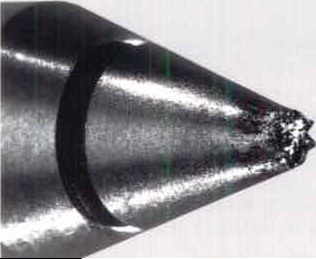
Striking the bulb shaves off some of the electrodes. If your bulbs fail by becoming unstrikable and you have sufficient no-load voltage to strike your bulb, then the number of ignitions mattered.
If your bulbs fail by becoming dim, flickering, enevelope blackening, exploding, etc., then ignition count didn't have much to do with the failure, and you could strike the bulb more often.
--jhawk
| IP: Logged
|
|
|
|
|
|
|
|
|
|
|
|
|
|
All times are Central (GMT -6:00)
|
This topic comprises 4 pages: 1 2 3 4
|
Powered by Infopop Corporation
UBB.classicTM
6.3.1.2
The Film-Tech Forums are designed for various members related to the cinema industry to express their opinions, viewpoints and testimonials on various products, services and events based upon speculation, personal knowledge and factual information through use, therefore all views represented here allow no liability upon the publishers of this web site and the owners of said views assume no liability for any ill will resulting from these postings. The posts made here are for educational as well as entertainment purposes and as such anyone viewing this portion of the website must accept these views as statements of the author of that opinion
and agrees to release the authors from any and all liability.
|

 Home
Home







 Printer-friendly view of this topic