|
|
This topic comprises 2 pages: 1 2
|
|
Author
|
Topic: Source for Hi- Rez Movie Poster artwork.
|
|
|
Frank Angel
Film God

Posts: 5305
From: Brooklyn NY USA
Registered: Dec 1999
|
 posted 11-17-2013 03:03 PM


James, how do you make your 1-sheets? Do you have a large format printer (oh how I wish we did), or do you use regular laser or inkjet printers that can "tile" the output? Since we run classics, we are left to our own devices to find 1-sheet images of a title on the web and then convert that to 1-sheet size posters.
When we are lucky and can find decent resolution images, we can get surprisingly decent looking 1-sheets. We may have to enhance as best we can, and then tile the output. Of course tiling requires carefully trimming and gluing nine 8.5x14 inch pages together, but with a little practice and a steady hand, you put that patchwork into a frame and anyone standing two feet or more away will think it's one single piece of paper, and more importantly, it gets the title and art work in front of the public.
Occasionally and especially when you can only find a low rez image, you may have to do some enhancement in Photoshop -- some gently sharpening of certain elements and perhaps just completely drop all the skinny fonts at the bottom which become illegible when blown up. I know this stuff must make Bobby cringe, but when you are desperately in need a poster of an old tile, an exhibitor's gotta do what an exhibitor's gotta do!
| IP: Logged
|
|
|
|
|
|
|
|
|
|
Bobby Henderson
"Ask me about Trajan."

Posts: 10973
From: Lawton, OK, USA
Registered: Apr 2001
|
posted 11-19-2013 09:40 AM
quote: Martin McCaffery
When I was out their his theatre was completely electronic advertising. The posters were mostly horizontal, so they either create their own or have enough pull to get them done by the disturbs.
The latter could be happening to some degree. Movie distributors will put together certain horizontal lock-ups of posters for special purposes like banners, subway poster ads, billboards, murals, etc. An HDTV friendly version would just be another option.
I would be a little disappointed encountering a theater that replaced traditional, vertical oriented one sheet poster cases with horizontal HDTV monitors. It just doesn't have the right visual feel to me. Ultimately it's going to make the movie-going experience even more like, using Quentin Tarantino's term, watching TV in public.
quote:
I know this stuff must make Bobby cringe, but when you are desperately in need a poster of an old tile, an exhibitor's gotta do what an exhibitor's gotta do!
"Up-rezzing" a low or limited resolution image doesn't do a whole lot of good, especially if someone merely uses the "bicubic smoother" setting in Photoshop. Vector-based artwork is the only thing that can be scaled from small to large sizes and still look razor sharp.
Some 3rd party Photoshop plug-ins & stand-alone applications do a little better job at resampling images up to larger sizes. Alien Skin Blowup 3 is a good step up from Photoshop's bicubic smoother. Perfect Resize 7.5 (an app formerly known as Genuine Fractals) appears to be better at enlarging images than Blowup 3. The latest version of Adobe Photoshop ("CC") has new enlarging tools that deliver results similar to Perfect Resize 7.5. However, the results from those tools is not perfect. They do a lot of work to hide the enlarged pixel grid. But in doing so the enlarged image can look a little like an oil paint filter has been applied to it. Some of the noise reduction smoothing that goes on can give the imagery a plastic like feel. Edge detail on elements like type can look a little wiggly and muddy. That's better than fuzzy, but still not so great.
Ultimately there is no substitute for native high resolution imagery. If I'm designing something like a billboard ad and need to buy a stock photo image I always buy the highest resolution version available. If I'm enlarging an image across a 14' X 48' billboard layout a 25 million pixel version of that image will hold up to the enlargement a lot better than a cheaper 5 million pixel version.
quote: Frank Angel
Plus, not for nuthin, but if you want digital, be prepaired to REALLY pay the price -- a lot more than what it would cost to create the 1-sheet in paper.
The "consumables" in large format printing (papers/vinyls, inks, laminates) are expensive. Most large format printing service bureaus include a set up charge for handling the artwork files, switching out printing materials & laminates, etc. They'll usually add on more fees if they have to manipulate the artwork at all.
| IP: Logged
|
|
Marcel Birgelen
Film God
Posts: 3357
From: Maastricht, Limburg, Netherlands
Registered: Feb 2012
|
posted 11-25-2013 04:16 PM
quote: Bobby Henderson
E-ink technology still has a ways to go before it can take off in popularity. If costs of OLED production could ever come down from the stratosphere it might have a better shot since OLED displays can be backlit and produce very vibrant colors and contrast while maintaining a very thin form factor.
E-ink would work in an outdoor situation, where the only other option currently is either something printed or big ugly LED screens that are sufficiently bright. E-ink is also perfect in situations where you do not have constant power available, but want to easily reprogram stuff on demand anyway. I've seen E-ink based price-tags and small information signs at several retailers quite recently, so the technology is making its way in, but slowly.
OLED would be the perfect replacement for back-lit advertisements, current LCD and plasma screen (with those nasty burn-in habits) installs.
But, unfortunately, the industry as a whole is not focusing on either technology right now, so there is not much progress happening. Instead of replacing LCD and plasma with OLED, they went the easier route of pushing 4K. And e-ink is also going nowhere, because hipster tablets all use "retina" LCDs...
| IP: Logged
|
|
|
|
Frank Angel
Film God
Posts: 5305
From: Brooklyn NY USA
Registered: Dec 1999
|
posted 11-28-2013 02:14 AM
Finally got around to taking some pics of the last home-made 1-sheet I needed and made by the tile-printing method on an ordinary under $200 HP ink jet. For what it does -- lets people know what your playing -- it does a decent job and it's not so shabby that you have to stand next to it and apologize.
This one was made from an image I got right off IMDB, so it's about as awful a source as you can get, yet, as you can see, out comes 9 pages of 8.5x11 paper and with a little snip and paste, you've got yourself that much-needed 1-sheet.
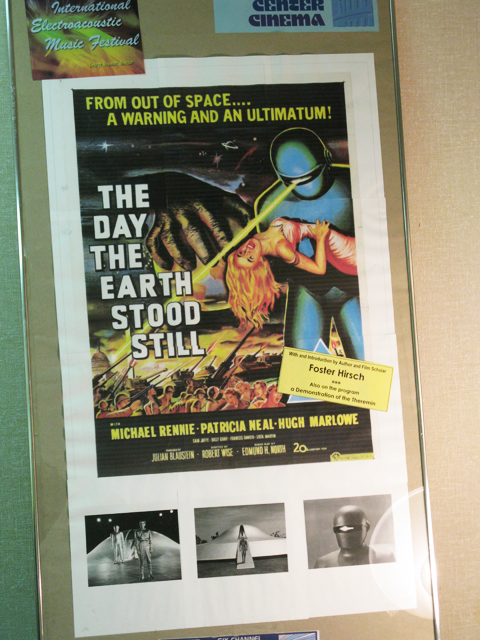
Of course you can't tell much from this picture of a picture, but if you look at the diagonal paste-on notice about Foster Hirsch and the Theremin which was printed on a laser printer, you can see the relative softness of the picture next to the printed text. Here is a closeup of the paste-on so you can see the clarity of it compared to the poster image.
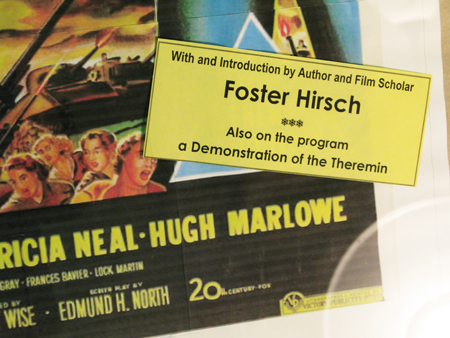
And of course it's not perfect. No matter how careful you are in cutting and lining up the pages, the moisture in the ink causes the pages to swell and warp ever so slightly and at different rates depending on the amount of ink. So you can wind up with slight mismatches. If you wait a day after you print, I found it's not as severe as you see in the detail below; it happens I needed this one immediately and I pasted them together right out of the printer. I also guess that a laser printer would cause less or no warping -- no liquid ink. You can see the mismatch here on the word STILL:

All in all, it's still beats having no 1-sheet at all.
HAVE A GREAT THANKSGIVING EVERYONE.
| IP: Logged
|
|
|
|
|
|
Bobby Henderson
"Ask me about Trajan."
Posts: 10973
From: Lawton, OK, USA
Registered: Apr 2001
|
posted 12-03-2013 04:11 PM
quote: Marcel Birgelen
There are tons of reasons why I generally don't like them... let me give you a few:
- Although this is usually an operational issue, most of them are far to bright at night. I guess many operators don't want to tune them down, because they think they make more impact this way.
- Most of them have abysmal resolutions. Many of them even have separate "dots" per sub-pixel.
- But my biggest issue is the gaps between the pixels. The resulting dot matrix remains visible from a large distance. This makes images look fake.
Big question, Marcel? What's the alternative? It sure isn't e-ink.
Most LED-based signs and billboards have brightness settings automatically adusted via solar cell input. Some will have it adjusted by a time settings. The only displays I see running full brightness at night are newly installed units where someone forgot to turn on automatic dimming. That's a rare occurence. Not many people will get away with deliberately running a LED sign at full brightness. City council members and police officers tend to get called about that sort of thing in a short amount of time.
Regarding "separate dots per sub-pixel" -well, yeah, you need at least a minimum of a red, green and blue LED for each cluster to create a proper "pixel" capable of full color display. This isn't any different from how a computer monitor works. It's just taking place on a much larger scale.
Regarding abysmal resolutions, gaps between pixels, etc. it all comes down to money. It costs more $ to pack more RGB pixel clusters into a given space. The smaller, more coarse looking units are more affordable for businesses to install. But they're also far more limited in what kinds of content they can show.
Most billboard sized LED displays (30' X 10' and 48' X 14' are the most common sizes) have a pixel pitch of 23mm, 20mm or 16mm from one pixel center to the next. Overglow from the LEDs fills in the gaps sufficiently unless you're looking at the board at a close distance. Pitches tighter than that (such as 12mm, 9mm, etc.) are overkill for billboards.
As LED-based signs and billboards continue to grow in popularity the costs per pixel will continue to fall and make higher resolution boards more affordable.
quote: Mitchell Dvoskin
For the amount of time and effort it took to tile print that poster and piece it together, you could have bought a 27x40 reproduction online for $15.
Don't forget about the cost of that desktop printer's ink! That stuff ain't cheap!
| IP: Logged
|
|
|
|
|
|
All times are Central (GMT -6:00)
|
This topic comprises 2 pages: 1 2
|
Powered by Infopop Corporation
UBB.classicTM
6.3.1.2
The Film-Tech Forums are designed for various members related to the cinema industry to express their opinions, viewpoints and testimonials on various products, services and events based upon speculation, personal knowledge and factual information through use, therefore all views represented here allow no liability upon the publishers of this web site and the owners of said views assume no liability for any ill will resulting from these postings. The posts made here are for educational as well as entertainment purposes and as such anyone viewing this portion of the website must accept these views as statements of the author of that opinion
and agrees to release the authors from any and all liability.
|

 Home
Home




![[Wink]](wink.gif)



 Printer-friendly view of this topic