|
|
This topic comprises 3 pages: 1 2 3
|
|
Author
|
Topic: Drive In Theater Design
|
|
|
Jack Ondracek
Film God

Posts: 2348
From: Port Orchard, WA, USA
Registered: Oct 2002
|
 posted 03-23-2017 08:05 PM


quote: Justin Hamaker
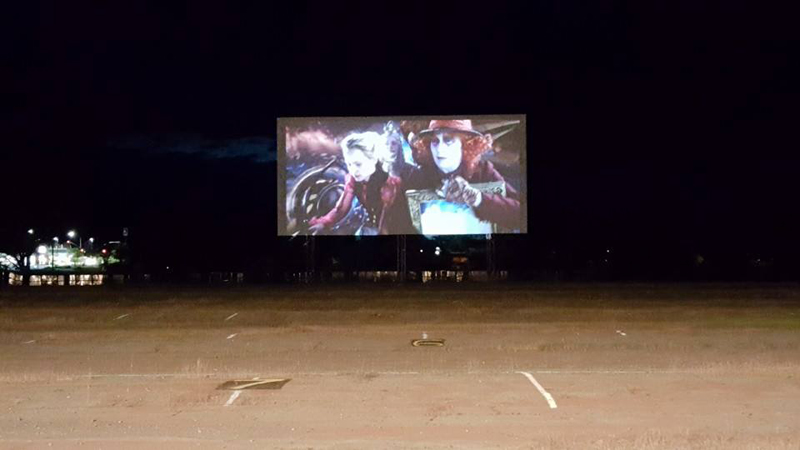
For perspective, this is what our screen looks like from the snack bar building - approximately 420 feet from the screen.
Nice, Justin.
That's what we have, though just a bit smaller... 43X86. Same projector.
Tammy... Won't chime in here too much, as Barry and Justin have nicely covered most of it.
If you can keep your screens at or below about 60 feet wide, a 4000 watt projector will work fine. Barco can go up to this level with single phase power. Perhaps Christie and NEC can as well, but I have no experience with these brands. If 3 phase isn't an issue where you are, then none of this matters. Screen size is a function of how large your field(s) will be, so that has to be considered at the same time.
Barry built his second screen with poles, so he can speak to the challenges inherent to this design. My back two screens were also locally built, but the framing was made from that square conduit you see parking lot light posts made of. The frame was welded together on the ground, then lifted into position by a couple of cranes. The front sheeting is simply corrugated barn roofing with a baked-on coating (pictures on our web site). It's a simple design that might give you a less-expensive alternative to the Selby product, though there's nothing to complain about their stuff.
I agree about 2 screens... at least! We have 3 here, which has worked out just about right.
| IP: Logged
|
|
Barry Floyd
Phenomenal Film Handler

Posts: 1079
From: Lebanon, Tennessee, USA
Registered: Mar 2000
|
posted 03-24-2017 01:52 PM
quote: Jack Ondracek
Barry built his second screen with poles, so he can speak to the challenges inherent to this design.
We really didn't have any "challenges" to speak of, it was just a daunting task. Our first screen is a Selby. It's literally a "set it and forget it" type of structure. All steel construction, triangular trusses, iron I-beams, and faced with the same material you see on the underside of of gas station canopies. Only maintenance we've done to it in 14 years is repaint the face twice and sandblasted and repainted the structural members once.
Our second screen is a pole screen like Jack mentioned. Not dinky little line poles that are in your neighborhood... these things are huge. Ours are "Class 1 Utility Poles" (24" in diameter at the bottom tapering to 13" at the top). Because our poles were so long, we had to get a special highway permit to transport them from North Carolina to Tennessee. We have 9 poles (11 feet in the ground in solid rock) spaced 7 feet apart. The poles have horizontal cross members of 2x6 pressure treated lumber every 24 inches vertically. The 2x6's are attached to the poles with 5/8" diameter x 20 inch long galvanized hex head bolts, with square cut washers and double bolted. The face of the screen is 1/2" x 2.67" sine wave corrugated steel attached to the horizontal cross members every 18 inches with stainless steel roofing screws with rubber washers. It's been standing since 2005 and we've never had an issue with it.
I can tell you that when it rains the picture looks better on the pole screen than it does on the Selby. Since the Selby screen face is a flat surface, the water sheet-flows down the front of it - creating "hot-spots" of white light. On the pole screen, because the surface is corrugated, the outside high points of the corrugations typically get wet while the inside corrugations do not. The light bends around the corrugations, and the picture stays pretty much perfect for the entire film.
For what it's worth, whenever we have big storms with high winds come through... we don't even think about the Selby screen, we only focus our attention to the other side.
| IP: Logged
|
|
|
|
|
|
|
|
Donald Brown
Expert Film Handler

Posts: 131
From: Lincoln, DE
Registered: Sep 2009
|
posted 03-28-2017 04:19 PM
As you plan the design of your new theatre, one significant consideration that should not be overlooked is the proper angle between the projector and the screen. Years ago, when theatres were much larger than today, there were screen/projection specifications advocated by SMPTE and NATO that provided for a complimentary viewing experience for the most patrons in the largest area of the theatre. To ignore the angular relationship between the two can produce an unappealing screen image.
Several years ago, a drive-in theatre that closed thirty years before was reopened an hour north of my location. The original buildings had been removed years ago, but the two original Selby screens remained. The restoration of the facility brought a new architectural design to the buildings which is aesthetically appealing, but the projection facilities were raised approximately two stories above grade. The change in projection/reflection angle was altered, and the picture, in the primary parking area, was so impacted that, on the night that I visited, I left with eye strain! However, before departing, when I walked back to the snack bar at the back of the lot, the picture was brilliant!
Accordingly, as you lay out your site, don't over look the need for compatible projection/reflection angles to provide the best on screen image for the broadest viewing area and the greatest number of patrons!
Good luck!
| IP: Logged
|
|
|
|
Tammy Rogers
Film Handler
Posts: 7
From: Buffalo, WV, US
Registered: Aug 2016
|
posted 03-30-2017 02:24 PM
Dave - For the most part we will have the greater Charleston market to ourselves. A population count says there are 529,000 people within a 35 mile radius. I'm about 15 miles from the nearest indoor theater. However, there is a new "drive-in" opening up this spring about 50 miles from us. Upon first hearing about it, it made me want to toss in the towel (and toss my cookies haha), but the more I read about it, the less worried I am. Their screen is 35 feet wide, no ramps, vendors for concessions, open only Friday nights, playing "a mix of classics and some new", it doesn't sound too competitive to me. I am located between the two largest markets, in the largest county, they are on the other side of Charleston, so a lot of people would have to pass me to get to them. I'm hoping it fizzles out after a year or so. Other than that the nearest drive-ins are more than 80 miles away, in Lancaster Ohio and Meadow Bridge WV.
Donald - the situation you were describing - was the screen tilted downward to accommodate the projection room at ground level? Is it okay to have a completely vertical screen and the projection from a second floor? Or would it need to be tilted too? For some reason tilting seems like it would be a lot harder to accomplish than a straight up vertical screen.
Is there some formula or way to decide how far back a row starts? And is there a purpose for having the front rows narrower than the back rows to form the wedge shape? Since my field is so skinny, can I have all rows the same width to form more of a rectangle shape? Would making the radius or curve not so deep let you scoot up closer to the screen and then have more rows (all the same width?)If you do that, does the screen need to be extra wide?
My field is about 950x290, with the narrowest side parallel to the road, so the current plan is for an entrance road on one side that travels back about half way or 400+ feet, before you get to the ticket booth. That would create room for about 20-25 cars to get off the road so it wouldn't back up traffic so much. The ticket booth itself would be about even with (and visible from) the concession building so after purchasing a ticket, the car would either continue forward to park in the rear field or make a right turn into the back part of the front field. I haven't decided if we should make a second road on the other side for an extra exit or just keep the one we have. A road takes up room where cars can park to view the movie! Again thank you all for your input, you fellas are awesome.
![[Smile]](smile.gif)
| IP: Logged
|
|
Donald Brown
Expert Film Handler
Posts: 131
From: Lincoln, DE
Registered: Sep 2009
|
posted 03-30-2017 05:40 PM
Projection and reflection angles are often quite different from location to location. Vertical screen surfaces worked very well on layouts which were designed as "reverse inclines", where the theatre was built on the side of a hill and where the projection booth was placed in the middle of the rise and would project on level with the center of the screen. Here, the reflected image would be directed back toward the booth in the middle of the lot.
A number of years ago, I visited a new build with two pole screens with vertical surfaces. While the image was brilliant from the second story booth, the picture was unimpressive from ground level. This location had a generally flat parking area.
The drive-in that I referenced, that had been reopened after thirty years, had two angled Selby screens that were situated to reflect images projected from the two original ground level buildings. While the restoration of the facility was aesthetically appealing, from the middle of the field, where I parked, the picture was poorly illuminated. At the back it was brilliant!
I operated a venue that was built in the late '40s and was working with its third generation screen! The booth was situated for the original screen, and as the successive screen structures were replaced, the orientation between the two was altered. The third, built by Screen Towers International, had an angled corrugated steel surface. The image reflected from this was directed to the east-front and center where the picture was better than at an indoor theatre! However, outside of that range, the picture was unexceptional.
The effect of image reflectivity resulting from projection and screen angles can often be noticed, a bit more subtly, in old indoor theatres as well.
| IP: Logged
|
|
|
|
|
|
|
|
Frank Angel
Film God

Posts: 5305
From: Brooklyn NY USA
Registered: Dec 1999
|
posted 04-01-2017 04:11 PM
The highlight of so many DIs is their unigue food service which is usually much more elaborate, and better tasting than hardtop concessions. I visited the Two-Hills DI in Harrodsberg Kentucky that had the most delicious pulled pork sandwiches that were hand made right on the premises. I always wondered why DIs that do have full kitchens don't simply open during the daytime hours as restaurants? Other than needing to add staff, they are fully equipped to just continue what they do during showtime. Seems like an obvious extension to garner income when the theatre is otherwise idle, making NO income. It would even facilitate income during the winter for those seasonal operations in the north. If the concessions building wasn't large enough to accomodate sit-down customers, people could still park in the field, come in, get their order and go back and eat in the car. Or, a DI could even partner with a known franchise like Chipotle or Wendy's, etc. Just seems like a natural to me.
I once stopped at a DI in upper Michigan; it was a unique place in that part of the property was a motel. Same idea -- get the property to produce income even when the DI is "light" :-) Every unit had a large picture window that looked out to the screen. Being in Michigan I am sure the DI was not running year round, but they still ran the motel business during the off season. Very cool idea.
I sub-ed at a DI that had a screen which was on the back wall of a thin, narrow building. The front of the building was the marquee; they used the interior for storage. Never had to worry about wind or poles and it gave a sense of "permanence" to the place. Does anyone use that kind of screen construction any more or is it all poles and scaffolding?
| IP: Logged
|
|
|
|
|
|
All times are Central (GMT -6:00)
|
This topic comprises 3 pages: 1 2 3
|
Powered by Infopop Corporation
UBB.classicTM
6.3.1.2
The Film-Tech Forums are designed for various members related to the cinema industry to express their opinions, viewpoints and testimonials on various products, services and events based upon speculation, personal knowledge and factual information through use, therefore all views represented here allow no liability upon the publishers of this web site and the owners of said views assume no liability for any ill will resulting from these postings. The posts made here are for educational as well as entertainment purposes and as such anyone viewing this portion of the website must accept these views as statements of the author of that opinion
and agrees to release the authors from any and all liability.
|

 Home
Home






![[Cool]](cool.gif)


 Printer-friendly view of this topic