Film-Tech Cinema Systems
Film-Tech Forum ARCHIVE


my profile | my password | search | faq & rules | forum home
  next oldest topic   next newest topic
» Film-Tech Forum ARCHIVE   » Operations   » Ground Level   » A New Low in Presentation Standards (Page 3)

 
This topic comprises 5 pages: 1  2  3  4  5 
 
Author Topic: A New Low in Presentation Standards
Bobby Henderson
"Ask me about Trajan."

Posts: 10973
From: Lawton, OK, USA
Registered: Apr 2001


 - posted 12-31-2016 11:17 PM      Profile for Bobby Henderson   Email Bobby Henderson   Send New Private Message       Edit/Delete Post 
quote: Tyler Purcell
In terms of 4k being a limitation for rendering, that's hogwash. I work for a few VFX houses, supporting their server infrastructure and client workstations when I'm not out making movies. They do everything in 4k and the difference in render time is negligible because they only render final approved outputs in 4k, everything else is 1080p. So the time it takes to render out 250 special effects shots in 4k vs 2k is what, maybe 3 extra days tagged onto post? Disney/Pixar have been rendering their all CG movies in 4k for over a decade. Yes they have one of the best render farms on the planet, but you never hear them complain about 2k vs 4k rendering.
I smell bullshit in that story. If 4K was really so fucking easy to render then why even bother with 2K, especially when 4K TV sets are totally taking over electronics store shelf space?

I don't make movies, but I've only been doing computer graphics work for my living for the past 25 years. I'm keenly aware of the capabilities and limitations for computer systems. And I'm also keenly aware of bean counters using those same facts of life regarding digital technology to their own benefit.

Nearly all movies are still having their final render done in mere 2K. I will not buy it for a second that all CGI is being output in 4K only to be dumped down to plain HDTV quality. The math of it easily spells out the render routines being dumbed down to 2K way ahead of post production crews getting their mitts on the assets. There is absolutely no logic at all for any movie to have all of its post production work done at 4K and then only get dumbed down to 2K for final theatrical release. The idea of that is only absolutely stupid.

 |  IP: Logged

Tyler Purcell
Expert Film Handler

Posts: 180
From: Van Nuys, CA
Registered: Dec 2015


 - posted 01-01-2017 01:52 AM      Profile for Tyler Purcell   Author's Homepage   Email Tyler Purcell   Send New Private Message       Edit/Delete Post 
Well it's all true and it's my business, I'm on the creative side of things and 4k is not a big deal at all. I work with Red Code, Pro Res XQ, Cinema DNG and Intraframe MPEG on a weekly basis, all of them in 4k workflows. Now my clients only need 1080p versions, but due to the ability to zoom up images and the higher color space of using the original files, I generally finish at the full resolution. Then I will down-res to match whatever the clients delivery requirements are.

This is the same workflow EVERYONE in the studio system uses. They don't convert the camera raw to 2k... no, they edit the show in a low-res proxy format. They take the project import it into DaVinci or equivalent software for finishing. They link to the original camera media which is in most cases 4k or above. They do all the finishing in that resolution. They give the effects houses colored camera original (and size) files to work with and the effects houses give them back exactly the same format they give to them in the first place. Once the whole show is complied and all the effects shots are replaced, they will export to the settings the studio requires.

This is how things are normally done. Yes I've been part of post production on many shows that shot on Alexa in 3.2k and they finished in 2k because in doing so, they fill-in the missing color information from the bayer pattern. Alexa shows are almost entirely finished in 2k as a result of this small issue. However, Red shows are always finished in 4k because the camera can't shoot less then 4k without cropping the imager. Same goes for the Sony F65 and even the new Alexa 65. Almost every digital movie made is shot with one of those 4 cameras; Alexa XT (3.2k), Alexa 65 (6k), Sony F65 (4k) or Red Dragon (6k).

 |  IP: Logged

Bobby Henderson
"Ask me about Trajan."

Posts: 10973
From: Lawton, OK, USA
Registered: Apr 2001


 - posted 01-01-2017 04:07 AM      Profile for Bobby Henderson   Email Bobby Henderson   Send New Private Message       Edit/Delete Post 
You're still talking about shooting live action imagery with video cameras, not the 3D/CGI rendering stuff and compositing chores which require an immense amount more of compute horsepower than merely shooting the live action "plates." All that post production stuff is really where the money choices between 2K and 4K take place. Way too many "deciders" go the 2K route thinking that's good enough.

 |  IP: Logged

Stephen Furley
Film God

Posts: 3059
From: Coulsdon, Croydon, England
Registered: May 2002


 - posted 01-01-2017 06:06 AM      Profile for Stephen Furley   Email Stephen Furley   Send New Private Message       Edit/Delete Post 
quote: Leo Enticknap
I played that Carmen Jones DCP at AFI last month. The DCP transfer is really merciless to the shortcomings of very early CinemaScope: grainy as hell and even medium close-ups have the mumps really badly.


Leo, it was certainly grainy, but I was surprised at how good the colour looked.

Interesting that you should mention the mumps. The BFI could not supply a trailer, and the several copies on Youtube were all terrible, so I went to HMV and bought the Blu-Ray. This had a somewhat better copy of the trailer, only SD, but the best that I could find. I keep a caption on the server to show before such 'bad' trailers, as we sometimes have to use for old films. The HD video of the film itself looked much better, in fact not a great deal different to the DCP unless you looked closely. Both showed signs of 'mumps', presumably they would both have been derived from the same digital transfer from film elements. However, the trailer looked much worse. Did they digitally distort the new trailer somewhat to reduce the 'mumps' effect? It would be interesting to overlay the same still frame from the trailer and the new trailer of the film.

The sound was a bit disappointing, but reasonable for its age; at least unlike an original Cinemascope print probably would have it didn't have 12 KHz tone.

 |  IP: Logged

Daniel Schulz
Master Film Handler

Posts: 387
From: Los Angeles, CA USA
Registered: Sep 2003


 - posted 01-01-2017 11:16 AM      Profile for Daniel Schulz   Author's Homepage   Email Daniel Schulz   Send New Private Message       Edit/Delete Post 
quote: Bill Brandenstein
Let me address Daniels's very reasonable complaint. It appears that screens 1 and 14 (the massive, balcony-equipped ones at the front left and right of the complex) have incorrect lenses. The screens are very large, the throw is modest, and the picture indeed doesn't quite fill the edges. That's just stupid. The ads are shown full-screen, then masking drops and the Rogue One scope image uses the bottom portion, meaning that the bottom corners "smile." But at least the masking is there and adjusts.
I was in one of the small auditoriums, and there was no masking at all. The screen was of modest size, as was the throw distance. I really want to like this theater, as I agree with you that their spending the money to put in Atmos on every screen and dual laser projectors suggests an intention to do right by the audience - which is why my experience with the image not filling the screen was so frustrating.

quote: Bill Brandenstein

However, to be fair Daniel, I'd love to know where you consistently enjoy going for movies. Arclight? Do you really think Arclight's images look as good as AMC Universal's lasers?

I used to like Arclight Hollywood, but it has gone *way* downhill over the years. I've been dividing my time pretty equally between the TCL Chinese IMAX, the Dolby Cinema screens at AMC Burbank or AMC Century City, the Village in Westwood (probably my favorite venue, as it is a huge non-stadium house with a huge, properly masked 'Scope screen and Dolby Atmos), and Arclight Hollywood for run-of-the-mill releases.

 |  IP: Logged

Bill Brandenstein
Master Film Handler

Posts: 413
From: Santa Clarita, CA
Registered: Jul 2013


 - posted 01-01-2017 03:56 PM      Profile for Bill Brandenstein   Email Bill Brandenstein   Send New Private Message       Edit/Delete Post 
Fair answer, Daniel. Helpful, even! And had "Sing" been in scope I might've had a different opinion (since screen 13 was small, and I don't know if the edges are true moveable masking or not).

Ever do Arclight Sherman Oaks? I've been to all of the venues you mentioned, all in pre-Atmos days, but not that one.

 |  IP: Logged

Bobby Henderson
"Ask me about Trajan."

Posts: 10973
From: Lawton, OK, USA
Registered: Apr 2001


 - posted 01-01-2017 05:32 PM      Profile for Bobby Henderson   Email Bobby Henderson   Send New Private Message       Edit/Delete Post 
I imagine Dolby Atmos ceiling surround speakers would be much more effective in a normal slope seating auditorium like the Village theater because of the lower ceiling.

 |  IP: Logged

Daniel Schulz
Master Film Handler

Posts: 387
From: Los Angeles, CA USA
Registered: Sep 2003


 - posted 01-01-2017 08:00 PM      Profile for Daniel Schulz   Author's Homepage   Email Daniel Schulz   Send New Private Message       Edit/Delete Post 
quote: Bill Brandenstein
Ever do Arclight Sherman Oaks? I've been to all of the venues you mentioned, all in pre-Atmos days, but not that one.

I don't mind Arclight Sherman Oaks, other than being annoyed that it was a retrofit to faux-Arclight of an existing Pacific; the Arclight Hollywood, built from scratch (apart from the Dome of course) is superior.

Honorable mention also for the Pacific in Winnetka - I don't go there much now that I no longer work in the West Valley (I used to stop at that Pacific on the way home from work sometimes), but the two big houses in Winnetka have killer Meyer sound systems, huge screens and good projection.

My closest theater is the Laemmle North Hollywood, which is OK mostly because it's pretty new.

 |  IP: Logged

Leo Enticknap
Film God

Posts: 7474
From: Loma Linda, CA
Registered: Jul 2000


 - posted 01-01-2017 10:05 PM      Profile for Leo Enticknap   Author's Homepage   Email Leo Enticknap   Send New Private Message       Edit/Delete Post 
quote: Brad Miller
Really the same thing could have been done with film, and was on occasion. Case in point everyone remember the Wizard of Oz reissue where most prints were 1.33 within a 1.85 "container" (to use digital lingo)?
Point taken, though with film, presenting a non-standard (as in, not 1.85 or 'scope) aspect ratio involved either the theater spending serious money (investing in a lens and plate for the desired ratio) or the distributor (creating pillarboxed prints, as you note, and which happened quite a bit in the '90s, e.g. with The Blair Witch Project and the Dogma 95 movies).

With a DCP, you don't need to spend that up-front money to avoid cropping the picture, but just because you can get the aspect ratio right in the DCP doesn't mean that the theater it goes to can mask the screen properly, or avoid presenting an unacceptably small image. If you want to be able to do the full range of ratios from 1.19 to 2.79 with an acceptable picture size, you need a native screen ratio of around 2.20 and adjustable masking on all four sides, which only a tiny handful of theaters are in a position to invest in.

quote: Stephen Furley
I keep a caption on the server to show before such 'bad' trailers, as we sometimes have to use for old films.
An excellent idea, which I fully intend to rip off - thanks Stephen! We do sometimes have to make DCP trailers for more obscure titles from less than ideal sources (including, very occasionally, ripped from YouTube), and so a snipe like that would be a good idea.

 |  IP: Logged

Jim Cassedy
Phenomenal Film Handler

Posts: 1661
From: San Francisco, CA
Registered: Dec 2006


 - posted 01-03-2017 01:10 PM      Profile for Jim Cassedy   Email Jim Cassedy   Send New Private Message       Edit/Delete Post 
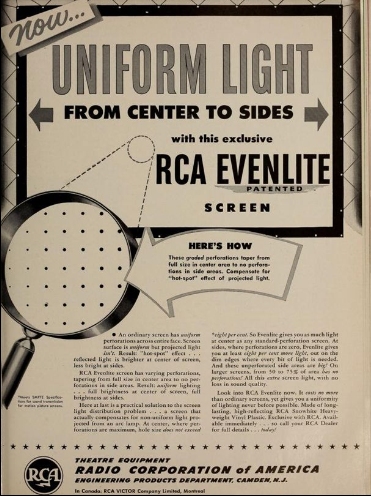
quote: Harold Hallikainen
I was researching papers on luminance measurement for a SMPTE
committee and ran across a paper from the 1950s about perforated
screens. In this paper, they proposed varying the perforation area

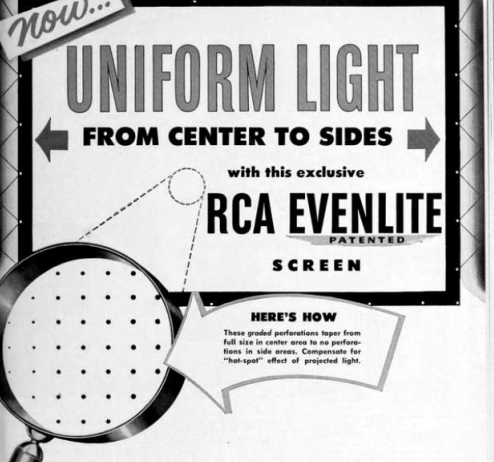
Apparently, RCA marketed such a screen in the early 1950's.
This ad-scan is from 1951:
 -

Close-up shows the 'graded perforations'
 -

 |  IP: Logged

Mike Blakesley
Film God

Posts: 12767
From: Forsyth, Montana
Registered: Jun 99


 - posted 01-03-2017 01:12 PM      Profile for Mike Blakesley   Author's Homepage   Email Mike Blakesley   Send New Private Message       Edit/Delete Post 
How are screen perfs made, anyway? Seems like it would be a fascinating process to watch a screen get made.

 |  IP: Logged

Jim Cassedy
Phenomenal Film Handler

Posts: 1661
From: San Francisco, CA
Registered: Dec 2006


 - posted 01-03-2017 05:36 PM      Profile for Jim Cassedy   Email Jim Cassedy   Send New Private Message       Edit/Delete Post 
I think they start off with a big box of little holes.
Then they spread them out on a flat surface and weave them together.

(But seriously, it would be a good topic for the "How It's Made" TV show.)

 |  IP: Logged

Mike Blakesley
Film God

Posts: 12767
From: Forsyth, Montana
Registered: Jun 99


 - posted 01-03-2017 06:10 PM      Profile for Mike Blakesley   Author's Homepage   Email Mike Blakesley   Send New Private Message       Edit/Delete Post 
I always thought they laid out thumbtacks on a floor and...never mind, getting ridiculous. I agree it would be a good TV topic.

 |  IP: Logged

Leo Enticknap
Film God

Posts: 7474
From: Loma Linda, CA
Registered: Jul 2000


 - posted 01-03-2017 06:57 PM      Profile for Leo Enticknap   Author's Homepage   Email Leo Enticknap   Send New Private Message       Edit/Delete Post 
I'm guessing that it's done in essentially the same way that film is perforated: a cutting block (like the one in a Neumade or CIR splicer) is driven through the surface under pressure. Presumably the screen surface has to be held taught in some way as this is done, to avoid hanging chads.

 |  IP: Logged

Tony Bandiera Jr
Film God

Posts: 3067
From: Moreland Idaho
Registered: Apr 2004


 - posted 01-03-2017 07:51 PM      Profile for Tony Bandiera Jr   Email Tony Bandiera Jr   Send New Private Message       Edit/Delete Post 
quote: Mike Blakesley
How are screen perfs made, anyway? Seems like it would be a fascinating process to watch a screen get made.
Well, I can tell you from some past experience that most screen makers guard that information carefully. I got to tour Stewart Filmscreens some years ago, and they would not show me the perforation or manufacture of the seamless screen materials. "Proprietary process" was the quoted reason.

 |  IP: Logged


All times are Central (GMT -6:00)
This topic comprises 5 pages: 1  2  3  4  5 
 
   Close Topic    Move Topic    Delete Topic    next oldest topic   next newest topic
 - Printer-friendly view of this topic
Hop To:


Powered by Infopop Corporation
UBB.classicTM 6.3.1.2

The Film-Tech Forums are designed for various members related to the cinema industry to express their opinions, viewpoints and testimonials on various products, services and events based upon speculation, personal knowledge and factual information through use, therefore all views represented here allow no liability upon the publishers of this web site and the owners of said views assume no liability for any ill will resulting from these postings. The posts made here are for educational as well as entertainment purposes and as such anyone viewing this portion of the website must accept these views as statements of the author of that opinion and agrees to release the authors from any and all liability.

© 1999-2020 Film-Tech Cinema Systems, LLC. All rights reserved.