Film-Tech Cinema Systems
Film-Tech Forum ARCHIVE


my profile | my password | search | faq & rules | forum home
  next oldest topic   next newest topic
» Film-Tech Forum ARCHIVE   » Operations   » Ground Level   » Lion King 2019 - soft volume (Page 2)

 
This topic comprises 3 pages: 1  2  3 
 
Author Topic: Lion King 2019 - soft volume
Sam D. Chavez
Film God

Posts: 2153
From: Martinez, CA USA
Registered: Aug 2003


 - posted 07-22-2019 04:21 PM      Profile for Sam D. Chavez   Author's Homepage     Send New Private Message       Edit/Delete Post 
quote: Steve Guttag
Such a simplistic view of sound. It would be nice if one could simply use one metric (overall SPL) to evaluate subjective sound levels without regard to acoustics, frequency, distortion, 1st arrival versus reflected, decay time...etc.

Tom Holman, early in the process of establishing THX criteria, dreamed of cinemas with no fader. True story!

 |  IP: Logged

Steve Guttag
We forgot the crackers Gromit!!!

Posts: 12814
From: Annapolis, MD
Registered: Dec 1999


 - posted 07-23-2019 07:33 AM      Profile for Steve Guttag   Email Steve Guttag   Send New Private Message       Edit/Delete Post 
Sam, you forgot to capture my line about "the original concept behind THX" that would reinforce your statement!

But yes, if the theatre could resemble the mixing room in terms of acoustics and performance, the theatre would hear what they heard and no need for further adjustments. The flaw there is that it presumes all patrons have the same tolerance as the person mixing the movie for things like volume. A business is going to respond to customer complaints if it wants to stay in business. You can educate them only so much (some less than others). The customer's solution to the problem would be to not go to the theatre anymore and stay at home where they DO have volume controls.

I do think we would be better served to standardize on LEQm and set realistic levels of tolerance for everything (ads, previews, features). Heck, it probably wouldn't be too hard for any DSP based sound processor (probably any being made now) to provide an LEQ(m) number on a CPL by CPL basis. Wouldn't that be pretty cool since a theatre could find a volume level for everything that is consistent with their customer base!

 |  IP: Logged

Harold Hallikainen
Jedi Master Film Handler

Posts: 906
From: Denver, CO, USA
Registered: Aug 2009


 - posted 07-23-2019 10:18 AM      Profile for Harold Hallikainen   Author's Homepage   Email Harold Hallikainen   Send New Private Message       Edit/Delete Post 
Also, SMPTE has a group on "B-chain Expectations" that is looking at ways of improving the consistency of sound in theaters. The group is meeting today, so if you are a SMPTE member, sign up!

Harold

 |  IP: Logged

Mike Blakesley
Film God

Posts: 12767
From: Forsyth, Montana
Registered: Jun 99


 - posted 07-23-2019 03:04 PM      Profile for Mike Blakesley   Author's Homepage   Email Mike Blakesley   Send New Private Message       Edit/Delete Post 
quote: William Kucharski
Everything should be played at 7, period.
If I played our system at 7 we would definitely lose business. It would drive ME crazy.

And we are calibrated every time our tech visits, and we've been through three different techs over the last 25 years or so, and they all say we're calibrated properly, and it STILL sounds best somewhere between 4.5 and 5.0 in 90% of cases. If we run it at 7, explosions and such sound really impressive but the dialogue just sounds too loud for listening comfort.

I always have the same complaint at CinemaCon... where they probably play everything at 7, and without fail it sounds too loud to me. Of course, there, you're mostly watching trailers which are always too loud to start with.

For what it's worth, in 40 years in the business I have never had one complaint that our sound was too soft. I HAVE had the occasional "boy, that's loud!" comment. (They are usually smiling when they say it.)

 |  IP: Logged

Justin Hamaker
Film God

Posts: 2253
From: Lakeport, CA USA
Registered: Jan 2004


 - posted 07-23-2019 03:18 PM      Profile for Justin Hamaker   Author's Homepage   Email Justin Hamaker   Send New Private Message       Edit/Delete Post 
I had a customer a few years back want to set up a private showing of some kind of art project. He was completely sold on the idea of having the fader set to 7 and wanted me to run a test with that value (we normally run at 4.0). So I obliged him, and I can honestly say it was physically uncomfortable for it to be that loud.

The level where we normally set the fader is where we do not get complaints of too loud or too quite. Every now and then we get a customer who wants it turned up, but this always leads to customers complaining it's too loud.

 |  IP: Logged

Martin Brooks
Jedi Master Film Handler

Posts: 900
From: Forest Hills, NY, USA
Registered: May 2002


 - posted 07-31-2019 12:17 PM      Profile for Martin Brooks   Author's Homepage   Email Martin Brooks   Send New Private Message       Edit/Delete Post 
quote: Bobby Henderson
But most of the time the sound is turned way down.
Quite the opposite in the theaters I attend in NYC. It's almost always at ear-piercing levels. I really don't want to be yelled at when it's a quiet talking scene. And when there's an action scene, the volume is at rock concert levels and highly compressed, so there's little dynamic range. I've taken to bringing hearing protection with me like I do at music shows. I don't wear them throughout the entire film, but I'll put them in if it gets bad.

I think part of the problem is that theaters set the volume for when there's a full house, but when a screening isn't very crowded, like during weekdays during the day, there aren't enough bodies (and in the summer, not enough coats) to absorb all that sound.

I've heard some lousy sound, but I can't remember the last time I thought the level was too low.

 |  IP: Logged

Harold Hallikainen
Jedi Master Film Handler

Posts: 906
From: Denver, CO, USA
Registered: Aug 2009


 - posted 07-31-2019 12:24 PM      Profile for Harold Hallikainen   Author's Homepage   Email Harold Hallikainen   Send New Private Message       Edit/Delete Post 
"I think part of the problem is that theaters set the volume for when there's a full house, but when a screening isn't very crowded, like during weekdays during the day, there aren't enough bodies (and in the summer, not enough coats) to absorb all that sound."

But, we generally do B chain alignment including level set (screen speakers at 85 dB (C) with -20 dB FS pink noise and surrounds at 82 dB (C) with an empty house. As such, I'd expect the level with an audience to be too low due to absorbtion. Also, how does absorbtion of empty chairs compare with full chairs? We are generally relying on direct sound, so reflections are minimal to begin with.

Harold

 |  IP: Logged

Allen Arin
Film Handler

Posts: 9
From: New Bern/north carolina,USA
Registered: Aug 2019


 - posted 09-02-2019 12:54 AM      Profile for Allen Arin   Email Allen Arin   Send New Private Message       Edit/Delete Post 
It won't be good to go above 5.5 [Big Grin]

 |  IP: Logged

Steve Guttag
We forgot the crackers Gromit!!!

Posts: 12814
From: Annapolis, MD
Registered: Dec 1999


 - posted 09-02-2019 09:29 AM      Profile for Steve Guttag   Email Steve Guttag   Send New Private Message       Edit/Delete Post 
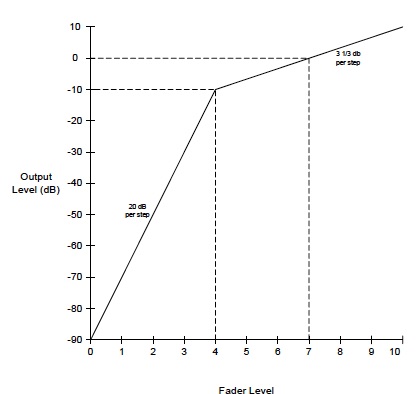
I wonder how many hear know of the "Dolby Fader Characteristic." That is, the digital faders try to simulate a log-taper analog fader using a 2-slope method (Harold can chime in if the USL products it was associated with followed suit).
 -

The hinge point is at "4.0". Below 4.0, the slope is MUCH steeper. From 0.0-4.0, you move from -90dB to -10dB (and 80dB change). From 4.0 to 7.0 you only move 10dB so doing some quick math, each 0.1 step is only .33 dB of difference (not much). Playing at 5.0 you are 5.67dB down. But the difference between 4.0 and 3.9 is much more drastic, that is a 2dB difference versus the mere .33dB difference between 4.0 and 4.1.

The point is that is bad to be hovering around the 4.0 point on a typical linear scale fader. Even on analog processors, the VCAs are not going to track very well down in that range from channel to channel.

For typical cinemas (not screening rooms or those prone to handle studio screenings), I'll target 82dBc for the main channels to build in a 3dB cushion (which is like lowering the fader to 6.1). This tends to keep the fader in the sweet spot of 5-7 for most of my customers.

I have also found that the better your speakers are, the better the acoustics of your room, the higher the volume can go without being offensive.

 |  IP: Logged

Jarod Reddig
Jedi Master Film Handler

Posts: 513
From: Hays, Ks
Registered: Jun 2011


 - posted 09-02-2019 05:21 PM      Profile for Jarod Reddig   Email Jarod Reddig   Send New Private Message       Edit/Delete Post 
Thanks for that graph Steve. Always wondered exactly how it "tracked" if you will. 4 to 3.9 wow.

 |  IP: Logged

Carsten Kurz
Film God

Posts: 4340
From: Cologne, NRW, Germany
Registered: Aug 2009


 - posted 09-02-2019 05:52 PM      Profile for Carsten Kurz   Email Carsten Kurz   Send New Private Message       Edit/Delete Post 
It's even more complicated than this. I always wondered why so many colleagues mention playing main features on their Dolby processors well below 5, and preshow below 4. While the typical setting on our (and other colleagues') Datasat AP20 is between 5.5 and 6.0.

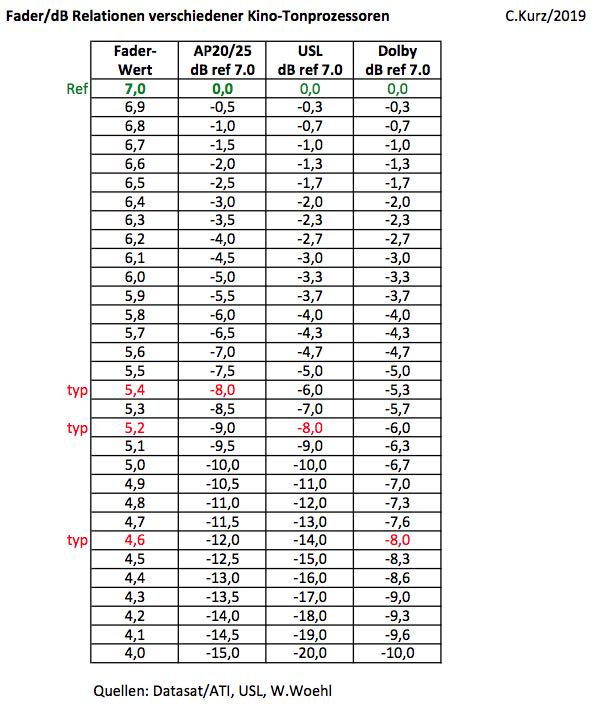
Well, recently I compiled this table, and marked 'our' typical main feature level (5.5, Datasat AP20) with it's actual attentuation figure (-8dB) against the same value of other processors. And immediately it becomes clear. With the same calibration setting performed at 7.0, a Dolby processor at 4.5 will output roughly the same level as the AP20 at 5.5.
 -

That image only shows the most interesting part, I have a full range Excel table if anyone is interested. Dolby here means CP650/750/850/950. The USL JSD80/JSD100 are somewhere between Datasat and Dolby, a bit closer to Datatsat. Which complies with a few other colleagues using JSD80/JSD100.
The USL JSD60 is somewhat special, as early firmware revisions apply the USL curve, while later ones (from 140723) emulate the Dolby curve. I think it would be good if all common processors used the same curve, as no one is playing at 7.0. I hope Dolby doesn't hold a patent on that curve ;-)

- Carsten

 |  IP: Logged

Marcel Birgelen
Film God

Posts: 3357
From: Maastricht, Limburg, Netherlands
Registered: Feb 2012


 - posted 09-02-2019 06:02 PM      Profile for Marcel Birgelen   Email Marcel Birgelen   Send New Private Message       Edit/Delete Post 
I do know about the Dolby fader curve. It's interesting to see Carsten's graph of other processors.

But even between Dolby models it might not be entirely consistent. I've checked the CP850 manual, but I couldn't find it. To me, it feels like the fader curve of the CP850 is less linear than that of the CP750, maybe the intention was to somewhat smooth the pretty hard transition point at 4.0?

 |  IP: Logged

Carsten Kurz
Film God

Posts: 4340
From: Cologne, NRW, Germany
Registered: Aug 2009


 - posted 09-02-2019 06:21 PM      Profile for Carsten Kurz   Email Carsten Kurz   Send New Private Message       Edit/Delete Post 
Well, there is a reason why there is that behaviour below 4.0. Dolby was free to choose anything beginning with the CP500. I am sure they don't believe that anything below 4.0 should be part of regular cinema operation. At some point well below reference, you want the volume to get down (or come up) quickly when turning the dial. And you want it to hit zero, -11, or infinity, whatever you call it.

- Carsten

 |  IP: Logged

Michael Kurtzke
Film Handler

Posts: 45
From: Ashburn, VA, USA
Registered: Feb 2013


 - posted 09-02-2019 06:31 PM      Profile for Michael Kurtzke   Email Michael Kurtzke   Send New Private Message       Edit/Delete Post 
quote: Carsten Kurz
I think it would be good if all common processors used the same curve, as no one is playing at 7.0.
I hate to be "that guy" but we play almost everything at 7.0, maybe 6.2 if it's poorly mixed.

In a well-tuned house, you shouldn't get many complaints. Sure, we get one every now and again (mainly from WB titles) but we tend to stick to 5.0 for Trailers and 7.0 for features.

On our QSC processors we do -6.0 and 0.0 respectively.

It can vary for repository titles. Some run hotter than others, like the latest Clue DCP. We ran that down at 4.5!

 -

 -

 |  IP: Logged

Carsten Kurz
Film God

Posts: 4340
From: Cologne, NRW, Germany
Registered: Aug 2009


 - posted 09-02-2019 06:39 PM      Profile for Carsten Kurz   Email Carsten Kurz   Send New Private Message       Edit/Delete Post 
On all ATMOS screenings I have attended so far, I got the impression that they were a bit on the soft side compared to what I experience from traditional 5.1/7.1 installations in similar auditoriums/chains, etc.

I am wondering wether ATMOS leaves some more headroom, or the room calibrations follows a slightly different scheme with it.

- Carsten

 |  IP: Logged


All times are Central (GMT -6:00)
This topic comprises 3 pages: 1  2  3 
 
   Close Topic    Move Topic    Delete Topic    next oldest topic   next newest topic
 - Printer-friendly view of this topic
Hop To:


Powered by Infopop Corporation
UBB.classicTM 6.3.1.2

The Film-Tech Forums are designed for various members related to the cinema industry to express their opinions, viewpoints and testimonials on various products, services and events based upon speculation, personal knowledge and factual information through use, therefore all views represented here allow no liability upon the publishers of this web site and the owners of said views assume no liability for any ill will resulting from these postings. The posts made here are for educational as well as entertainment purposes and as such anyone viewing this portion of the website must accept these views as statements of the author of that opinion and agrees to release the authors from any and all liability.

© 1999-2020 Film-Tech Cinema Systems, LLC. All rights reserved.