Film-Tech Cinema Systems
Film-Tech Forum ARCHIVE


my profile | my password | search | faq & rules | forum home
  next oldest topic   next newest topic
» Film-Tech Forum ARCHIVE   » Community   » Film-Yak   » Super-8 vs 16mm (Page 2)

 
This topic comprises 2 pages: 1  2 
 
Author Topic: Super-8 vs 16mm
John Pytlak
Film God

Posts: 9987
From: Rochester, NY 14650-1922
Registered: Jan 2000


 - posted 08-28-2002 07:46 AM      Profile for John Pytlak   Author's Homepage   Email John Pytlak   Send New Private Message       Edit/Delete Post 
Peter asked: "A quick (but tricky) technical question for John Pytlak as well. In a darkened room with a good 16mm projector (250 watt bulb) running a scope lens, how small/large an image should be projected to guarantee a 16 footlamberts result?"

Too many variables to answer:

How efficient is the illumination system of the projector?

What is the gain of the screen?

Most tungsten lamp 16mm projectors should be able to handle a screen up to about 2 metres wide with good illumination.

But it is best to actually measure the screen luminance:
http://www.kodak.com/US/en/motion/newsletters/pytlak/spring98.shtml
http://www.kodak.com/US/en/motion/newsletters/pytlak/march2000.shtml
http://www.kodak.com/US/en/motion/newsletters/pytlak/june2000.shtml

------------------
John P. Pytlak, Senior Technical Specialist
Worldwide Technical Services, Entertainment Imaging
Research Labs, Building 69, Room 7525A
Rochester, New York, 14650-1922 USA
Tel: +1 585 477 5325 Cell: +1 585 781 4036 Fax: +1 585 722 7243
e-mail: john.pytlak@kodak.com
Web site: http://www.kodak.com/go/motion

 |  IP: Logged

Leo Enticknap
Film God

Posts: 7474
From: Loma Linda, CA
Registered: Jul 2000


 - posted 08-28-2002 07:54 AM      Profile for Leo Enticknap   Author's Homepage   Email Leo Enticknap   Send New Private Message       Edit/Delete Post 
If 250 watts is regarded as 'good', then I'd imagine we're talking about halogen rather than tungsten. At one of the many fleapits I worked to keep myself alive as a student, we had two Hell & Bowell portables which were identical in every respect apart from the lamphouse - one was tungsten, the other halogen. The tungsten machine (with a separate reflector and condenser lens) had a 1kW bulb. The halogen projector, the lamps for which were a bulb and dichroic reflector in a single, disposable unit, used 250 watt bulbs.

Their light output was to the naked eye virtually identical, though as you'd expect, the colour temperature was radically different. I did once have to run a show with these two machines that included a changeover, and a customer remarked that it was a pity that the colour seemed to have faded so much during the last half of the film!

For what it's worth, I suspect that the reason why 50mm primes are shipped as standard is that 16mm portables were intended to be used in classrooms, training and conference situations rather than in homes. In this kind of environment you would typically want a throw of 5 to 10 metres rather than the 2 to 3 you have in a living room.


 |  IP: Logged

Bernard Tonks
Jedi Master Film Handler
Posts: 619
From: Cranleigh, Surrey, England
Registered: Apr 2001


 - posted 08-28-2002 09:29 AM      Profile for Bernard Tonks   Email Bernard Tonks   Send New Private Message       Edit/Delete Post 
When I converted my RCA Hollywood projector to 24 volt 250 watts from 240 volt 2000 watts, both type of light sources as Leo well described, the light output was considerable higher and much whiter. The screen was a Dulux brilliant matt white painted surface.

Peter,

I hope you will able to get a very good quality 25mm lens to double your picture width. With my 25’ throw I upgraded my standard 50mm lens for academy & scope. And purchased a good quality 37.5mm size lens for 1.85 wide.

My first projector was a Bell & Howell 631, had a variable aperture plate, which worked satisfactory on a masked screen. The RCA was much better though with the 1.85 aperture plate machined and fixed into a set of gate runners, I was able to file out the plate to fit precisely. Also a vast improvement with the RCA compared to the B & H was the extremely smooth optical framing adjustment by the claw movement.

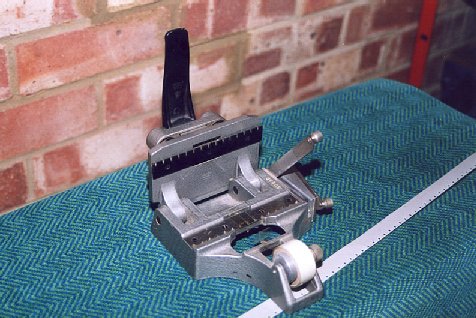
Here is a picture of the best type of Tape Film Splicer to look out for, made in Italy by CIR would be ideal for you. The special myler splicing tape you will need is 15mm in width. I didn’t bother doing a photo of my Rewinder as it is duel 16/35 which is geared ideal for 16mm 5000’ long play reels. You should be able to pick up a decent cheap small 16mm Rewinder just for 1600/2000 reels. Do check that the spool security clips are complete and sound though before you buy.


 |  IP: Logged

Leo Enticknap
Film God

Posts: 7474
From: Loma Linda, CA
Registered: Jul 2000


 - posted 08-28-2002 09:38 AM      Profile for Leo Enticknap   Author's Homepage   Email Leo Enticknap   Send New Private Message       Edit/Delete Post 
Locking flanges are for wussies! Just wear a suit of chain mail whenever you rewind a film, that'll do fine!

Very hard to get but very useful if you can get one is a variant of the 16mm CIR joiner in Bernard's picture which has a set of retractable pins on both edges of the film path, so you can tape over both sides without having to turn the film around horizontally.


 |  IP: Logged

John Pytlak
Film God

Posts: 9987
From: Rochester, NY 14650-1922
Registered: Jan 2000


 - posted 08-28-2002 10:07 AM      Profile for John Pytlak   Author's Homepage   Email John Pytlak   Send New Private Message       Edit/Delete Post 
I assumed a more efficient modern tungsten-halogen lamp with integral reflector.

Obviously, a xenon or metal-arc (Marc 300) lamp would be more efficient and a higher color temperature.

------------------
John P. Pytlak, Senior Technical Specialist
Worldwide Technical Services, Entertainment Imaging
Research Labs, Building 69, Room 7525A
Rochester, New York, 14650-1922 USA
Tel: +1 585 477 5325 Cell: +1 585 781 4036 Fax: +1 585 722 7243
e-mail: john.pytlak@kodak.com
Web site: http://www.kodak.com/go/motion


 |  IP: Logged

Brad Miller
Administrator

Posts: 17775
From: Plano, TX (36.2 miles NW of Rockwall)
Registered: May 99


 - posted 08-28-2002 01:32 PM      Profile for Brad Miller   Author's Homepage   Email Brad Miller       Edit/Delete Post 
Neumade makes an excellent 16mm "wrap around" splicer.

 |  IP: Logged

Peter Berrett
Jedi Master Film Handler

Posts: 602
From: Victoria, Australia
Registered: Nov 2000


 - posted 08-29-2002 12:58 AM      Profile for Peter Berrett   Author's Homepage   Email Peter Berrett   Send New Private Message       Edit/Delete Post 

Thanks everyone

In terms of splicing at least oen distributor I have spoken to has indicated that they prefer that home users don't do any splicing. They would prefer that the film was returned and they will fix it. However for any films I buy a splicer would be handy.

Thanks John and others for the technical help. One day when everything is set up I'll see if I can find someone with a light meter to come around to my place and measure the light output of my projector and how changing the size of the screen affects teh luminosity.

cheers Peter


 |  IP: Logged

Hillary Charles
Jedi Master Film Handler

Posts: 748
From: York, PA, USA
Registered: Feb 2001


 - posted 08-29-2002 08:03 AM      Profile for Hillary Charles   Email Hillary Charles   Send New Private Message       Edit/Delete Post 
There's a version of that CIR splicer that has adjustable pins on one side of the splice. It's very handy for making good butt splices on a film which has shrunken a bit.

 |  IP: Logged

John Pytlak
Film God

Posts: 9987
From: Rochester, NY 14650-1922
Registered: Jan 2000


 - posted 08-29-2002 08:21 AM      Profile for John Pytlak   Author's Homepage   Email John Pytlak   Send New Private Message       Edit/Delete Post 
Peter said: "Thanks John and others for the technical help. One day when everything is set up I'll see if I can find someone with a light meter to come around to my place and measure the light output of my projector and how changing the size of the screen affects teh luminosity."

For a given projector and lens, screen luminance is directly related to the image AREA. If you double the AREA, you halve the screen luminance. If you double the width (quadruple the AREA), you need four times more light from the projector.

------------------
John P. Pytlak, Senior Technical Specialist
Worldwide Technical Services, Entertainment Imaging
Research Labs, Building 69, Room 7525A
Rochester, New York, 14650-1922 USA
Tel: +1 585 477 5325 Cell: +1 585 781 4036 Fax: +1 585 722 7243
e-mail: john.pytlak@kodak.com
Web site: http://www.kodak.com/go/motion

 |  IP: Logged

Peter Berrett
Jedi Master Film Handler

Posts: 602
From: Victoria, Australia
Registered: Nov 2000


 - posted 08-30-2002 03:43 AM      Profile for Peter Berrett   Author's Homepage   Email Peter Berrett   Send New Private Message       Edit/Delete Post 

Thanks John

Can someone please explain to me a little about lenses. I have a 50mm lens - doe the 50mm refer to the width of the lens or the focal length? Also why will a 25mm lens give me twice the size picture?

cheers Peter

 |  IP: Logged

Bernard Tonks
Jedi Master Film Handler

Posts: 619
From: Cranleigh, Surrey, England
Registered: Apr 2001


 - posted 08-30-2002 05:56 AM      Profile for Bernard Tonks   Email Bernard Tonks   Send New Private Message       Edit/Delete Post 
Peter,

It is to do with focal length! A shorter focal length, will give the larger size picture. And the longer focal length, the smaller picture! to explain in easiest terms. A 25mm lens needs to be good quality as your picture is twice the size of your standard supplied 50mm lens.

 |  IP: Logged

Leo Enticknap
Film God

Posts: 7474
From: Loma Linda, CA
Registered: Jul 2000


 - posted 08-30-2002 06:19 AM      Profile for Leo Enticknap   Author's Homepage   Email Leo Enticknap   Send New Private Message       Edit/Delete Post 
Think of it like camera lenses in reverse. With a 50mm lens on your SLR, you'd need to stand about 6 feet away from the average car to get all of it in the picture. With a 28mm wide angle lens, you'd only need to be about 3 feet away.

 |  IP: Logged

Jeff Taylor
Jedi Master Film Handler

Posts: 601
From: Chatham, NJ/East Hampton, NY
Registered: Apr 2000


 - posted 09-03-2002 03:01 PM      Profile for Jeff Taylor   Email Jeff Taylor   Send New Private Message       Edit/Delete Post 
FWIW: I have a 20' throw for 16mm and use Eiki 350 watt xenons. I found that my best shot was an Eiki 38mm (1.5") prime lens with an Eiki .75-1.25 zoom adapter to take it down to roughly 30mm for flat. For scope I remove the zoom adapter and use the 38mm prime. I get just short of a 10' scope image, which is all my screen can take, and a 6' flat image. I know that zooms are supposedly less than perfect, but the image is terrific, and short of having a custom ground 30mm prime lens there was no way to accomplish what I needed to do. For those who are curious, Eiki charges $350 US for the 38mm lens new. I got my zoom and scope lenses from ebay for around $80 US each. In terms of light output, I find the Eiki "half brightness" switch position fine for flat films (+/- 12 amps), and generally use full brightness (+/-16 amps) only for scope films or really dense IB Tech prints. Overall, I think it's the rare home screening room that can live with the standard 2" lens.

 |  IP: Logged

Leo Enticknap
Film God

Posts: 7474
From: Loma Linda, CA
Registered: Jul 2000


 - posted 09-04-2002 02:38 AM      Profile for Leo Enticknap   Author's Homepage   Email Leo Enticknap   Send New Private Message       Edit/Delete Post 
AFAIK the only issue with zooms is that they absorb light like I absorb beer. If you have a slightly overpowered lamp to start with, then no problem.

A student film society I ran many years ago did exactly what you do (this being 35mm): on each projector we used one prime lens plus a Schneider zoom converter for 1.38, 1.66 and 1.85, and the prime plus an anamorph for 'scope. We had 2.6k lamps on a screen that I would guess was 25ft across in 'scope, so all we needed to do was to wind up the amps a bit to compensate for the zoom. Even then the lamp was well within limits and I honestly don't think it made a visible difference to the optical quality of the projection.

 |  IP: Logged


All times are Central (GMT -6:00)
This topic comprises 2 pages: 1  2 
 
   Close Topic    Move Topic    Delete Topic    next oldest topic   next newest topic
 - Printer-friendly view of this topic
Hop To:


Powered by Infopop Corporation
UBB.classicTM 6.3.1.2

The Film-Tech Forums are designed for various members related to the cinema industry to express their opinions, viewpoints and testimonials on various products, services and events based upon speculation, personal knowledge and factual information through use, therefore all views represented here allow no liability upon the publishers of this web site and the owners of said views assume no liability for any ill will resulting from these postings. The posts made here are for educational as well as entertainment purposes and as such anyone viewing this portion of the website must accept these views as statements of the author of that opinion and agrees to release the authors from any and all liability.

© 1999-2020 Film-Tech Cinema Systems, LLC. All rights reserved.