|
|
This topic comprises 3 pages: 1 2 3
|
|
Author
|
Topic: Passenger sets fire to paper on plane.
|
|
|
|
|
|
|
Stephen Furley
Film God

Posts: 3059
From: Coulsdon, Croydon, England
Registered: May 2002
|
 posted 09-23-2004 05:41 PM


quote: Leo Enticknap
I didn't know that John Huntley had died. Was this quite recent?
Last year, 7th August 2003 I think it was. He gave hs last film show in Croydon in March that year. He anounced that he was giving up six months previously. Various reasons were given, but I'm sure that John knew as well as everyone else that he did not have long to live. There was a gap, and then three final monthly shows in January to March. I didn't go to the final show; tickets had sold out in advance. The last show repeated the subjects of his first one; Croydon Airport, and the Crystal Palace.
Since John's death occasional shows have been given. His daughter, Amanda, has sometimes presented them in the past, but is not very happy about appearing in public. In the last couple of years John did not present most of the shows himself, due to his age, and deteriorating health. Three names were given as future presenters; Alan Willmott, Ex. British Transport Films, Rob Foxon, who gives similar shows, mainly in the Midlands, have both presented shows at Croydon this year. Both of these men are mainly interested in transport subjects; the third name was Andrew Youdell from the BFI; I assume he was included for hs interest in music, which was, of course, John's original involvment with film. It's interesting that John in his later years came to be known mainly as a transport historian, something that was always a secondary interest to him.
I sense that relations between John and the BFI thawed somewhat in his last few years, he did give a couple of shows at the NFT after a gap of many years.
John was a controversial figure, but a lot of material which survives in his archive probably would not have done so elsewhere.
| IP: Logged
|
|
|
|
Paul Mayer
Oh get out of it Melvin, before it pulls you under!

Posts: 3836
From: Albuquerque, NM
Registered: Feb 2000
|
posted 09-24-2004 11:59 AM

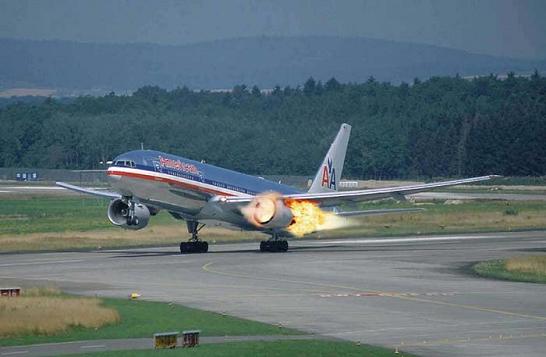
Nice shot Daryl! ![[thumbsup]](graemlins/thumbsup.gif)
Of course on a 767 in addition to the red-lit fire handle, you get a master warning light, an additional fire light, a text warning message on the EICAS, and an annoyingly loud bell audio. Makes you think they're trying to tell you something.
Turbine engine fires are non-events now. Sure it's exciting for the passengers, but for the pilots (especially on any of today's twin jets) it's a yawner. If you're already past V1, you don't do nuthin' while continuing the climb to 1000' AGL and simultaneously hunting for the button that will silence that stupid bell. Set TOGA power on the other engine if it's not already there. Maybe trim in some rudder while waiting for 1000' to show up. At a 1000' pull and twist the fire handle (there goes the galley power--and I was so looking forward to that first cup of hot coffee after the level off dammit!), run the engine fire checklist, notify ATC and dispatch, and plan to return to the departure airport. Brief the cabin attendants so they can calm and prep the by now screaming self-loading cargo. May have to dump some fuel too. No big deal. You do it in the simulator every six months until the day you stop flying. ![[sleep]](graemlins/sleep.gif)
Piston twin pilots may have to do all that a little quicker since they will more than likely never make it to 1000' before the remaining engine delivers them to the crash site. And single-engine pilots really do have to hustle. ![[evil]](graemlins/evil.gif)
But a fire anywhere in the fuselage... Now that gets the juices flowing! Of course there are Halon systems or airtight compartments to deal with fire below the cabin and fire extinguishers for use in the cabin, but in many cases those have proved to be inadequate. Obviously there are many ways to die in an airplane; burning alive or slowly suffocating while trying to get a disintegrating machine back on the ground has got to be one of the worst.
[ 09-24-2004, 01:01 PM: Message edited by: Paul Mayer ]
| IP: Logged
|
|
|
|
Paul Mayer
Oh get out of it Melvin, before it pulls you under!
Posts: 3836
From: Albuquerque, NM
Registered: Feb 2000
|
posted 09-24-2004 01:49 PM
Leo, was it one of these?

If so, it's a DHC-8-311 "Dash 8." Not to worry--turbine engines! America West used to fly them in and out of the Grand Canyon here. Made by De Havilland Canada (now Bombardier). Good airplane.
Sounds like you rode through a standard go-around (Yank term, in the UK I think it's called an overshoot). Yes, the sensation can be a bit disconcerting. At least nowadays the conditions allowing a descent below the decision height (DH) during an approach are very clearly spelled out in the regulations. In the old days one only needed to have the "runway environment" in sight to continue below the DH. In my case that meant that if I could see only the Proud Bird restaurant sign through the fog near the corner of Aviation and Imperial Highway, I could continue on below the DH to runway 25L at LAX, knowing that the threshold was but a mere half-mile further along on a magnetic heading of 255 degrees or so. Restaurant and gas station signs are no longer on the list of approved things to see at DH. ![[Smile]](smile.gif)
As to airplane appearances, the late great Paul Thompson once observed:
quote:
If it's ugly, it's British; if it's weird, it's French; and if it's ugly and weird, it's Russian.
Wonder where Canadian planes fit on that continuum? ![[Big Grin]](biggrin.gif)
| IP: Logged
|
|
Leo Enticknap
Film God

Posts: 7474
From: Loma Linda, CA
Registered: Jul 2000
|
posted 09-24-2004 03:25 PM
Yes, that was it alright.
Point taken about how it was standard, but it felt pretty scary nonetheless. Very glad to hear that it isn't a plane which dooms its 'walking cargo' should one engine fail during takeoff! Before last week's trip I'd only once flown on anything smaller than a 737 (this was something called a 'Twin Otter', taking off from the beach on the Isle of Barra), and the approach to Plymouth was a bit dramatic. The pilot said on the Tannoy that he thought an attempt to land was a bit of a lost cause, given the very low cloud, and that we'd probably end up diverting to Exeter (which was what eventually happened). This surprised me a little, because I thought that modern radio beacons, GPS etc. allowed any passenger plane to land at any airport in practically any weather short of a hurricane. When, on our way down, the cloud cleared and I saw the roof of a college next to the airport, it was obvious that the rate of descent had gone fine - the only problem was that we were flying parallel to the runway but about 300 yards to the side of it. I guess that the pilot realised this a second or two later than I did because the plane was pitching slightly up at the time and so presumably, he had a restricted view (i.e. upwards) out of the cockpit. But it was a bit of a shock to find out that they still rely on what they can see out of the window to approach and land - naively, I thought that a lot of that was automated now.
Incidentally, here is a picture I took of the Mayflower Steps in Plymouth, about an hour after we arrived by bus from the diverted landing (the weather, apparently, had actually improved slightly in the meantime!):
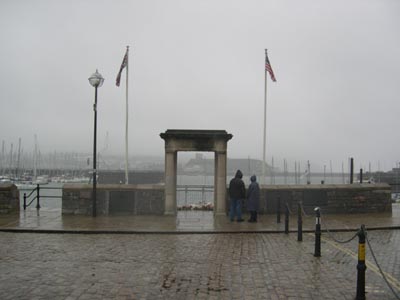
As you can see from the cloud mist covering even the masts of the boats, the weather was absolutely shite. No wonder a 'visual' landing in conditions like that was impossible (the airport is about 6 miles from where this pic was taken).
And this was where I went to warm up immediately afterwards...
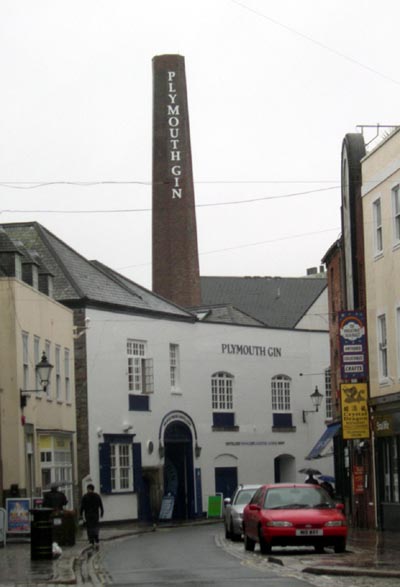
Ironically, this is the building in which the Pilgrim Fathers spent their last night in England before boarding the Mayflower. Needless to say, it wasn't a distillery at the time!
| IP: Logged
|
|
Daryl C. W. O'Shea
Film God

Posts: 3977
From: Midland Ontario Canada (where Panavision & IMAX lenses come from)
Registered: Jun 2002
|
posted 09-24-2004 03:53 PM
Paul, even though I've heard it all before, I laughed my ass off. Please stop, the pain from laughing with pneumonia is killing me.
Now what were ya sayin' 'bout dem dare kinadean planes dare, eh?
Leo, Paul's got it all wrong. It's only called a go-around when you know where the runway is. Otherwise it's called a wildlife study.
As for aircraft that can basically land themselves in absolute zero visibility, there are some, such as many of the Airbuses, etc., but there are fewer that can than there are that can't. There are very few commuter jets that can do this.
Now, if you've never auto-landed in zero-vis in an A-318, preferrably in heavy lightning , you haven't lived. There's nothing like having the computer switching the turbines over to full reverse thrust a second before you hit the runway. In such a 'small' aircraft (typ. 107 passenger & 103' long) you really get to feel it... especially when your head is planted on the seat in front of you as you and the 50+ ton aircraft stop in literally only hundreds of feet so that you can clear the active as quickly as possible.
| IP: Logged
|
|
Paul Mayer
Oh get out of it Melvin, before it pulls you under!
Posts: 3836
From: Albuquerque, NM
Registered: Feb 2000
|
posted 09-24-2004 04:20 PM
Daryl overlapped me here so I'll edit a bit. Get well Daryl! I've never had pneumonia but from what I've heard I'm glad for that.
Because of the additional certification expense (each runway, plane, and flight crew must be specially certified) one usually sees autoland capability only at the busiest airports, and then only those where low visibility is commonplace. For example London Heathrow has runways that are certified down to Category IIIc, allowing for landing in zero-zero (no ceiling and no visibility) conditions. For those not so equipped, every instrument approach must at some point become a visual landing. The only difference between the various instrument approaches available is where the transition to visual flying takes place. BTW the Hawker-Siddeley Trident was the first airliner to fly automated landings in routine service. Airbuses just make it more exciting--Daryl's description sounds like a typical navy pilot landing.
The DHC-6 Twin Otter is my favorite. Not pretty, not fast, not quiet inside, not pressurized. But it is simple, extremely tough, and very reliable. It will carry anything one can fit through the door--even pairs of Motiograph pedestals. ![[Eek!]](eek.gif) It's easy to fly and easy to work on--the perfect aircraft for bush or tundra flying. My old F-T pic was taken in the cockpit of one. It's easy to fly and easy to work on--the perfect aircraft for bush or tundra flying. My old F-T pic was taken in the cockpit of one.
Leo, I wish I still had my airline IDs. That distillery does look warm and inviting, the perfect destination for a jumpseat (i.e. free) trip. Anyone for a Film-Tech UK Drink? ![[beer]](graemlins/beer.gif)
[ 10-30-2005, 01:54 AM: Message edited by: Paul Mayer ]
| IP: Logged
|
|
|
|
|
|
Paul Mayer
Oh get out of it Melvin, before it pulls you under!
Posts: 3836
From: Albuquerque, NM
Registered: Feb 2000
|
posted 09-24-2004 08:13 PM
Scott, I think it mostly depends on the avionics (and of course how much money you want to spend). So just about any Cat III-certified aircraft can be certified for autoland if you have the avionics (key items would be the existence of approved autothrottle, autobrake, and runway centerline guidance systems for the aircraft). To meet Cat III requirements the aircraft itself has to have certain low-speed handling qualities at the maximum landing gross weight (especially in regards to pitch sensitivity to power changes). I imagine there are some aircraft types that can't be certified for Cat III or autoland due to this requirement.
There are also heads up display systems out there that allow hand-flown (as opposed to autopilot) approaches to at least Cat IIIb minimums. PSA had some of their MD-80s and I think B-727s equipped that way since they used to fly high-frequency schedules into foggy LAX, SAN, SFO and OAK.
Can't seem to find a definitive list of autoland approved aircraft types. Yes, the L-1011 came from the factory that way, and so does the B-747-400 apparently. And I think all of the fly-by-wire Airbuses (A.318 and up) can come that way too. FAA Advisory Circular AC 120-28 lists some examples but I'm sure it's not a complete list: A.300, B-747, B-757, B-767, DC-10. I know the B-737 (300 series and up), B-777, and MD-11 can come that way.
Many airlines don't bother to certify to Cat IIIc minimums even if the aircraft is so equipped. With Cat IIIc it is possible to land with absolutely no visibility. Once you come to a stop on the runway you can't see enough to taxi to the gate! Consequently the runway has to be shutdown until the ground guys can grope their way out through the soup to find and drag your Cat IIIc-certified butt in with a tractor.
Daryl, my first jumpseat ride was under similar secrecy conditions many years ago. ![[Wink]](wink.gif) A late night ride in an empty B-727-200 from LAS to YUM and back watching a training captain give a couple of newly upgraded F/Os their required landings prior to a checkride. Touch-and-gos, steep turns, approaches to stalls (just to the stick-shaker), engine-out approaches, missed approaches, raw-data approaches--all stuff they do in that infernal bungee-cord-and-bellows-hell-box now. It was a night I will never forget. A late night ride in an empty B-727-200 from LAS to YUM and back watching a training captain give a couple of newly upgraded F/Os their required landings prior to a checkride. Touch-and-gos, steep turns, approaches to stalls (just to the stick-shaker), engine-out approaches, missed approaches, raw-data approaches--all stuff they do in that infernal bungee-cord-and-bellows-hell-box now. It was a night I will never forget.
| IP: Logged
|
|
Stephen Furley
Film God
Posts: 3059
From: Coulsdon, Croydon, England
Registered: May 2002
|
posted 09-25-2004 03:47 AM
quote: Leo Enticknap
Throughout its year in regular transatlantic service, the Hindenburg regularly carried nitrate film as cargo
Ok, let's make a post that brings together several themes from ths post; aircraft fires, smoking, nitrate film, John Huntly and British Technicolor films.
Leo, back in the days when Charles Beddow was the chief at the NFT, they used to tell the story of a nitrate fire they had, sometime in the '70s I think. The story was that a print was brought in for a festival, and was not delivered in advance, but was brought in at the time of the screening and delvered in person. There was not time to inspect the film as thoroughly as would nrmally be done, and it was not realised that it was nitrate, and therefore the normal precautions were not taken. The film ignited during projecton, and the full burned. The story was that the print had been brought over n cabn baggage on a passenger flght. Was thiis story still being told when you were at the NFT, and do you know if there is any truth in it?
The NFT would still have been running nitrate quite frequently at that time, and it seems unlikely that anyone handling film there wouldn't have checked anything that was old enough to have possibly been nitrate before screening it without the precautions which were normally taken with nitrate prints. There was a nitrate fire at the NFT during this period, this is on record in several places, and there used to still be some visible evidence of it in the box of NFT 1 at around the tiime when the Kalee 20s pointing the other way into the original NFT 3 were removed.
As for bringing a print over in cabin baggage, in those days people didn't take the very large bags with them that they do today, some of the thiings which you see being lifted into the overhead lockers are larger than the suitcase that I take with me! I doubt that most features would fit in the luggage taken on board in those days, but a short would, or I suppose two passengers could split the reels between them. I would hope that nobody would knowingly transport nitrate prnt in this way, and that anybody responsible for the prnt would have been aware that it was nitrate, and ensured that it was suitably packed and labeled etc., not just gven to somebody to take on the plane wth them. Was there really any truth in this story, or were they just trying to scare people?
Another story was printed in the magazne of either the Cinema Theatre Association, or the Projected Picture Trust some years ago, and did seem to be genuine. Ths one concerned the shipment of a large batch of scrap film, around the time of the First World War. Old flm was used at that time to make dope for aircraft fabric. The film was to be transported in metal-lined wooden cases, which were sealed by soldering. This does sound strange, I'm not sure if they mean the cases were totally sealed, or if this was just a seal to prevent tampering, and there was ventilation elsewhere in the cases. This was realised to be a hazadous process, and a suitable expert was brought in to carry it out. Despite his experience, something went wrong, and he died in the fire.
Would I want to be flying around in an aircraft built of wood, fabric and nitrate with people firing guns at me? It's a tough queston; I'll have to thnk about that one.
To return to John Huntley, he led an interesting life; ths is what the Huntley Achhves web siite has to say about him.
"John Huntley ...
John Huntley was born in Kew, Surrey in 1921. He left school in 1937 with five 'O' levels, and began his first job as a junior clerk in an insurance company - The Employers Liability Assurance Corporation. He remained there for two years until, in 1939, he was given a job as a teaboy at Denham studios, under Alexander Korda. John had always enjoyed films, often going to the cinema two or three times a week, sometimes to see the same programme, but when the outbreak of war caused the larger part of Denham to be closed down, his contract ended after only eighteen months, and it almost seemed that his opportunity to work in the industry had disappeared.
In 1940, John joined the Royal Air Force as a wireless operator / mechanic for the RAF Army co-operative Command. Later, in 1943, he joined Bomber Command as a wireless airgunner, then in 1944 he moved on to Coastal Command. It was here, however, that he found the chance to further his interest in movies, as he started to work as a lecturer and camp projectionist, showing educational films. He also put on entertainment programmes, and travelled around showing these at different camp cinemas.
John also began to write for the RAF journals, which included the occasional film review. He started to write for various periodicals, including Sight and Sound and later wrote for the Penguin Film Reviews. In 1944 he began work with the American Film Music Bulletin as their British correspondent, and continued writing for them until 1950. It was also during these years that he began writing his first book, British Film Music which was later published in 1947.
Following the end of the war, John was offered a position with the J. Arthur Rank Organisation at the re-established Denham and Pinewood Studios. He worked as a music and sound technician with Muir Mathieson, who had realised John's enthusiasm for film music through his writing and publications. He worked on many famous movies such as Hamlet, A Matter of Life and Death, David Lean's Oliver Twist, and The Red Shoes among others. With access to the other departments at the studios, John's interest in film developed further as he wrote his second book - British Technicolor Films - published in 1949. Unfortunately, however, with the collapse of the Rank organisation in 1950, the music department was disbanded, and the employees went their separate ways.
In 1951, John worked as part of the technical team - Telekinema - who organised the film contribution for the Festival of Britain. Telekinema became the original National Film Theatre, and John worked as a Programme Director for two years. During that time, one notable project was the revival of Buster Keaton's career in Britain. A contact from Cinematheque Francais saw Buster Keaton performing in a Paris circus, and having found copies of The Navigator and The General in the French archives, he was brought over with his movies, and re-introduced to the British public.
John's association with the British Film Institute came in 1952, through his work with the NFT. During the twenty-three years that he was there he worked in many positions, beginning as Programming Officer. He continued to present large scale film shows and festivals at venues such as The Royal Festival Hall and The Barbican, on topics ranging from transport to ballet. From 1966 he was involved in opening regional film theatres, and when he left in 1974, John was the Head of the Regional Unit of the BFI, and thirty-five theatres had been opened throughout the country.
During this time, John continued contributing to various journals and publications and wrote a further three books: The Technique of Film Music (with Roger Manvell), Railways in the Cinema and How Films are Made (with Stanley Reed). He also became very involved with the broadcasting world, producing and presenting many television programmes, including Clapperboard (co-presented with Chris Kelly, directed by Graham Murray) for Granada, Bygones and Bioscope Bygones for Anglia and Attic Archives for the BBC. He also began a long association with the world of radio, speaking as an expert on various aspects of film and conducting interviews.
When he left the BFI in 1974, John worked as a theatrical agent with Richard Jackson Personnel Management. He continued to present film shows, and to add to his collection of movies, primarily on the subject of transport, but then growing to encompass all topics and periods. In 1985, he and his daughter Amanda decided to set up Huntley Film Archives, and so the company as it is today was first established. The Archive continues to grow, and moved to its current premises in 1994.
Although heavily involved with the day to day running of the Archive, John still finds time to make radio and television broadcasts and appearances, such as Much Ado About Shakespeare and The History of British Film Studios for Radio Four, a film star series for Radio Two and The Train Now Departing. He also recently featured in the BBC's Leisure Hour. He has researched, written and presented numerous videos with Peter Middleton (producer - Video 125) on the history of transport. John updated Railways in the Cinema, and Railways on the Screen, which includes listings of steam on television, was published in 1993"
John presented many television programmes, including a very early schools television programme for the BBC about the recordiing of the musical score for 'Hobson's Choice', a print of which still survives in his archive. The use of television in schools was rare at that time.
Unsurprisngly, there is no mention of the later dspute between John and the BFI, though it is mentioned in the lengthly obituary to him which was printed in the Guardian newspaper.
I visted the Archve a couple of times, once with somebody who was collecting some material for a show; one of the required prints couldn't be found. There were piles of flm cans lying around everywhere, seemingly in no particular order, and John was frantically searching through them, sayng, in his usual loud and somewhat gruff voice, 'I know it's here somewhere'!
Some of John's actiivities activities in the past may have been questionable, he was much better at simply acquring large amounts of film than he was at running an archive, or indeed running any other sort of business, I know people working in television production who were frustrated at sometmes havng to wait for months to be billed for material they had used, so they could tie up the accounts on a production. He did however collect a great deal of materal that would not otherwise have survived. Film produced for training or publcity purposes, for example, which had long ceased to serve its original purpose, but which was not at the time old enough to be seen as having any hstorical value, has survived because John took it into his private film collection, whch later became the archive.
John had largely retired from the running of the archive several years ago, but he did still have some involvement until the end. The last time I saw him was a few months before his death, sitting reading a book as I passed by on a bus.
| IP: Logged
|
|
|
|
All times are Central (GMT -6:00)
|
This topic comprises 3 pages: 1 2 3
|
Powered by Infopop Corporation
UBB.classicTM
6.3.1.2
The Film-Tech Forums are designed for various members related to the cinema industry to express their opinions, viewpoints and testimonials on various products, services and events based upon speculation, personal knowledge and factual information through use, therefore all views represented here allow no liability upon the publishers of this web site and the owners of said views assume no liability for any ill will resulting from these postings. The posts made here are for educational as well as entertainment purposes and as such anyone viewing this portion of the website must accept these views as statements of the author of that opinion
and agrees to release the authors from any and all liability.
|

 Home
Home





 Printer-friendly view of this topic