|
|
This topic comprises 3 pages: 1 2 3
|
|
Author
|
Topic: Trivia question - what does VHS stand for?
|
|
|
|
|
|
|
|
|
Monte L Fullmer
Film God

Posts: 8367
From: Nampa, Idaho, USA
Registered: Nov 2004
|
 posted 02-23-2005 05:15 AM


quote: Marc Hansen
The first JVC beat them by a couple of months but was 2 hours only and did not use off-azmith recording
...wasn't that the JVC HB-3300 "VidStar" machine - the one with the dual rotary tuning dials to the right of the cassette loading door - the picture below?
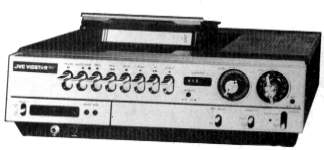
Being a single speed (SP) unit, didn't the VidStar also have a larger "write" area on the tape being that the heads were larger in surface area, thus having more lines of resolution, or just more clarity than the later 2 and 3 speed units of all of the other manufacturers?
I have a Magnavox(Panasonic) VR-8417 that I purchased back in 1984 - one of the first HiFi units to be released. Just a 4 head-2 video and 2 audio. Unit setup is included as an audio recorder along with video, with VU's, input slider adjustments, Dolby "B" encoding for the linear track, and of course dBx "sound exander" configuration for the HiFi FM recording.
Only thing I had to replace is the mode switch, and that was about 7 yrs ago.
Can't find these kind of recorders anymore.
-thx Monte
| IP: Logged
|
|
|
|
|
|
|
|
|
|
|
|
|
|
Paul Mayer
Oh get out of it Melvin, before it pulls you under!

Posts: 3836
From: Albuquerque, NM
Registered: Feb 2000
|
posted 02-26-2005 08:37 PM

"Baseband" just means any signal that can modulate a carrier. In the case of video, baseband refers to the video signal prior to the input of an RF modulator or transmitter.
Video tape recorders modulate an FM carrier with the baseband video signal. The FM RF signal is what is actually recorded onto the tape. On quad machines there were several sets of FM carrier frequencies used to represent the sync tips, blanking level, and peak whites of the video signal:
Low-band mono: Sync tip 4.28 MHz, blanking 5 MHz, 100IRE 6.8 MHz.
Low-band color: Sync tip 5.5 MHz, blanking 5.79 MHz, 100IRE 6.5 MHz.
High-band: Sync tip 7.06 MHz, blanking 7.9 MHz, 100IRE 10 MHz.
High-band performance was good enough that it was adopted as the modulation standard for Type C when it came along. Most quad machines were eventually upgraded to high-band capability. Due to their lower tape writing speeds, helical consumer and U-Matic machines don't have the frequency response needed to handle the high end of these carrier frequency sets (where the color information is)--that's why they adopted JVC's color-under modulation scheme.
| IP: Logged
|
|
|
|
|
|
|
|
|
|
All times are Central (GMT -6:00)
|
This topic comprises 3 pages: 1 2 3
|
Powered by Infopop Corporation
UBB.classicTM
6.3.1.2
The Film-Tech Forums are designed for various members related to the cinema industry to express their opinions, viewpoints and testimonials on various products, services and events based upon speculation, personal knowledge and factual information through use, therefore all views represented here allow no liability upon the publishers of this web site and the owners of said views assume no liability for any ill will resulting from these postings. The posts made here are for educational as well as entertainment purposes and as such anyone viewing this portion of the website must accept these views as statements of the author of that opinion
and agrees to release the authors from any and all liability.
|

 Home
Home












 Printer-friendly view of this topic