|
|
This topic comprises 4 pages: 1 2 3 4
|
|
Author
|
Topic: Incandescent light bulbs rule.
|
|
|
|
|
Evans A Criswell
Phenomenal Film Handler

Posts: 1579
From: Huntsville, AL, USA
Registered: Mar 2000
|
 posted 12-03-2007 03:54 PM


I've bought GE "soft white" compact fluorescents that are 26W and supposedly put out the light of a 100W incandscent. The color is nearly indistinguishable from an incandescent, although I've been to friends' houses and they'd have other brands that had terrible harsh colors.
As for tube fluorescents, I'm seeing more and more T8's. F32T8's have taken over in 4-foot fixtures. The color rendition is superior to the old cool-whites and the bulbs don't lose their brightness over time to the degree that the old F40T12s did. You get almost as much light as the 40W T12 with the 32W T8, and it's a more pleasing light. The T8s come on instantly (many are actually run on instant start ballasts) and will work in low temperatures, and are run at higher frequencies and are totally silent! The ballasts are more efficient so there is less power overhead in running the bulbs.
I'm also seeing more and more T8s being used in 8-foot fixtures. The 86 watt 96-inch T8 is probably going to replace the old standby 110W T12 8-footer for high-output fixtures eventually. As before, excellent color rendition and more lumens-per-watt.
By the way, "slimline" does not necessarily mean T8, but refers to the "cold cathode" variety of instant-start fluorescent, which have a single pin on the end, the most common of which is the 96-inch 75 watt T12.
| IP: Logged
|
|
Frank Angel
Film God

Posts: 5305
From: Brooklyn NY USA
Registered: Dec 1999
|
posted 12-03-2007 05:48 PM
I needed to install an indication light up in the 5th floor rewind room so that when the camera system was that is located up there is turned ON or OFF from the stage via an X10 telco responder (stage manager calls up the X10 unit and gives it the appropriate command) to power the camera and associated electronics equipement. This system sends a video signal of what was going on on the stage to the monitors in the lobbies.
I needed the stage manager to be able to look up at the booth and verify if the system had actually turned ON or OFF -- the X10 in our building is only about 90% reliable due to dirty AC we have to live with.
I figured I need indication that is only a very small pin-point of light so as not to spill all over the place, but bright enough to be seen 150ft way, and very directional. AND, it is in a place that is very difficult to get to -- it is on the outside of the booth wall and the camera and port glass need to be removed in order to change whatever pilot light I might decide to use. I figured using LEDs which I thought would have a lifespan that would outlast me, in place of incanies, seemed to be a brilliant idea....on paper. Green LEDs....how cool is that.
I chose this:
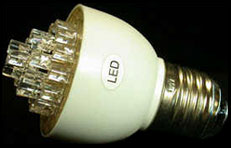 Direct Replacement High Intensity LEDs - Green Direct Replacement High Intensity LEDs - Green
Long life? In actuality, the first one went dead in about a year (in real-time use -- probably only about 300 hours). I figured it was just a fluke. Second one went dead not even 100 hours.
I did my usual ranting to my collegue, our lighting director, who, come to find out, had been using exactly the same LED unit but in red. He needed a "spotting light" for ballet dancers (they need a pinpoint to look at when they spin or something or other happens to them....they spin off the stage or something, not sure what exactly) and he had the same experience -- you just look at the damn things and they blow out. Evedently they are very intolerant of any aberations on the electrical line. Turn them upside down and they self-distruct from their own ballast heat.
In this case, the ole incandescant pilot bulb beat the high-tech LED "bulb" hands down.
| IP: Logged
|
|
Bobby Henderson
"Ask me about Trajan."

Posts: 10973
From: Lawton, OK, USA
Registered: Apr 2001
|
posted 12-03-2007 08:10 PM
quote: Evans A Criswell
I'm also seeing more and more T8s being used in 8-foot fixtures. The 86 watt 96-inch T8 is probably going to replace the old standby 110W T12 8-footer for high-output fixtures eventually. As before, excellent color rendition and more lumens-per-watt.
In general office use, I can see T8s and other "slimline" lamps getting more and more use.
Although the color rendition of these 4000K-4500K standard T8 lamps may be "excellent," the light they put out is still a little too yellow and dingy looking for my purposes (lighting up electrical sign cabinets with back-lighted faces).
Some 6500K "daylight" rated T8 lamps do exist. But they're usually very expensive and run at higher wattage levels. A standard F96T12D/HO lamp runs on 110W and costs several bucks. The 6500K T8 may run at 192W and cost several times the price per lamp.
If bulb manufacturers can deliver high output slimline lamps that emit 6500K color and do so within 110W I'll be excited (especially if the price is comparable to a standard T12D/HO. Building mounted "box" style sign cabinets with back-lit Lexan or Acrylic faces can look very clunky when their cabinet depths exceed 12" or more. Go too narrow and you'll see lamp hotspots through the sign face. It's possible to run a bunch of slimline lamps in a really narrow sign cabinet or light box and have a very even spread of light. But that color temperature really needs to get closer to the 6500K level to make most back-lighted graphics look really good.
quote: Frank Angel
Long life? In actuality, the first one went dead in about a year (in real-time use -- probably only about 300 hours). I figured it was just a fluke. Second one went dead not even 100 hours.
LEDs aren't perfect, but LED-based light fixtures have definitely improved a great deal over the years.
One thing I have to ask about that LED light is, "who made the LEDs?"
General Electric is widely regarded to make the highest quality, most dependable LEDs. Phillips also makes good quality LEDs. Many LED-based fixtures do not use higher quality American or European LEDs. Many use cheaper, less reliable components made in China. This is a really critical issue when it comes to products that use a lot of LEDs, such as electronic variable message center signs.
A good quality, high intensity LED should have a lifespan of at least 100,000 hours of use at full power. The problem is other components in that lighting fixture or complex display system are not going to last nearly that long without failure. Anyone who drives past a LED-based billboard has probably seen the thing with a flaky driver board at some time or another.
| IP: Logged
|
|
|
|
|
|
|
|
|
|
|
|
All times are Central (GMT -6:00)
|
This topic comprises 4 pages: 1 2 3 4
|
Powered by Infopop Corporation
UBB.classicTM
6.3.1.2
The Film-Tech Forums are designed for various members related to the cinema industry to express their opinions, viewpoints and testimonials on various products, services and events based upon speculation, personal knowledge and factual information through use, therefore all views represented here allow no liability upon the publishers of this web site and the owners of said views assume no liability for any ill will resulting from these postings. The posts made here are for educational as well as entertainment purposes and as such anyone viewing this portion of the website must accept these views as statements of the author of that opinion
and agrees to release the authors from any and all liability.
|

 Home
Home



![[Wink]](wink.gif)





 Printer-friendly view of this topic