|
|
This topic comprises 3 pages: 1 2 3
|
|
Author
|
Topic: Wife wants an airplane
|
|
|
Leo Enticknap
Film God

Posts: 7474
From: Loma Linda, CA
Registered: Jul 2000
|
 posted 10-12-2012 02:41 AM


quote: Mike Blakesley
Then an hour or two later we were over the mountains of western Montana. Not a farm, field or road in sight. I could see Tom was looking around and seeming kind of nervous, so I said "what's the matter?" He said "You know what? If the engine was to quit right now...we're fucked."
Reminds me of the joke about the Irish jumbo jet, en route across the Atlantic. About halfway over the ocean, one of the engines breaks down. The captain gets on the PA: "Ladies and gentlemen, this is your captain speaking. You may have noticed that one of our engines stopped working just now. That's a bit annoying, but it's nothing to worry about - after all, we have another three. But it does mean that we've slowed down a bit, and will be a little late in to New York'. Unconcerned, the passengers continued knocking back their Guinness and Black Bush, and the flight continued. But a few hundred miles further on, another engine broke down. "This is Captain O'Muckerty again. I'm really sorry about this, but we've lost another engine. There's nothing to be alarmed about, but I'm afraid that the delay will be quite a serious one." A little while later, out goes engine no. 3. Captain: "The other one had better not stop, or else we'll be stuck up here all bloody day!".
| IP: Logged
|
|
|
|
Jack Ondracek
Film God

Posts: 2348
From: Port Orchard, WA, USA
Registered: Oct 2002
|
posted 10-12-2012 09:14 AM
quote:
I wouldn't ever try to freighten my wife in an airplane.
What I meant to convey was, instead of the standard airplane ride where you just get to fly over your house, she gets to go out to the practice area and maybe fly the plane for a few minutes.
I took lessons at that business, many years ago. While I don't remember all the people who worked there, personally, I certainly know the business and the kind of people who run it. They're good people. If I explain what I want, ask nicely and tip the guy a few bucks, they'll certainly do that.
If my wife ever got wind of the fact that I paid the guy off to give her a rough ride, she'd divorce my ass for sure!
Two things would come to my mind. In the first place, anyone who would act like a jackass on an introductory flight would not be someone I'd want to fly with at all. Every year, I participate in 4 or 5 events that give kids their first airplane rides (Young Eagles). For a lot of these kids, the only thing that gets them in the plane is peer pressure and their first impression of you as their short-term guardian. In a lot of ways, it's no different for adults. What responsible person would risk scaring someone away from flying for the sake of a couple of stupid maneuvers?
On your comment regarding your wife getting to "fly" the plane: That's fairly common on introductory flights, if the pilot senses your wife is open to it. Once you're in the air, flying is really simple. In many planes, two fingers on the "wheel" is all it takes to keep it straight & level. A couple of minutes "in control" is all it takes for a lot of people to look forward to their next flight.
quote: Mike Blakesley
I could see Tom was looking around and seeming kind of nervous, so I said "what's the matter?" He said "You know what? If the engine was to quit right now...we're fucked."
Yah... The hard-nosed pilot would probably point to that as a lack of planning, if your brother in-law was truly nervous about the situation. Over here, we're between a couple of mountain ranges. Some are comfortable, flying right over the top of them. For me, with a single-engine plane, I prefer to fly through the passes. For one, the altitude requirements are different. Also, there's a 4-lane freeway under me, if something bad was to happen. My flight isn't such a straight line in a case like this, but each pilot has to judge what's the safest way to fly, and for me, that's it.
| IP: Logged
|
|
Scott Norwood
Film God

Posts: 8146
From: Boston, MA. USA (1774.21 miles northeast of Dallas)
Registered: Jun 99
|
posted 10-12-2012 11:42 AM
quote: Jack Ondracek
In many planes, two fingers on the "wheel" is all it takes to keep it straight & level.
Does this only apply to light planes?
I ask this because I once had a chance to "fly" a DC-9 simulator (in the early '90s, as a teenager, at the Northwest Airlines training facility...long story). Anyway, it was a fun experience...sort of the greatest video game ever designed...and I got to take off, circle the airport, and land, while being guided by a real pilot. For me, flying straight and level was the hardest part, mostly because there is a delay between the control inputs and their actual effect on the aircraft's position. The takeoff and landing, by contrast, were fairly straightforward (mostly because there was a pilot right behind me to tell me what to do). The autopilot did a good job of flying straight-and-level, but that's all that it does in a DC-9; the landing and navigation still need to be done manually. Newer planes have more automation.
I'm guessing that a Piper or Cessna is a bit easier to fly than a full-size commercial jet, but now I'm curious. I think that the smallest plane that I have been in as a passenger is a 20-odd-seater twin-engine turboprop.
| IP: Logged
|
|
|
|
|
|
Paul Mayer
Oh get out of it Melvin, before it pulls you under!

Posts: 3836
From: Albuquerque, NM
Registered: Feb 2000
|
posted 10-12-2012 03:03 PM
Regarding Scott's Q and control forces, most single-engine light planes have pretty light control forces. Like Jack says, two fingers on the yoke is plenty of control. In rough air you'll probably fly it with a more firm grip on the yolk, or stick, for those lucky enough to fly an aircraft that uses one.
I flew Twin-Otters for a while (12,500 lbs gross weight in the US, 14,500 lbs gross weight in Canada, manual controls). Although they can easily be flown one-handed, sometimes one will resort to two-hands on the yolk during rapid maneuvering. But normally, it's one hand on the yolk, and one hand on the power levers, if necessary. Like most smaller aircraft, the Twin-Otter uses cable linkages between the controls and the control surfaces - no hydraulics. The captains I flew with likened flying the "Twotter" to driving a dumptruck. ![[Smile]](smile.gif) I used to fly a Piper Seminole (light twin - max gross weight 3800 lbs.) to keep night current, since almost all of my Twin Otter flying was during the day. Flying the Seminole after a day in the Twotter WAS a two-fingers-on-the-yolk affair. I used to fly a Piper Seminole (light twin - max gross weight 3800 lbs.) to keep night current, since almost all of my Twin Otter flying was during the day. Flying the Seminole after a day in the Twotter WAS a two-fingers-on-the-yolk affair.
Back to Randy's thread - I too gave up flying after 17 years because I just couldn't continue to justify the expense - it had become a very expensive hobby rather than an investment in my professional future. But Randy and his wife seem to have a good handle on the pros and cons of personal flying. I'd say go ahead and try it in the way its being discussed here. If the magic happens, looking at owning vs. renting then becomes the next step.
When I soloed 80 octane avgas was about 80 cents a gallon. By the time I quit, low-lead 100 octane avgas was pushing $2.00 USD a gallon. These days avgas here is around $6.00 USD per gallon. It used to be that about 200 hours a year was the minimum usage needed to justify ownership. I have no idea what that number is today.
| IP: Logged
|
|
|
|
Randy Stankey
Film God

Posts: 6539
From: Erie, Pennsylvania
Registered: Jun 99
|
posted 10-12-2012 05:41 PM
Getting back to flying airplanes is one of those things I have always wanted to do. I soloed and passed ground school but never took the exam or the flight test. My wife, Melanie's, idea has just sort of brought that dream back into focus a little more.
If she really wants an airplane and really wants to learn to fly it, I'm all for it.
However, the reason I stopped was because of money. If I had a good reason to fly, I'm sure I could have found the money but I was having a tough time in life at the time so flying had to fall by the wayside.
As it is, now, if I HAD TO fly a plane because my life depended on it (if the pilot got conked out, for instance) I'm sure I could get the plane down in one piece.
The skill of flying really isn't that hard to learn. It's a very detail oriented thing that has many little gotchas but, unless you are an aerobatic or a military pilot, I'd say that most able-bodied people of normal intelligence could learn to do it, PROVIDED they took the time and put the right amount of effort into it.
I certainly think Melanie could do it if she really wanted to. I, myself, would love to have a chance to get back into the pilot's seat.
It would be something neat for us to do together. It would add a new dimension to the idea of going on a trip for the weekend! ![[Wink]](wink.gif)
Just to be clear, we're not going to run out and buy a plane next week but it's something for us to think about. Maybe we will. Maybe we won't.
Some time during the next few weekends, when the weather is clear, we'll go over to the airport where I used to take lessons and set up an airplane ride. Okay, when I said I'd tip the guy off to give Melanie the "full treatment," I was being a little silly. I meant it more like "tell me everything."
When I was a kid, my father had a few buddies who were pilots. On a couple of occasions, my brother and I were outside playing in the yard when my dad and his buddies flew over in an airplane. They would come in low with the power off and throw beer cans at us. Times were crazy back then!
| IP: Logged
|
|
|
|
|
|
|
|
Jack Ondracek
Film God
Posts: 2348
From: Port Orchard, WA, USA
Registered: Oct 2002
|
posted 10-14-2012 11:22 AM
quote: David M. Leugers
It seems Piper didn't make much progress from their Apache with the newer Seminole. They used to say that when you lost an engine in an Apache, you used the remaining engine to take you to the crash site...
That was certainly true of the early Apaches. They had the same engine a Cherokee 140 came with... certainly not enough to keep the thing in the air.
Later versions came with more horsepower, and were a bit more manageable in engine-out situations.
quote: Don Furr
I could handle that ok until the FAA came out with an Air Worthiness Directive (commonly called an AD) that required inspections of my 3 bladed McCauley propellers and to make a long story short required replacements were going to cost upwards of $20,000 for both props.
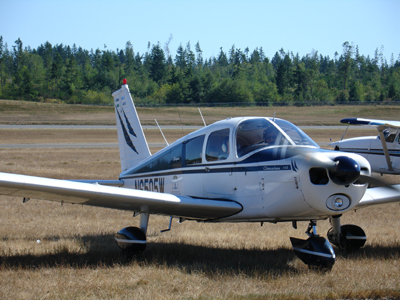
My Cherokee was the first of its model on which a constant speed prop was fitted. The STA was written on that plane, and it looks a lot like what you would have seen on an early Apache. That was back in '69. This year, the FAA decided there was a concern that my type of (Hartzell) prop hub might be in the very early stages of developing a hairline crack. The fix is an $8,000 hub plus another $2k or so for the labor work. With screen renovations and 3 screens worth of big, new Barco machines in the works right now, that's effectively put my plane in the hangar for a few months.
Sux!
| IP: Logged
|
|
|
|
|
|
All times are Central (GMT -6:00)
|
This topic comprises 3 pages: 1 2 3
|
Powered by Infopop Corporation
UBB.classicTM
6.3.1.2
The Film-Tech Forums are designed for various members related to the cinema industry to express their opinions, viewpoints and testimonials on various products, services and events based upon speculation, personal knowledge and factual information through use, therefore all views represented here allow no liability upon the publishers of this web site and the owners of said views assume no liability for any ill will resulting from these postings. The posts made here are for educational as well as entertainment purposes and as such anyone viewing this portion of the website must accept these views as statements of the author of that opinion
and agrees to release the authors from any and all liability.
|

 Home
Home






![[thumbsup]](graemlins/thumbsup.gif)


 Printer-friendly view of this topic